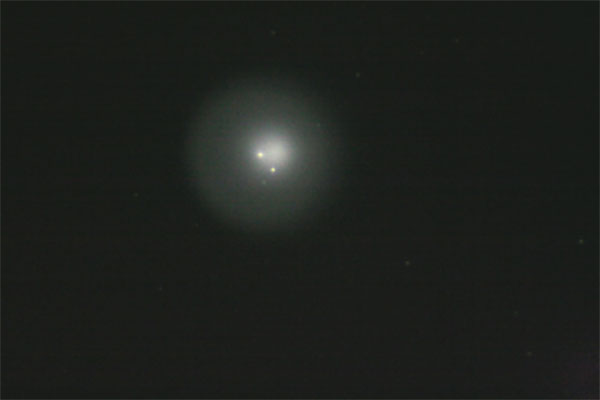
A formerly very dim comet called Holmes (17P) flared up October 24th growing many magnitudes brighter. It's currently outside the orbit of Mars and in the southern portion of the constellation Perseus. Last night, following a day of clouds, mist, and rain, I stepped outside to a clearing sky. It took me only a second to find Holmes and view it through my 10X50 binoculars. It was a beautiful sight, though to the uninitiated, it's just a big fuzzball. That is, of course, how it looked… a large, brightly glowing puff with a bright dot in the center — how comets look "head-on" with any tail streaming behind and away from the viewer. The glow was slightly yellow or golden… quite an unusual object. Nobody's sure how long the flareup will last –heck, it was totally unexpected– but it's got the astronomical community all excited which, by itself, has been a lot of fun. For the record, Comet 17P was serendipitously discovered by Edwin Holmes back in 1892. He had been observing Jupiter and some double stars when he happened across "his" comet when aiming his 32-cm (12.6-inch) reflector towards the Andromeda Galaxy (or "nebula," back then) to finish up for the night. So his surprise then is a surprise and delight to us today.
I'll be going out to the observatory tonight to take a good look at this comet and try to get some images. We'll see if anyone else shows up there … I've notified the astronomy class and put a notice on our Web site. It should be fun, regardless. One sees only just so many comets in a lifetime and I want to make the most of this one!
Read and post comments | Send to a friend
 PhotonStopper