The seeing and the starry sky were exquisite Saturday night for our September Open Night. The sky over the village was cloudless and sparkling with diamond stars. The Milky Way stretched broad and bright overhead, arcing half-way across the sky, dust lanes evident. It was the finest sky I've seen in quite some time. All told 49 visitors came, stretched out over the two hours of the event — much better than 49 all showing up at once, which has often happened! The smaller crowds at any given time allowed for better interaction with visitors and gave them the sense that they could take their time looking through the telescope. Several College students were in attendance including a young man from Mexico City. Students rarely show up at these events so it was a pleasure to have them. Three students arrived at the scheduled 11:00 closing time and I spent a half-hour with them… they were excited and enthusiastic about the entire experience. Earlier in the evening a girl, maybe eight years old, was obviously enthralled with her views of Jupiter and the Galilean Moons; she even used a chart I provided at the eyepiece to put names to the star-like dots aside the huge planet. It is extremely gratifying when someone, most especially a child, really "gets" what they are seeing when looking through a great telescope. That young lady wasn't just looking at Jupiter, she was observing! Also featured was the Andromeda Galaxy which filled the field of view with its misty wonder – the light of a trillion stars 2.5 million light-years away! Jupiter was resplendent with not only the dark, broad equatorial cloud bands visible, but other "stripes" could be seen in the temperate zones. I must say, between the excellent seeing and improved tracking of the telescope, I enjoyed the best views I've ever had of those two objects, both at 122X. The telescope's right ascension clutch has been slipping badly. By hand-tightening the clutch I found that the telescope tracked as well as some modern electrically-driven scopes making higher-magnification public views practical and enjoyable. Observing Jupiter was, by the way, greatly aided through use of a neutral density filter — it was difficult to observe without the filter as Jupiter was so very brilliant! It was an excellent night.
telescope
All posts tagged telescope

The Perseids Meteor Watch I worked last night was very mixed in results. The Park District set us up in a fine little park with no ground-level lights, a nice paved parking lot, and clear grassy areas. There was a wide view of the sky and a good southern horizon. A Sheriff's deputy was on hand as was the District's naturalist — really good support. Then there are the "buts"…
Admittedly we put the event together in hurried fashion. Word didn't get out to the public as broadly or with enough lead time so only a couple of families showed up.
Then there was the sky. We were not far away from the city of Ravenna but I'd hoped we would be just far enough away to escape the "light bubble." Not much luck there. As the Sun sank below the western horizon a funny thing happened … twilight moved to the south. Yeah, huge levels of light pollution rose up in the southern sky right through the heart of Sagittarius. So while the clear skies allowed us to see the Milky Way with dust lane directly overhead, its heart was obliterated by the "Ravenna Nebula." Too bad.
Attendees and volunteers did, however, enjoy a few very good Perseid meteors. I myself saw only about five; being busy with telescopes and chatting with visitors has its costs. The telescope worked fairly well but was impeded for want of a really good polar alignment: it had problems centering on objects it was told to "GoTo" but tracked well once there. The dew point was high and everything quickly became quite damp, even wet. The AstroZap dew shield saved the telescopic view, however, so we saw decent views of Jupiter, the Andromeda Galaxy, and M15 (a globular star cluster in the constellation Pegasus). My night ended with a beautiful meteor speeding overhead, a faint trail lasting for a couple of seconds after its passage. Thank you!
I tore down after the official 11:30 close and headed home. As usual I opened equipment cases and removed the telescope so that it could dry in the dining area of our house. Storing wet equipment isn't a good thing to do. Gad that's a big telescope!
The morning dawned hazy and cool. The chipmunk-planted sunflowers glowed in the early-morning sunshine. And I'm glad I took the day off; perhaps I can nap later.

It is an unexpected clear night, and it is cold: 17 degrees (F). Between the temperature, recent snows, and being tired it did not make a lot of sense to either set up a telescope (in my situation*) or drive to the observatory to look for the green comet Lulin (C/2007 N3). I did want to see it, however, and it should be easy to spot since bright Saturn and Lulin would be very near each other in the sky.
Even with a relatively clear sky the light pollution of our suburban area is bad. Only the brightest stars and planets were visible this night: Venus was brilliant in the twilight and for a couple of hours after sunset, as it has been all winter. Now Saturn rises at a decent hour and tonight it was well above the southeastern horizon in the great constellation Leo and, due to its golden color, was easily found. Leo was difficult to make out so I'm glad I didn't depend upon it!
Standing in my winter coat and pajama bottoms –yes, it's 17 degrees– I aimed my 10 x 50 binoculars at Saturn. The brilliant dot floated in the visual field. I couldn't make out the planetary disk but nearby, and to Saturn's south, was a faint, diffuse, oblong cloud — Comet Lulin. Invisible here to the unaided eye, it's being estimated at between magnitude 5 and 6. No nucleus was visible and no color noticeable. That should not be surprising given less than ideal base sky conditions, light pollution, and the small-aperture binoculars. I took one last look at the semi-starry sky and gingerly walked the icy path back to the house.
Still, I saw the comet on the night when it is passing closest to Earth. And I got out under a "clear" sky with an optical instrument for the first time in months! It has been a long, cold, snowy, and cloudy winter and I'm hoping conditions improve soon. Our first public night for the year is set for March 7 when we'll be looking at Saturn — the rings will be edge-on this year. And maybe I'll get a better look at that little green fuzz-ball Lulin. You never know!
* I've only purchased equatorial, tripod-mounted refractors til now. For occasions like this, however, a nice Dobsonian-mounted reflector would be great as a grab-and-go telescope. Hmmm…. is there room left in my basement?
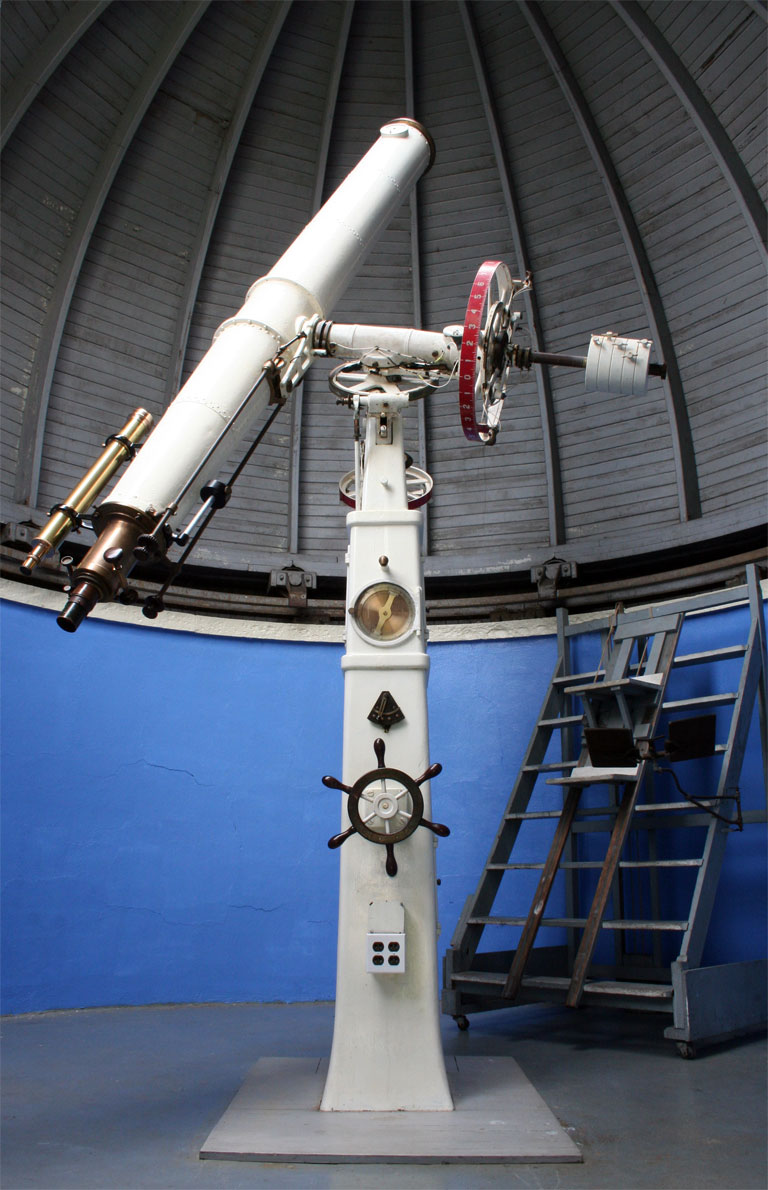
During a Public Night at the observatory not long ago, I noticed a young boy picking at the blistering paint on the curved wall that supports the dome. Had it gotten that bad, so bad that you could see the flakes in the darkness? Yes, it was that bad. So I spent a good amount of effort wire brushing the flakes from the wall, applying a primer coat –in some places bare concrete stucco had been exposed– finishing with the color coat. In a reverse-order move I noticed that the capstones supporting the dome rotating mechanicals looked pretty bad with their yellowed gray paint. So I wire brushed them, applied primer, and painted the capstone faces. Had to clean up a few drips that fell on the newly painted wall below but I'm glad I did it anyway. So here, in living color, is a photo of the Cooley Telescope surrounded by a non-gray wall, capped with stones painted to look like stone… their own native sandstone to be specific.I'm sure some antique observatory folk will be shocked when they see it. I, however, think it looks splendid. I'd have done the inside of the dome too, if I'd have been able. Next I must find a way to refinish the telescope in situ.

The 2008 edition of the Cuyahoga Astronomical Association's OTAA Convention saw good attendance and an enthusiastic crowd Saturday evening. While attendees enjoyed themselves, however, the hot and muggy conditions were well suited to creating the hazy and cloudy skies that dominated the evening's events.
Case Western Reserve University's Department of Astronomy Chair Heather Morrison was keynote speaker. She delivered a talk on current research and exciting new results coming from the Sloan Digital Sky Survey; it was entitled "The Four-Dimensional Galaxy and the Square Telescope." {The Sloan instrument is a reflector design housed inside a square wind baffle making it appear to be a square telescope.}

The ever-popular raffle took place after dinner. Prizes ranged from shirts and gift certificates to software and an Orion Aristocrat Executive desktop telescope. I won the brass telescope! Though intended mainly as a desk piece, it's actually very nice! I hope to try it out tonight on Jupiter. So what if it's a "beginner's scope" — it's probably better than what Galileo had! I'm happy to have won the grand prize though the Vixen eyepieces were awfully nice…..
Many individuals brought telescopes with them, "just in case," but only a couple were actually assembled in the field. One belonged to a CAA member whose mammoth long-tube 8-inch refractor {pictured here} impresses everyone who sees it. Turns out it's a darned good telescope, besides!
As night fell a few "sucker holes" opened up in the sky revealing brighter stars and brilliant Jupiter. Through Wiersma's refractor viewers could easily see Jupiter's major cloud bands with hints of other detail and the four Galilean moons resolved to disks. It's a fine telescope I've seen many times before but never got to use.
Clouds soon filled in most of the holes and many attendees went home. It was, however, a good night and despite the cloudy skies, most folks left smiling.

In Other News: Today (Sunday) we took delivery of a grand new washing machine. Our old Maytag Neptune fried a circuit board that would have cost hundreds to replace. We picked out a new, rather pricey, Kenmore He model that we've already used and are falling in love with…. well, whatever it is that you do when you decide you really appreciate a major appliance. Tomorrow it's back to work and the kickoff of yet another IT project to be followed by another, then another….. Job security, I guess!

Saturday was a kind of personal "astronomy day" for me.
First I met my predecessor in the position of Observatory curator. Bob was coming to town for a visit with family and wanted to meet me at the college Observatory. He's 77 now but active in his retirement as a tour guide at a professional observatory facility in Arizona — "for the perks!" The job gives him access to the facilities himself. He filled me in on some of the recent history and background of the Ohio facility and the workings of our century-old telescope. Though he rarely visits the area, he has taken an interest in the progress we're making with the Observatory and cares about its future, especially, of the vintage instrument. I'm sure we'll be in communication with each other for some time to come.
Sky conditions for Saturday night were forecast to be excellent (for Northeastern Ohio). I learned that some friends from the astronomy club were going to the club's observing site. I decided to take advantage of the situation and use my own telescope for the first time in more than a year! Well, even our usually accurate sky forecast can be wrong and this one was! An unexpected thin layer of cloud moved in so that, by twilight, it covered the darkening sky with a thin "haze." Drat! Everyone was disappointed as it was our best chance for stargazing for the entire holiday weekend. As it turns out the experience served us well as a shakedown. Lynn was learning how to operate the Sphinx computerized telescope mount (much cursing), Steve was apparently having focus problems (maybe atmosphere related but he wasn't sure), but I had a pretty good night.
I remembered how to put everything together –which was a bit surprising– and, even more surprising, my own computerized telescope system performed flawlessly. It had been very tempermental most times in the past. My telescope's alignment was a bit off (my fault) so the system wasn't perfect in finding things, but I did manage to find and enjoy views of Saturn (beautiful), Mars (tiny and disappointing), galaxies M81 & M82 (unimpressive this night due to atmosphere), and a surprising view of M104 –the Sombrero– which I had never seen before. The Sombrero, to my eye, looked like a long string of stars, like a stretched star cluster, instead of a fuzzy cloud — the way most galaxies look when viewed through a small telescope. Optically my big refractor did at least as well as neighboring Schmidt-Cassegrain Telescopes (SCT) delivering excellent quality images of, especially, Saturn under the less than ideal conditions. I was very happy with the beast! I also spied my first Iridium flare which is an extended "flash" of light reflected off one of the many Iritium communications satellites that circle Earth. I had forgotten the custom dew shield for the telescope and, by about midnight, the objective was getting fogged up — the telescope tube was already just about dripping!
I came home happy but late after a rewarding day with friends and the night sky.

We spent Saturday doing mostly practical things: grocery shopping, gardening (She), a thorough cleaning of my car (me… finally). Then, as the skies grew hazy with a layer of thin clouds, I headed off to the Observatory for a scheduled open house and public stargazing session — it was national Astronomy Day.
Saturday evening the clouds gave the Moon –even through the telescope– a hazy look. Yes, we could see detail, beautiful detail, in our views of Luna but the overall effect was one of looking through a thin blanket of fog. As the Moon sank behind our neighboring line of trees and the skies grew darker, I turned the big telescope to Saturn — one of the few identifiable objects in the sky. It was beautiful! First we looked at the Ring World at 100X and it was good, though tiny. Next we saw the planet at 133X and it was still very good. Finally I bumped the power up to 266X and the view was glorious! We could see hints of color in the planetary body, glimpses of cloud banding, and the ring shadow across the face of that world more than 800 million miles distant. We also observed the planet's shadow falling across the rings as they passed behind that globe so far away. More than one visitor, on realizing what they were seeing, was awestruck. Over the evening we hosted 23 visitors of all ages and looked at Saturn again and again. It was a good night and perhaps my best-ever observations of Saturn.
Sunday was Mother's Day so, sleeping in a bit after a long night, we headed west and into a couple of hours of rainy driving. It was wet, chilly, and miserable but a fairly easy drive to see Mom and my sister with her family. All three of use kids brought or sent flowers: two planters and a corsage. Lots of flowers! Mom is doing great after her surgery, physical therapy, and balancing out of blood chemistry. My oldest nephew is excitedly preparing to move into a house he and his parents took from "delapitude" to coziness. We spent a pleasant afternoon catching up, had a pizza dinner –little work for anyone– and headed east, homebound.
This morning's email brought an update from Cincinnati regarding Howie, the cat. It seems he was picked up from the vet Saturday and moved into his foster home. After the expected adjustments there, he seemed to calm down and enjoyed being petted and spoken to. He didn't like being picked up, however, according to his hostess. I wouldn't be too worried just yet about him being anti-social… after all, he got put in a cage, neutered, then locked in a strange house all within about 48 hours! I'm not sure I'd want a stranger holding me, either!
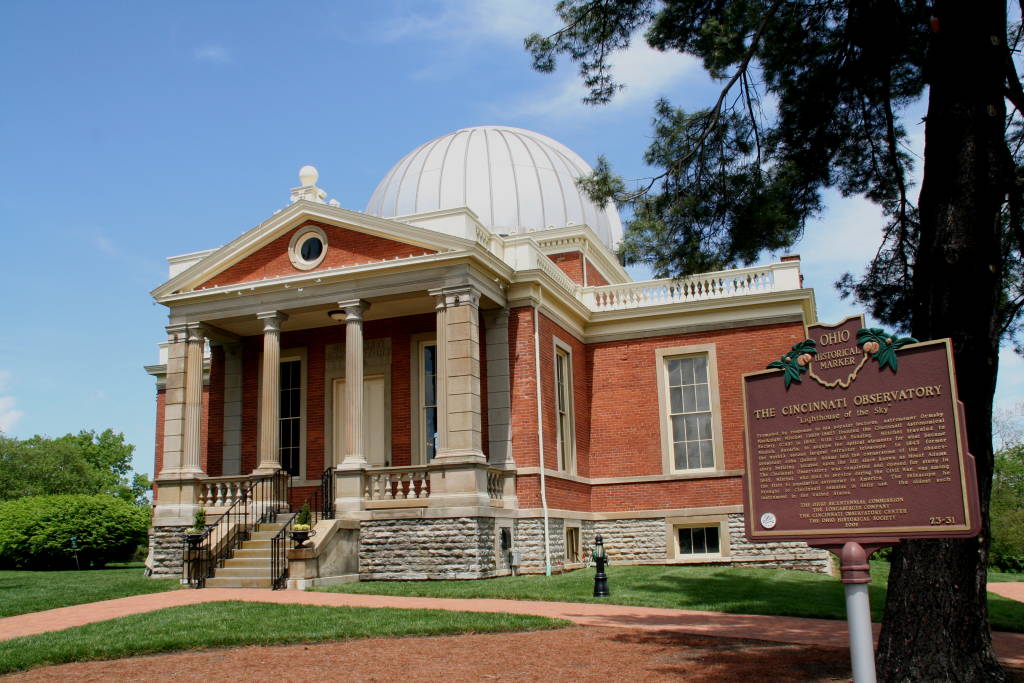
The day of presentations seemed to go on forever at the Antique Telescope Society's workshop. There was really good content but way too many hours of it. So I got up and walked out of the classroom –the former meridian transit room of the observatory– or shifted in my seat. Often. At times rain poured down in sheets as we heard discussions of the viability and survivability of "Vintage Observatories" in the 21st century. Don't get me wrong… the presentations were both interesting and informative. My bottom still got sore from all the sitting, though. Fortunately the sky began to clear off in the late morning hours and many of us enjoyed strolling around the grounds of the Cincinnati Observatory Center. I shot many photos both indoors and outdoors showing various views of the main observatory building and the smaller Mitchel Building on Mt. Lookout. After dinner I listened impatiently to presenters but was really anticipating sunset and a chance to look through the grand 16-inch Alvan Clark & Sons telescope, showpiece of the Center.

From inside the classroom I heard a rumble. Someone said that was the sound of the dome being rotated. So I ran up the stairs and into the dome room and got to see the huge dome rotate above me. The presenting astronomer for the evening offered me the honor of opening the shutter for the night's observing. He said to be careful to stand directly under the rope-operated pulley so as not to derail the rope and cause it to fall off. I got the shutter opened but managed to drop the rope! {Sigh.} Fortunately it was easy to fix: rotate the dome so that the aperture was over the observer's chair, climb up, loop the rope over the pulley — fixed!
The astronomer also let me turn the crank to wind the drive weights into position. Or was that something like Tom Sawyer "letting" his friends paint the fence? No matter, I grabbed hold with both hands and turned the crank lifting 300 pounds of cold iron. Conversing with the observatory staff and just hanging around in the dome was a fine time for me, far from the yammering crowd below!
As luck would have it –this always seems to happen– clouds began to roll in at about the time it got dark enough to spot Saturn. We all got at least one glimpse of the ringed world before solid overcast moved in and shut us down. I was allowed, and requested, to run the R.A. slow-motion control to center up Saturn before clouds could obscure it. That would allow some lead time should another opening appear in the cloud deck (and one or two did) whilst the telescope was tracking. The telescope is the largest refractor I've ever used and it moved smoothly and easily with the turn of a knob. I got one good, brief look at Saturn but that second or two hinted at how good the telescope is: I glimpsed at least three of Saturn's moons, some banding in the planetary body, and my first look at the Cassini Division — the dark separation in the ring system. And that was on a night of poor seeing!
The conference ends tomorrow (Sunday) with a half-day of sessions, door prizes, and a fond farewell to the Observatory Center. I may post one more photo here, but I'll have much to think about and photos to share and enjoy for quite some time to come. It's been a good visit.

After a day or two of nail-biting, monitoring forecasts of sky conditions, the Clear Sky Clock tipped the scales for me… Wednesday night's sky would be clear and we would be able to see the Feb. 20 total lunar eclipse.
I packed up only one extra eyepiece –the great antique scope has a wonderful low-power ocular that presents the entire lunar disk– and bundled myself up. It was a c-o-l-d night!
As the eclipse was getting underway a freshly-cleared sky began to cloud up. A thin layer of cloudiness obscured all detail from the Moon just as Earth's shadow was taking a good chunk out. And a little snow fell through the dome slit! Gad! Just as I was beginning to give up hope, however, the sky quickly cleared and we had good seeing for the rest of the night!
The view of the Moon through the 9-inch refractor was typically spectacular. Even the full Moon looks great through that scope with its fist-sized eyepiece. During the partial phase of the eclipse, however, there was a time when the lunar limb was relatively bright, the central portion of the disk was bluish, and the dark shadowed region took on a reddish hue. Quite beautiful. During totality the Moon took on a pale coppery color; it was not a particularly colorful eclipse. Impressive and beautiful, nonetheless.
In all more than 44 visitors came into the observatory — there were probably more but people were coming in to look through the telescope and going out to enjoy the sky with their own eyes … they were getting into the event!
The last visitors left at around 11 PM and I was finally free to try some photos. A little too late, however, to get the shot I wanted… looking at the Moon along the telescope and through the dome. The Moon had already brightened to the point that I couldn't balance the exposure. It's a nice photo anyway and I'll use it for some things, it's just not the picture I had imagined. It was getting late and my feet and hands were getting cold –it was 18 degrees F. in the dome– so I closed up and went home.
A very good night of eclipse watching.
 PhotonStopper