On a walk today, I glanced down an alleyway and spied this scene: patio seating in a very grungy setting. The dreary skies softened lighting in an already-shaded area and amplified the mood of the al fresco table. I’ve ordered a replacement smart phone for my trusty iPhone SE that has served me so well so this may well be one of the last photos I shoot with its remarkable built-in camera.
Uncategorized
I suppose one cannot return to something one hasn’t left. Still, with weather settling down and sunset coming earlier I’ve been looking to further explore the night sky.
We live in a small city with big light pollution. The light dome over our area has grown steadily over the past decade and from our backyard most northern stars lower than Polaris are completely obliterated by artificial light. To the south, the view is probably similar to “suburban” light pollution levels. Which is to say, bad but not impossible.
Lately I’ve been using my new telescope in imaging experiments. This week, unlike earlier recent efforts, I was able to get the telescope mount aligned well which allowed its computer to find dim objects in our bright sky. I was able to visually observe Jupiter (with Great Red Spot front and center), Saturn, the M15 star cluster, the Perseus Double Cluster, the Ring Nebula in Lyra, and the Andromeda Galaxy.
Attaching one of my DSLRs to the new Cassegrain reflector, I shot images of several of the larger deep sky objects. Vibration and tracking were issues, as was achieving camera focus. Working around those challenges as best I could, I made multiple images of the Ring Nebula (M57) and one of the clusters in the Perseus Double (NGC869).
Looking at the camera’s built-in LCD panel that night, I was astonished… I could see color in the Ring Nebula! Visual observers, using smallish telescopes, usually see no color in the Ring; film and electronic sensors readily collect enough photons to register color. Still, a very happy surprise to me! So I shot a series of prime focus images of the nebula. The Perseus Double was also visually attractive so I shot that as well. About 10 seconds for each of those. Efforts at shooting M15 failed: the telescope didn’t track well enough to produce round stars in the exposure time set — possibly too long an exposure.
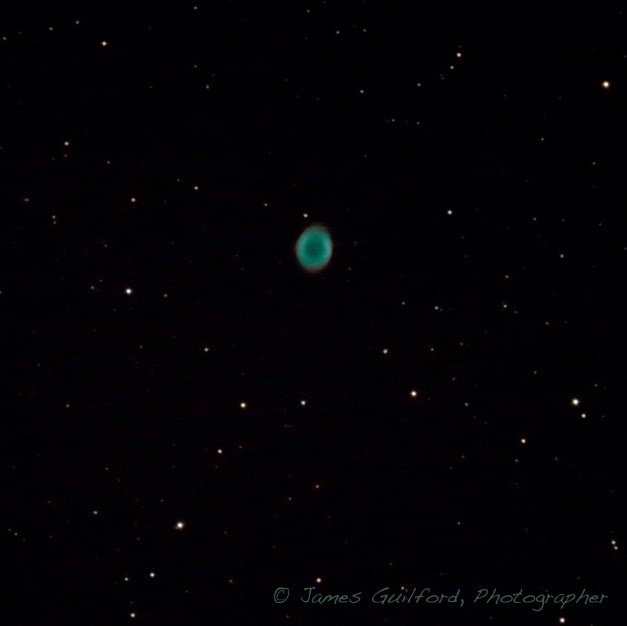
The Ring Nebula (M57) in Lyra glows. Observed visually through small telescopes, the nebula usually looks gray.
Astrophotography of deep space objects can be extremely technical. The learning curve on an excellent product like PixInsight is more like a cliff than a curve. I searched and found a software that is excellent for me at my relative beginner level — Starry Sky Stacker (SSS). The SSS has the important basics for good astrophotography, and has an easy-to-learn image processing process with little frustration. So, to get started producing and learning, I used SSS to align, stack, and integrate the images for both NGC869 and M57 with results pleasing to me.
Over the coming weeks and longer, I’ll be assembling more equipment and skills and with luck, by spring, will be producing decent space pictures beyond the Sun and Moon.
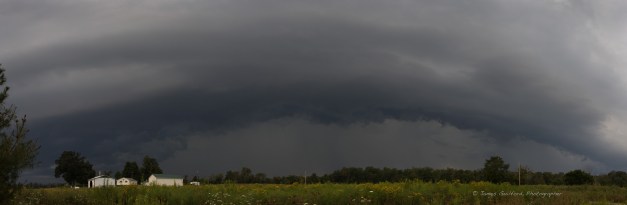
We have had a few days recently when heat and humidity-driven storms have roamed the region. On Tuesday, August 20 we saw a long line of powerful, even severe-warned, storms develop to our west. Though the line appeared to be moving at a leisurely rate, I arrived at one of my favorite observation sites with just enough time to set up before a broad shelf cloud appeared on the horizon.
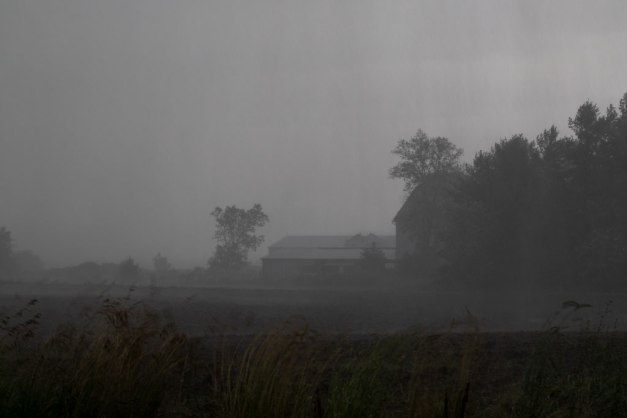
The leading edge passed over my location and, as is expected with these things, heavy rain immediately followed and I retreated to my car. After a quick splash of intense rain, the precipitation stopped! I got back out of my car and shot a few photos of the areas about to be visited by the storm. One view in particular from behind the shelf cloud: from a spot spared rainfall was this view of the dark clouds overhead, curtains of intense rain drenching the area, and brighter skies being engulfed.
Ah! Stormy weather!
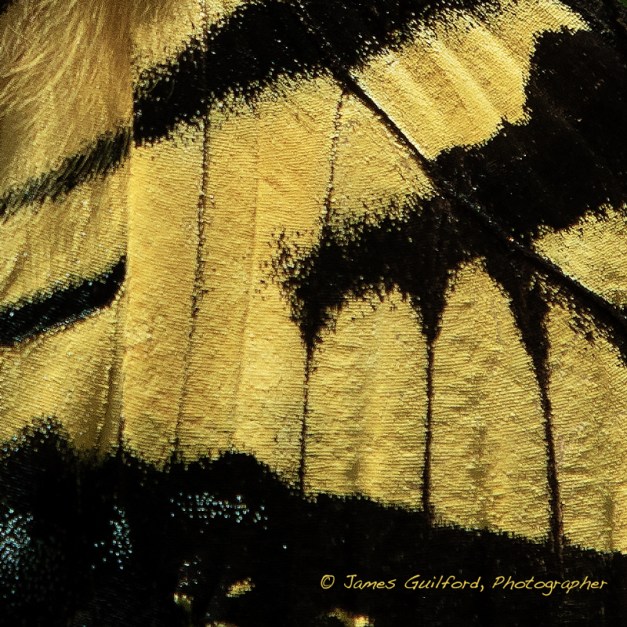
Saturday night I spent imaging very large objects: Earth’s Moon and craters measuring nearly 60 miles in diameter. Sunday I photographed a lovely Tiger Swallowtail butterfly (Papilio glaucus) as it sampled nectar from a flowering plant; then, during editing, I cropped in close creating an image depicting an area of only an inch or so square on that insect’s wing. I do love exploring things from the very large to the very small.
Even smaller details, an unexpected bonus emerged in the cropped image. The swallowtail’s wing was at a severe angle to the morning’s sunlight enhancing the view of the individual scales that cover butterfly wings.
And yes, the butterfly was photographed alive and well, and left in that condition!
I was messing around with my recent soft-focused “antique” image of Moon’s Crater Tyco when I discovered a Photoshop sharpening feature I’d never used. I reprocessed the image using that setting and got a “better” result: sharper appearance of the crater itself but with more grain. I think I like this new one better than the one I originally posted. Here they both are: Reprocessed Above / Original Below.
I’ve tried in the past to directly connect a modern DSLR camera to the ca. 1901 Warner and Swasey 9-inch telescope I operate for a small college. Because some original fittings have been lost over the decades and I use an eyepiece adapter a predecessor built, the telescope’s couldn’t be used for focal plane camera operation. Focal plane would have been like using the telescope as a 3,200mm telephoto lens. So I was limited to afocal use — holding the camera with one of its own lenses over the telescope eyepiece and trying to record that image. When it worked afocal photography produced very good, even excellent results for the Moon; dim objects could not be handled that way.
Recently it occurred to me that I hadn’t tried eyepiece projection: using a special adapter to hold an eyepiece, connect to the telescope and camera, and project the eyepiece image on to the camera’s image sensor. I scrounged around and found and eyepiece projection adapter in pieces, put it back together and, trying it last night, got interesting results. On this first try with the vintage scope the images all came out in soft focus with details at the center of the image somewhat better than those surrounding it. The overall effect is, I think, quite artistic.
I’ll keep trying with that old scope, with my own new telescope as well, to try and get sharp images but, for now, we have some lovely lunar art!
It surprised me. We were expecting rain and thunderstorms but the approaching weather looked disorganized and “wet” — that is, plenty of rain leading the way and blocking views of the storm clouds. Suddenly I got indications from observers to my west that something was cooking, so I fired up my radar access and saw a well-defined monster of a storm approaching. I grabbed a camera and headed out, knowing I couldn’t get far before meeting the storm.
Finally getting through town and out into the countryside, I saw on the horizon hints of the approaching line. I quickly located a farmer’s field access path and pulled off. I got there just in time to watch the shelf cloud develop, roll toward me, and pass overhead.
As the ominous clouds passed overhead, I knew to what to watch for: torrential rain! I strolled to my car as the wind began to rise, got in, and enjoyed the arrival of the downpour from dry, air conditioned comfort!
This was possibly the most impressive shelf cloud I’ve seen; bear in mind I don’t chase in the Great Plains. I nearly missed this one and, as it turns out, I grabbed the wrong camera — could have done with the wide-angle lens left behind!
Thanks to the unnamed property owner who drove over to see what I was doing and generously allowed me to stay put on her drive!

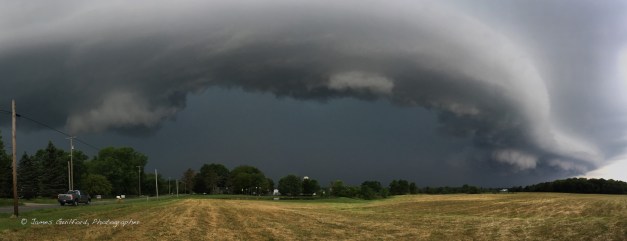
Shelf cloud photographed July 2, 2019 in central Medina County, Ohio. Note the area of heavy rain to the left, the “clear” area bearing strong winds to the right.
I love shooting shelf clouds — clouds that form a line or arc along the leading edge of a gust front in a thunderstorm. They are awe-inspiring, scary, to me they’re just beautiful in their power rugged symmetry. I’ve looked at clouds from both sides now (apologies to Joni Mitchell) and discovered something at least as impressive; clouds of chaotic shards and pieces, tumultuously flowing together as a mass. I saw this configuration with a severe thunderstorm that dropped a tornado a few weeks ago, and I saw it again today in another severe thunderstorm — after the shelf cloud passed. I still love photographing shelf clouds (called “shelfies”, a twist on self-portrait “selfies”) but…

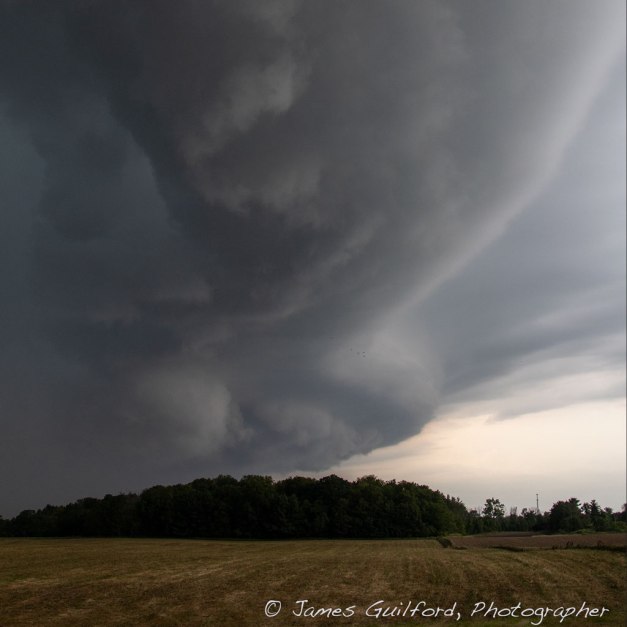
StormLight — Storm clouds close in giving last light to a farmer’s field before rain began. Canon 6D MK-2 Image.
May and June bring stormy weather and stormy weather often means dramatic skies. The evening of June 1 saw strong storms moving across Northeastern Ohio and when I saw an outflow boundary showing up strong and clear on radar, I headed out to see what was happening. I had not driven very far when I reconsidered my original observing destination and headed for the nearest open area I could find. Sweeping toward me over the treeline was a very impressive line of cloud; the line was so long I quickly shot several images using my trusty iPhone SE with the idea in mind of creating a multi-panel panorama later.
Once the outflow boundary rolled over me, I continued my trip seeking the cleanest storm edge I could find; several appeared to be headed my way but the line of storms seemed to be changing direction. After a good bit of moving around, I decided to head to the Wellington area in Lorain County as my best chance at a storm intercept. I discovered a farmer’s field access drive off a rural road and waited, surrounded by open fields, for the weather to come my way. And I waited. And waited. While I waited I photographed the changing cloudscape and wound up with my favorite view of the day — the last light illuminating a field as stormy clouds closed in. A complex and brilliant bolt of persistent Cloud to ground lightning convinced me my time in the open was done. Not set up for lightning photography, I watched from inside the car for a bit and headed into rain and home.