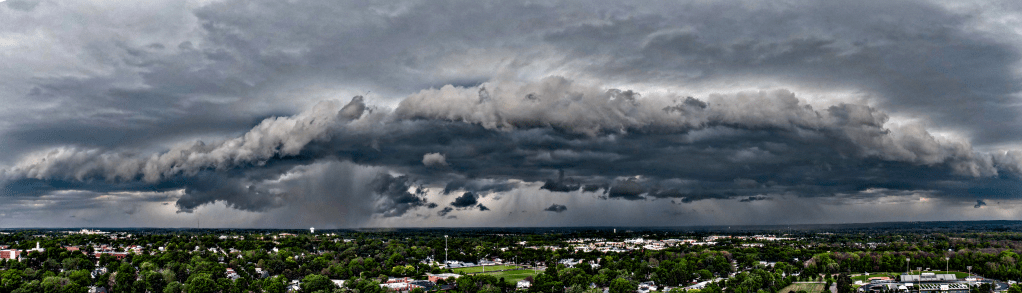
The nasty looking underside of a shelf cloud overrunning the city of Medina, Ohio the evening of May 19, 2026. Behind it were spotty torrential rains, and a brief period of gusty winds, the remnants of an expansive squall line that developed just west of Ohio in the afternoon heat. Photo by James Guilford.
An approaching squall line, the evening of May 19, looked promising so as the storm approached, I dusted off my drone to get a peek. After some panic due to low battery power levels, and an outdated USB cable, I stepped outside and launched just in time to see the storm’s arrival. I haven’t seen a shelf cloud in some time, so it was great to witness this one. It was also quite some time since I’d flown my drone and that was fun! I must get out more often.
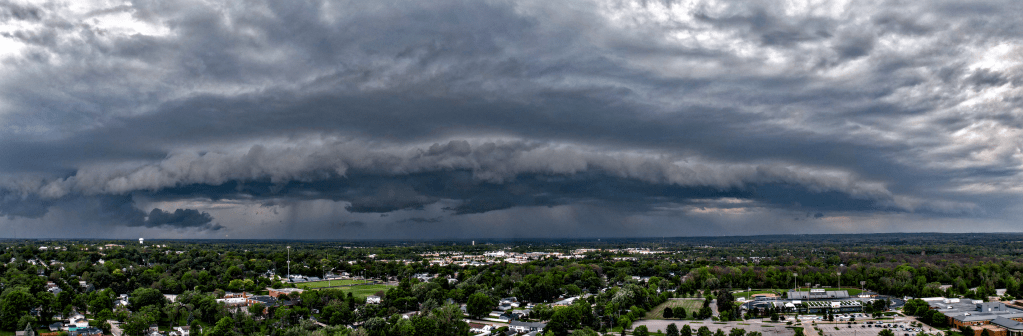
The shelf cloud of May 19, 2026 as it neared the city of Medina. This view, shot earlier than the one above, displays more of the grand structure that makes shelf clouds an attractive subject for me. Photo by James Guilford.
Our neighborhood star: The Sun. Photographed in hydrogen-alpha light, this image shows the roiling chromosphere of our star with a large filament parallel with the left-hand edge of the picture, sunspots strung vertically across the center, and a good number of prominences along the rim, glowing against the dark background of space. Image has been rotated; east is up, north is right. Imaged 2024-10-26. 18:43 UTC. Credit: James Guilford
For some time now, as weather permits, I do a little daytime astronomy as in viewing and photographing our neighborhood star: The Sun. Of course I practice vision safety; observations and imaging employ a range of filters and equipment that protect both eyes and cameras from blinding, concentrated sunlight. Equipment ranges from simple white light solar filters, to a Herschel wedge prism-type device, and a more recent addition, a dedicated hydrogen-alpha (Ha) telescope.
White light allows viewing Sun as if we could stare directly at it without the resulting blindness. The Herschel wedge does much the same thing but with, perhaps, a bit more contrast and detail. Both of those white light views allow us to see a layer of the solar atmosphere called the photosphere. In the photosphere the most apparent details are sunspots, standing black against a white background. With enough resolution we can also see granulation — enormous convective bubbles of searing solar plasma.
One layer above the photosphere — yes, above — is the chromosphere. Shining in the wavelength of hydrogen-alpha, the chromosphere is not visible to us without light filters that exclude all light but Ha. A wholly different view of our Sun is available in that wavelength. Swirling seas of plasma form curves and hash as they are moved by magnetic fields, long filaments float over those seas, as fountains of glowing gas arc from the solar disk contrasted against the blackness of space. On closer examination, the solar limb appears rough, a bit like a fine-toothed saw blade, as innumerable spicules, jets of glowing gas, are seen in contrast. Yes, sunspots are visible but are no longer the primary interest.
After many tries and failures at processing images to best show the chromosphere complete with prominences, I finally learned what some other imagers were using to process their images: Solar Toolbox — a package of programming scripts used with the PixInsight imaging application. I still have much to learn about Toolbox but it has already been enormously helpful to me in the challenging world of solar imaging! Thus, the image above is from very good data recorded about seven months ago, now reprocessed using Toolbox.
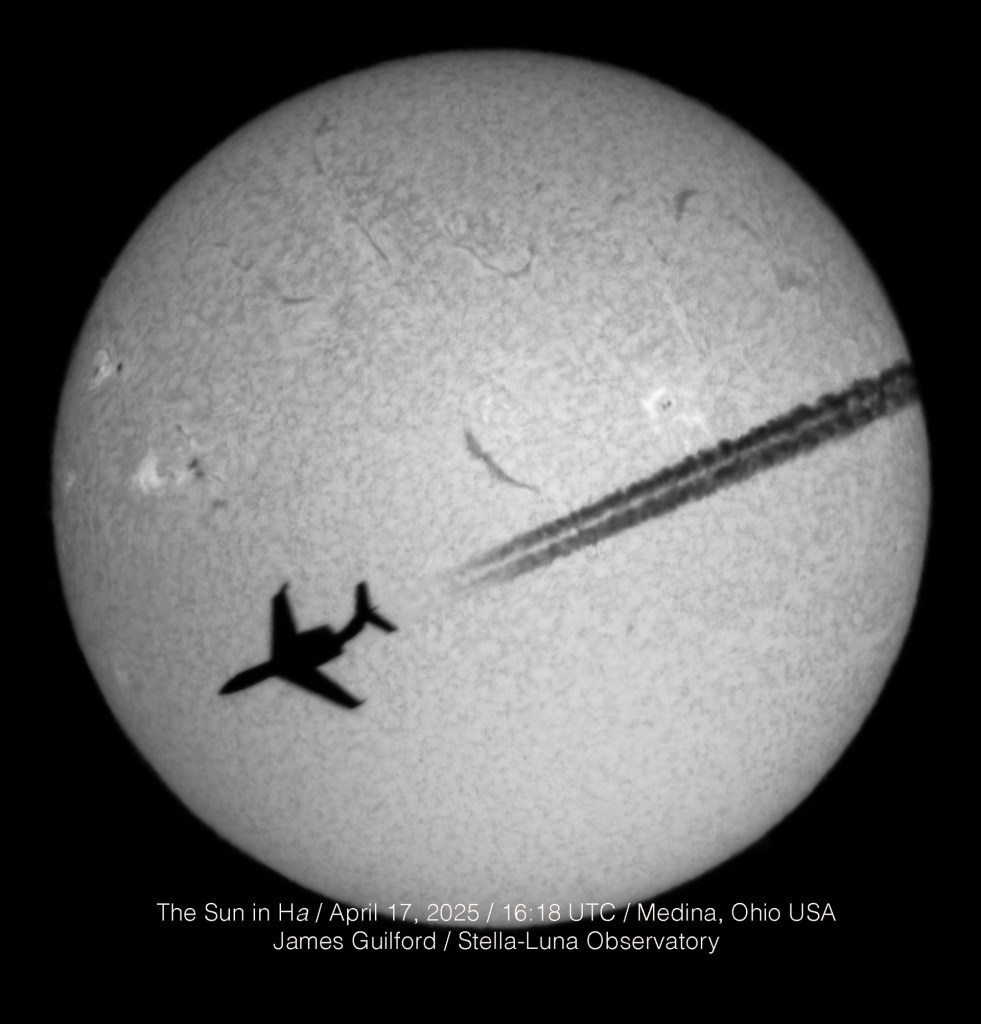
I had just finished setting up for some solar astronomy and tapped the button to begin a video sequence when something flashed across the computer screen. A jet appeared for less than a second, contrails briefly persisting, silhouetted against the roiling solar disk! I’ve only seen this twice while observing Sun, this being the second time, and I only captured this image by shear luck. The first time I witnessed a solar “photo-bombing” was under similar circumstances. Previously, I had completed setup, was refining focus, and just about to begin recording exposures. I missed imaging that encounter by about the same interval as I succeeded this time!
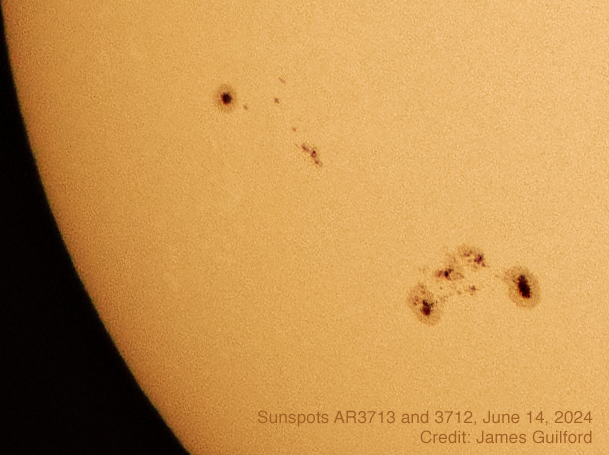
Sunspots AR3716, AR3713, and AR3712 are nearing the sun’s western limb or horizon to disappear for at least a couple of weeks or possibly forever. Vixen VC200L Cassegrain telescope with white light solar filter. Image Credit: James Guilford
Braving the already hot and humid morning today, I set up my telescope and made photos of three large sunspots. I’ve been checking on them daily since they made their appearance and wanted to bid them a fond farewell before they disappear to Sun’s far side. The close-up view is via my telescope while the full disk image is from my Canon 400mm telephoto lens; both images recorded using my Canon EOS 7D Mk. 2 DSLR camera body.
Full disk image of our nearest star via Canon EF 400mm 1:5.6 L lens with 2X extended and a white light solar filter used to prevent severe damage to the camera and to the photographer’s vision. Image Credit: James Guilford.
Detail copied from the whole-disk image of Sun, showing sunspots AR3713 and 3712 as they appeared June 14, 2024.
We have not been taking nature walks the way we used to so most photos of animals have been very close to home. I have been photographing the sun lately — maybe especially since the April total solar eclipse. I’ve been interested in Sun at one level or other since my youth. Though I hope to develop the ability to photograph old Sol in Ha or hydrogen-alpha (look it up) exposing chromospheric details in the plasma maelstrom of our nearest star, I remain fascinated with sunspots and the solar photosphere.
Today was another day featuring a cloudy morning and sunny afternoon. This time, however, we experienced excellent seeing for a while — just long enough to record today’s solar portrait. I’m so pleased with the “inset” image that we’re featuring it first — it’s cropped directly from the whole-disk picture. Obviously sunspots AR3713 and AR3712 are dominant features but there is a parade of features visible.
Annotated whole-disk image of the sun as it appeared the afternoon of June 14, 2024.
Doing this the “old-fashioned” way, this image was a single exposure manually selected as best of a larger group of shots. The chosen image is edited to produce the best available picture from the data gathered. Today’s excellent seeing made for an unusually good photo. I’m pretty pleased.
I saved a number of “also-good” exposures and may some day use them in the modern process of stacking sub-frames to create an even better view. Today, however, I’ll just sit back and enjoy what I got.
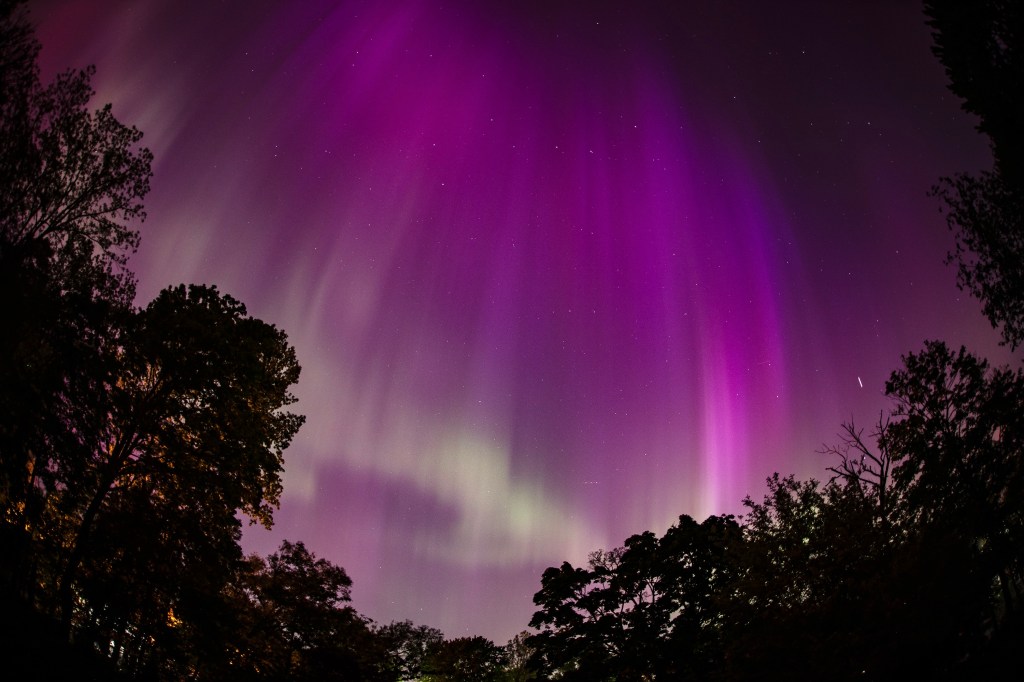
My first DSLR shot of the night turned out to be the most spectacular. This is a view looking northward from the city of Medina, Ohio.
It turned out to be a stronger impact than forecast, and the strongest thus far of this solar activity cycle; the geomagnetic storm of May 10 – 11, 2024 produced auroras (Northern and Southern Lights) visible at night from locations nearly pole to pole.
The forecast of possible aurora prompted me to step outside at about 10 PM (EDT), when twilight had faded, to check the skies. At first I saw what I thought might be clouds but knowing auroras can be feeble, I watched. Sure enough, there was movement in those “clouds”.
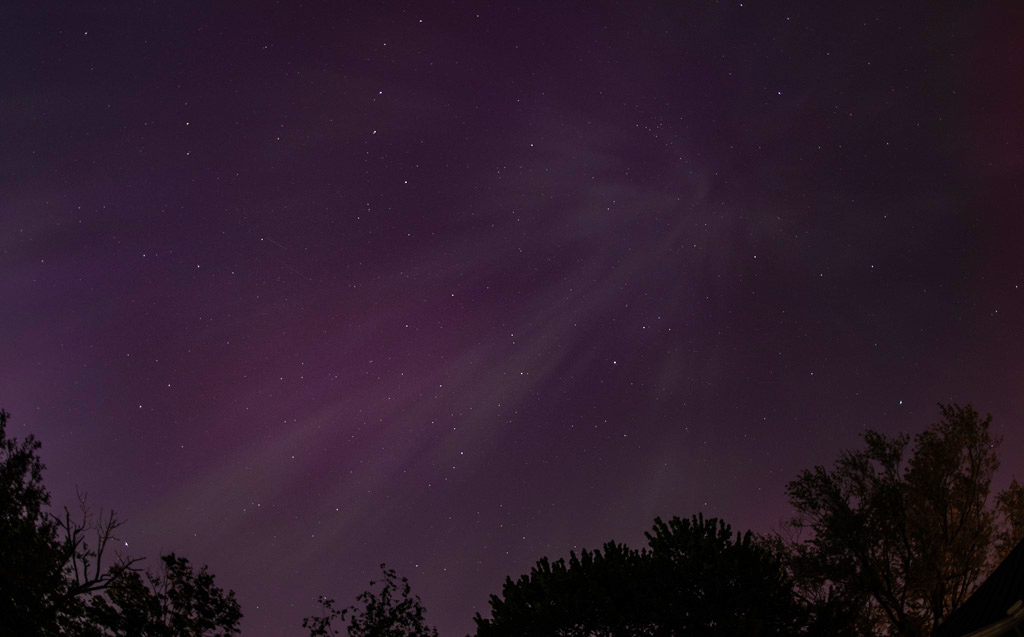
To the unaided eye, the great aurora of May 10 looked like this — streaks of “cloud” with a bit of color. Watching the streaks closely, however, the observer could see them changing in size and shape more rapidly than simple cirrus.
Glancing overhead I saw what I found hard believe — aurora ray features directly overhead … at 41º latitude, a rare sight, indeed! Rushing back indoors, I pulled together camera, fisheye lens, and tripod and headed back out.
My first image of the night was from my iPhone 13. So little effort to see and record such an amazing view! It was exciting to be able to share this with the world in real time via social media!
The aurora still presented itself as cloudy streaks with, perhaps, hints of color. Now also armed with my smartphone, I activated its camera and aimed it at the sky. There on the screen, light amplified by the phone’s electronics, glorious, eye-popping colors filled the sky! I’d never before experienced an aurora like it.
A rare sight indeed is an aurora borealis streaking down from directly overhead at 41 degrees latitude! I’ve never before witnessed such a display.
Only occasionally, during the time I was out, did the aurora’s color become visible to me; apparently being just below the limits of my, and others’ visual perception. Another local observer noted color was more visible shortly before I stepped outside to check on things — the actual peak of the display must have happened as twilight was ending and before 10 p.m.
Colorful curtains lit the northeastern sky as the aurora re-surged from a quieter moment.
I observed and photographed the aurora from shortly after 10:00 until about 11:30 EDT and in that hour or so, the intensity faded and then re-surged before fading away which was my signal to shut down.. I might have stayed out longer but had a commitment for the next day — sleep was needed — so, satisfied I’d seen the phenomenon at its best, I put away the camera gear.
Looking north, find the “Big Dipper” tipped over as if pouring watercolors down on the land. The single dot visible near the center of this picture is the North Star, Polaris. Note how one can find Polaris by looking where the two stars of the dipper’s bowl point.
Knowing it would be all over the news, I submitted my most spectacular shot of the night to the local newspaper — a daily that publishes on Saturday but not Sunday. It was too late for the Saturday edition but the editor gave my photo a three-column, Page 1 spot on Monday.
Our Sun is still in its peak activity period, by some accounts it won’t hit solar maximum until some time in 2025, so there may be more auroras in our near future but this was one for the history books!
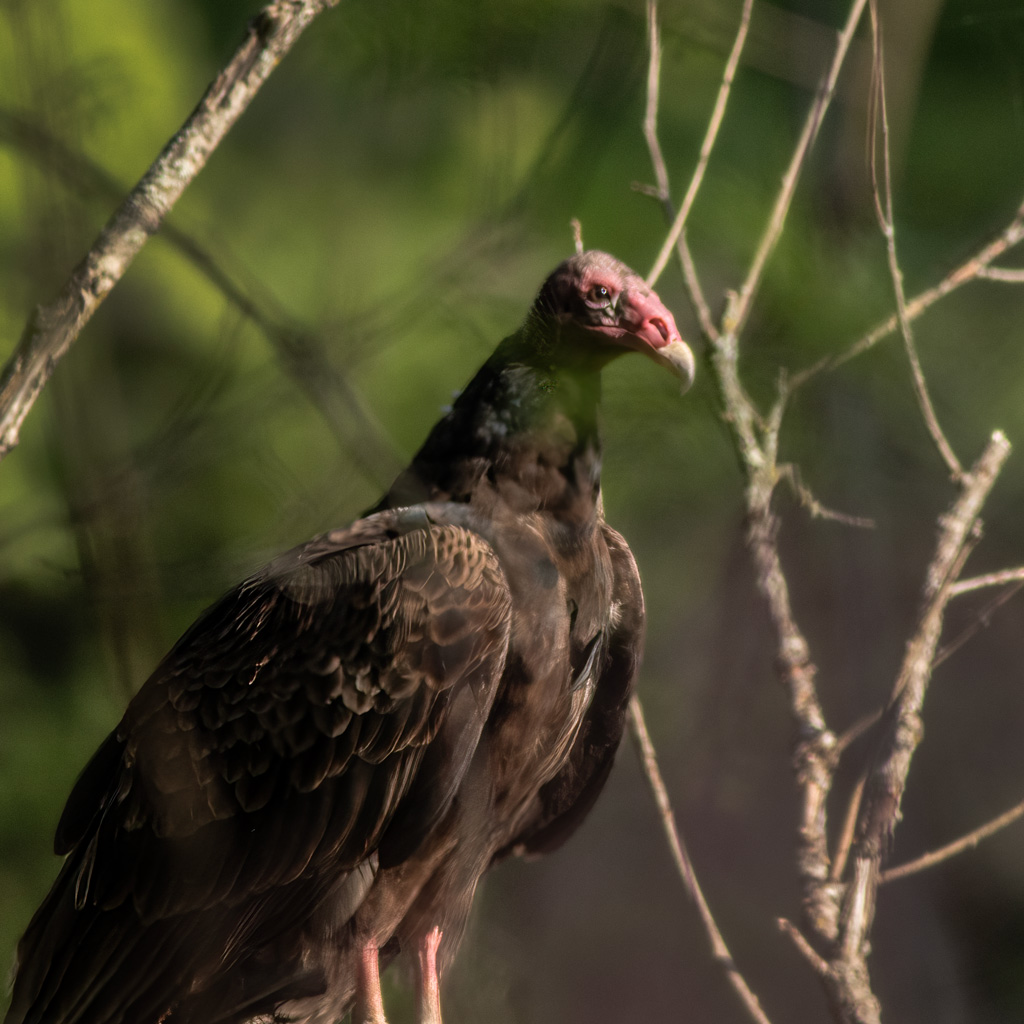
The Turkey Vulture (Cathartes aura) perched on a tree trunk this morning, surrounded by smaller branches of the same tree; its red head helps distinguish it from the Black Vulture. Photo by James Guilford.
We had visitors this morning! A Turkey Vulture was spotted first on a tree limb low above the pond. When I went to investigate, I spied second bird higher in the same tree. A second Turkey Vulture? No, it turned out to be a Black Vulture! I watched them both for some time before first, the Turkey Vulture, and then the Black Vulture, took off in different directions. It’s increasingly common to see Black Vultures in this area of Northern Ohio. It seems Turkey Vultures are quite adept at locating meals — usually carrion — which is something the Black Vultures aren’t so good at. The more aggressive Black Vultures are more skilled at opening thick-skinned carcasses. The complimentary abilities lead to the two types of bird being sighted together. The more common Turkey Vulture is annually celebrated in the neighboring town of Hinckley with springtime Vulture Days.
This morning’s visiting Black Vulture (Coragyps atratus) perched high in a backyard tree. Its featherless, grayish-black head and neck, help distinguish it from its red-headed “cousin”. Photo by James Guilford.
Prominences erupt and loop over the eclipsed Sun’s limb. This is only one of several locations along the edge where proms could be seen but the loop at center above was large and visible to observers with their unaided eyes. The red color is due to how hydrogen glows at extreme temperatures. Photo by James Guilford.
After days of negative weather forecasts, and spring’s reputation for cloudy skies, the clouds thinned Monday, April 8, leaving a milky film across most of the sky. We did, after all of the worry, get to see a very beautiful eclipse. Because the sun is so active right now, the dark disk of moon hiding sun was ringed with easily-seen prominences or “proms”, and surrounded by a fairly round corona.
I’d set up two telescopes in the driveway as I was concerned views from a backyard setup might suffer due to trees. I’d also hoped visitors might drop in to take a look. Only two neighbors visited, one during totality, but it was very nice to visit with them. Overall, since the eclipse was visible from people’s own backyards, we believe many, maybe most, simply stayed home and enjoyed the show; streets were quiet and, from what we could tell, crowds small.
The driveway telescope setup: In the foreground, the 9-inch Vixen Cassegrain telescope with solar filter, a Canon 400mm EF L lens and DSLR camera riding piggyback. In the background is the Askar 103 APO telescope with its solar filter, a DSLR at its focal plane. The eclipse totality images here came from the Askar and its Canon EOS 5D Mk. 4 camera. The solar halo in the clouds was not something I even noticed as I made this snapshot!
While I had hoped and planned for a sky clear enough to enjoy an expansive view of the solar corona, the aforementioned thin cloud cover successfully masked the delicate outer corona leaving only the brilliant inner level accessible. At first I was disappointed but was consoled by my images of prominences — something I did not expect to record in such detail — and that was rewarding indeed!
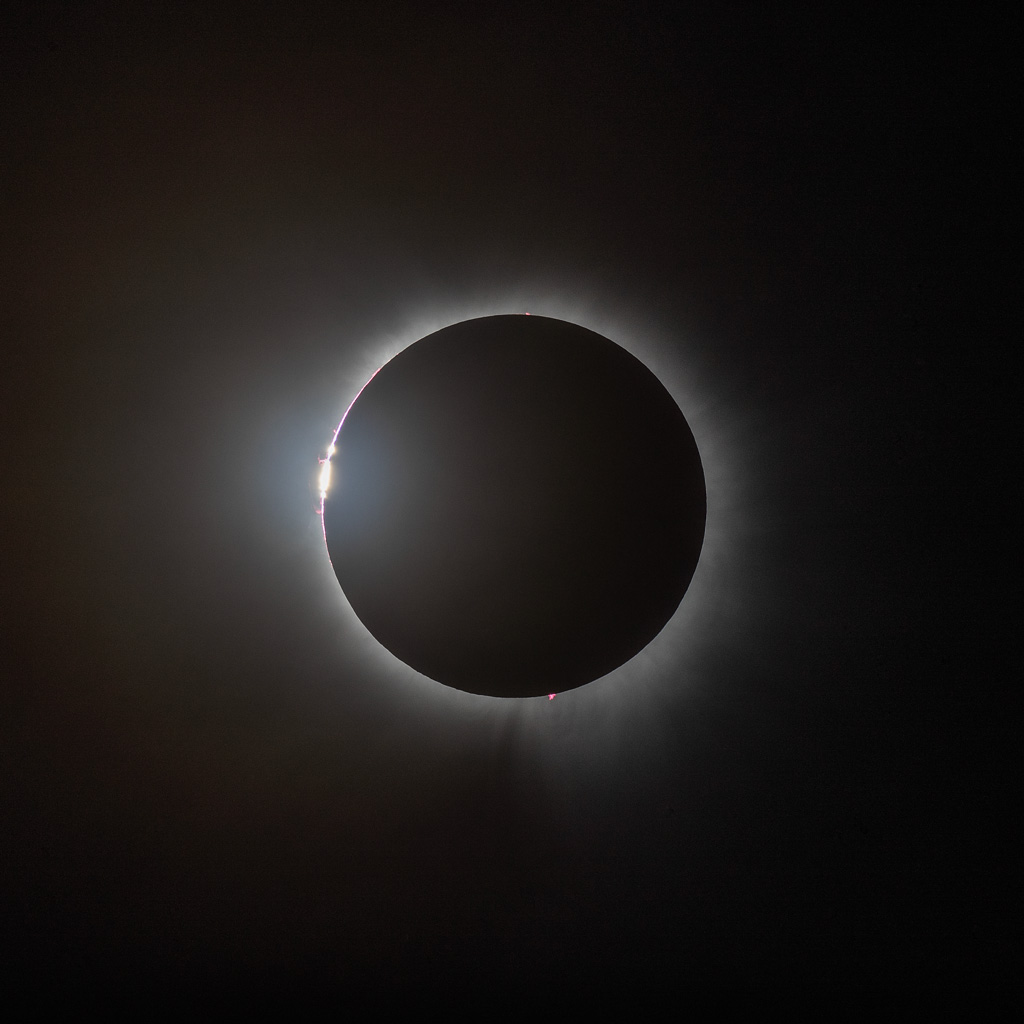
Baily’s beads show in this image as the moon nearly completes its coverage of the sun. Hints at the extent of prominences can also be seen around the dark circle of Moon.
As totality’s appointed hour neared, sunlight faded and took on an eerie quality seen, really, only during solar eclipses. Darkness began to set in and the breeze, as expected, turned cool. The world became quieter. A robin began singing its evening melody. When the last bit of sun winked out behind Moon, cheers rose from people gathered at a nearby public event. I removed the solar filters from my cameras and let them shoot photographs of totality. I looked at the eclipse, a bright light flared from the six o’clock position of the dark circle — a huge prominence that caused my visiting neighbor to ask about. Around three-quarters of the surrounding horizon was glowing in sunset color while the area under the ongoing eclipse was dark. One camera continued its slow count of shutter clicks. And then the world began its return to daylight. Quickly covering lenses I was gratified that I was able to, after days and weeks of concern and doubt, see the complete eclipse event.
I grafted together portions of two of my totality images to illustrate the number, size, and position of the prominences visible during the eclipse. One image was shot immediately after totality began, the second was recorded just before totality ended with Moon covering and exposing various portions of Sun’s limb as it swept across its shining disk.
It’s here that I confess that, in spite of my attempts to test and set up the cameras in advance of totality, I failed. My Canon EOS 6D Mk. 2 did not work as expected. I shot a few single images with it but ended up relying on the Canon 5D Mk. 4 for nearly everything. Even the 5D was not without issues as it did not automatically bracket exposures as I believed I set it — I’ll chalk that up to “operator error”. At least it “failed” with an excellent shutter speed to image the inner corona and those proms I’d wanted to catch!
Through a “white light” solar filter, Moon’s silhouette is seen as the orb progresses across the face of Sun, about to cover a sunspot.
Looking back on the day I can appreciate how lucky we were here at our Northeast Ohio home. Monday morning’s sky was covered in thick cloud and the forecast called for from 40 to 60 percent cloud cover. The sky later cleared to beautiful blue and, though a high thin cloud deck moved in, we saw and photographed a glorious natural phenomenon. This was only my second total solar eclipse, the first experienced in 1970, and it is quite likely my last since I’m not much of a “chaser”. Though I regretted my failings with my photographic plans, the results I did achieve delight me. It was indeed a day of luck and beauty.
1970 Total Solar Eclipse during totality as viewed from Virginia Beach, Virginia March 7, 1970. Photo by James Guilford, digitally scanned from film negative.
Portrait of Cleveland radio personality “Count” John Manolesco, made in the 1970s. Photo by James Guilford
“Cleveland radio has had more than its share of characters. Take “Count” John Manolesco, for example, who hosted a show on news/talk WERE. Manolesco, who claimed to be a physic from Romania, went so far as to perform a live, on-air exorcism.” — Kabir Bhatia, Ideastream.org
I was assigned by a local magazine to shoot photos of Manolesco for a feature article on the Cleveland talk radio personality. I did make the usual photos of him but shot one or two using a low-angle flash — a proven technique to introduce a spooky mood to an image. This is my favorite shot from the job.
John Manolesco was born December 3, 1918 in Timisoaka, Romania, and died January 10, 1983 in Cleveland, Ohio at 65 years of age.
Honorable Mention for my entry entitled “Northward” in the September/October issue of Weatherwise, a respected meteorological journal.
Well would you look at that! One of my pictures received an Honorable Mention in the 2023 Weatherwise Photo Contest! I found out about the honor when the September/October issue arrived today. Weatherwise is the respected meteorological journal featuring “The Power, The Beauty, The Excitement” of weather. You may know I don’t generally enter photo contests. To be selected for even honorable mention from among thousands of entries is, yes, an honor.










 PhotonStopper