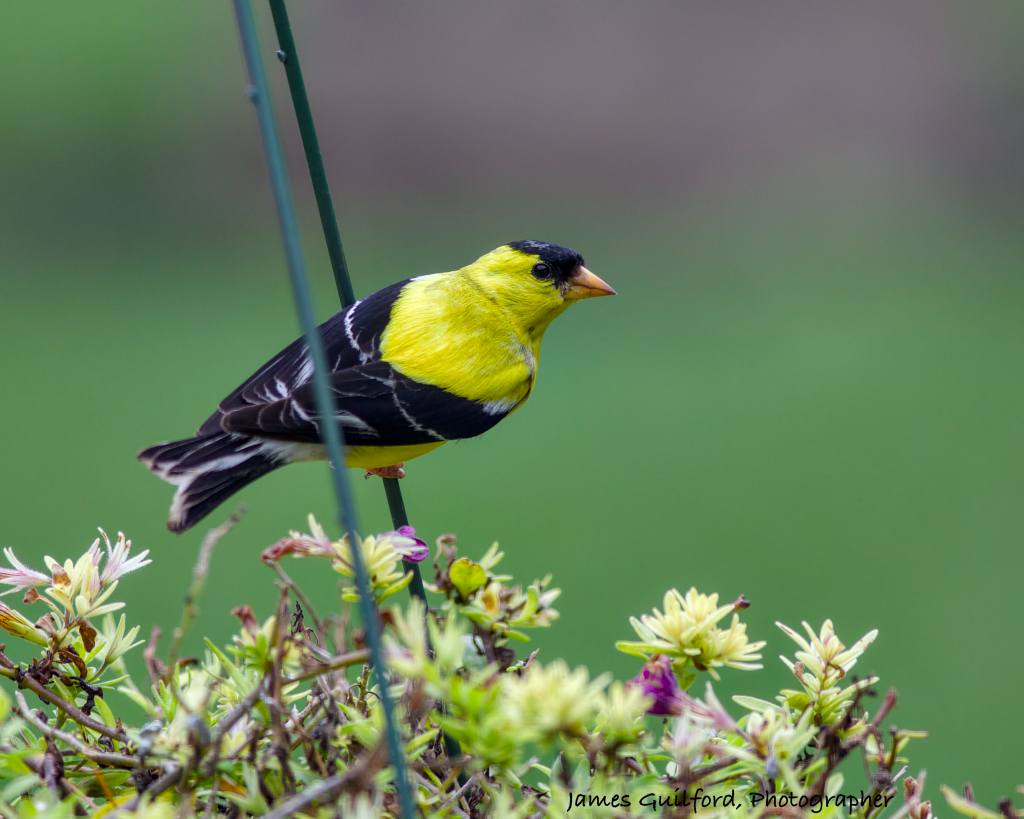
Wearing his full seasonal colors, this American Goldfinch waited his turn at the feeder today, clinging to supports for a hanging plant. Goldfinches raise their broods later than most songbirds, mating and nesting in late summer when their favored food, thistle, matures in nature.
A long period of cold weather and a heavy snow or two have produced persistently covered ground, making winter foraging more challenging for resident birds. Our feeders have been busy. Here are a few photos of some of this year’s guests, representing only a small sample of species dining with us. We have also hosted: House Finches, Downy Woodpeckers, Hairy Woodpeckers, Crows, Dark Eyed Juncos (Snowbirds), Northern Cardinals, Bluejays, Nuthatches, Sparrows, Caroline Wrens. As I said, our feeders have been busy.
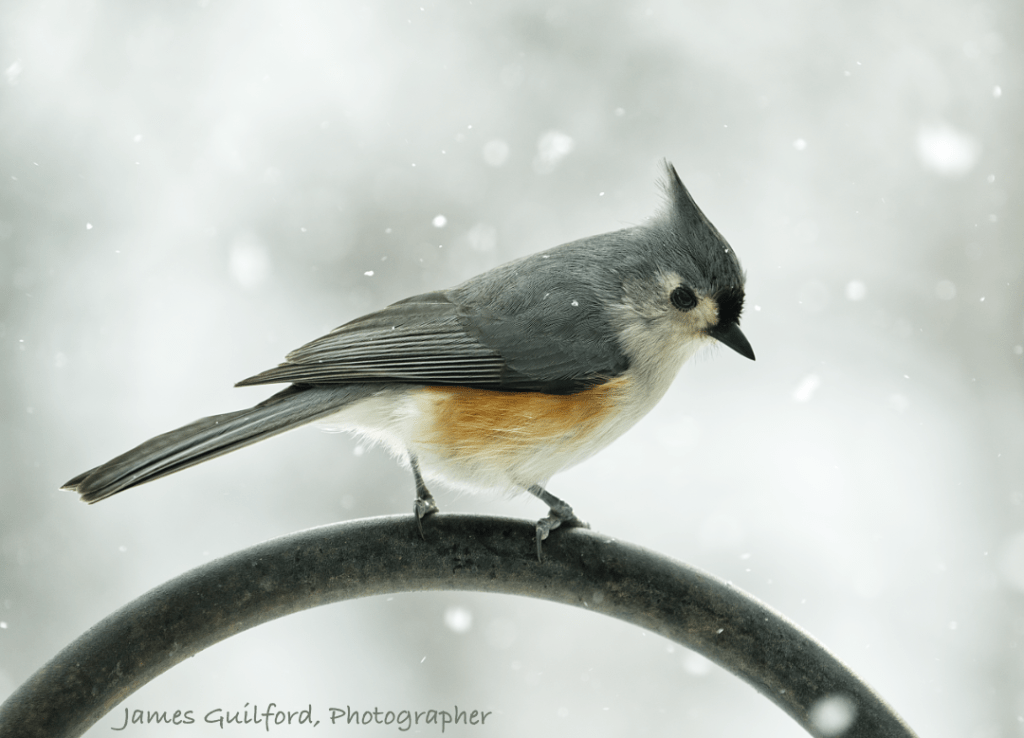
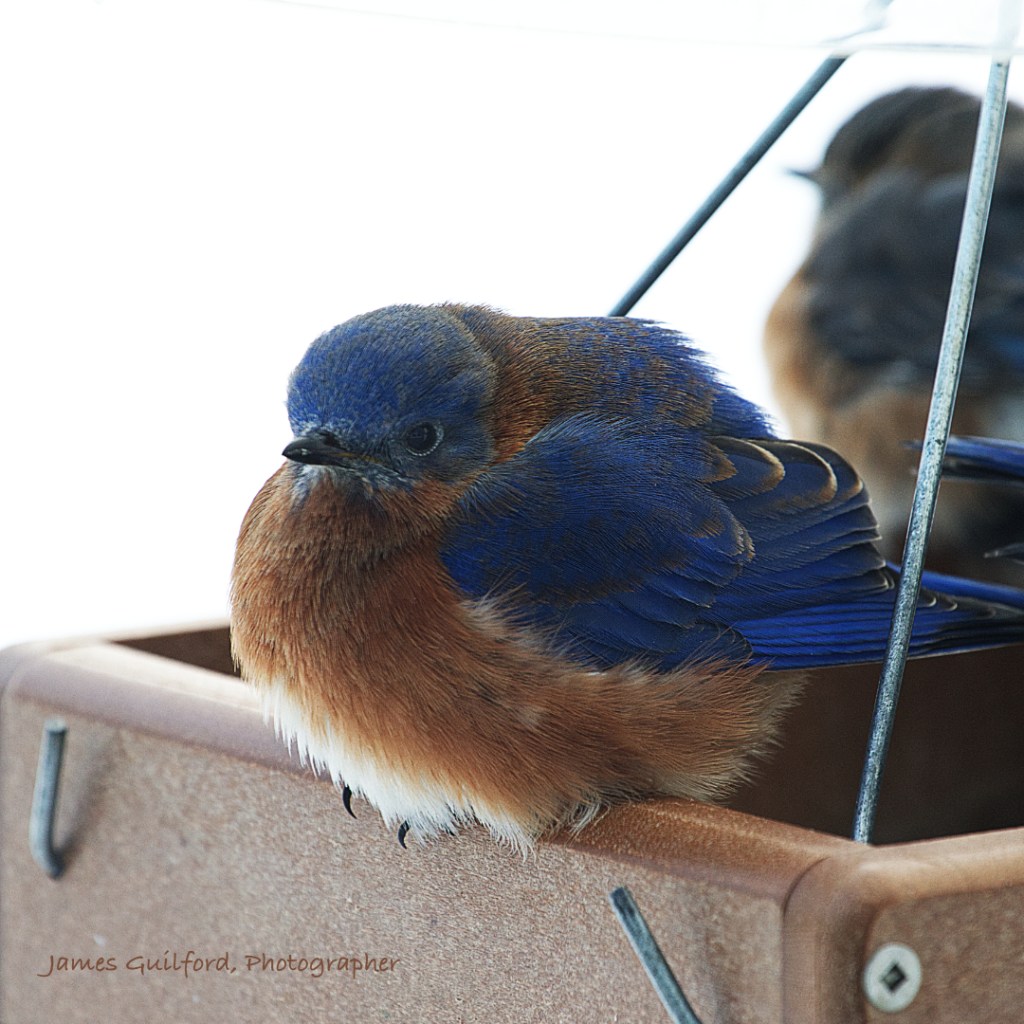
Tufted TitmouseA male Eastern Bluebird, puffed up against the cold, along with four others, perches on the edge of a platform feeding station.European Starlings fill the platform feeder to capacity as they devour the seed within.Not all visitors to the bird feeders were birds.
A group of Eastern Bluebirds perch along the edges of a box-shaped platform feeder enjoying the spread. Accumulated snow sits atop the plastic rain dome from which the feeder hangs. Photo by James Guilford.
Winter has been very cold, lately, with enduring snow cover. In these conditions we enjoy helping out the local birds. In the last couple of years we’ve seen a growing year ’round presence of Eastern Bluebirds both at our feeders and around the property. Today four to five of the little beauties showed up at the tray feeder — by coloration, all boys — enjoying the spread. As they busily picked away at the seeds the view was often blue bird butts. Sill in all, a welcome break from February’s shades of gray.
A Cooper’s Hawk perches on a tree branch, its eyes trained on nearby bird feeding stations. Heavy snow swirls around, as if in a snow globe. — Photo by James Guilford.
Early January and heavy snow was falling. Local birds were flocking to our bird feeders. Suddenly, the small birds disappeared. The local Cooper’s Hawk had showed up for lunch and our smaller feathered friends did not want to be lunch. Snow and blowing snow came and went as the raptor sat, observing from a tree branch. Sometimes the hawk could be seen clearly, sometimes snow completely hid it. The hawk watched for a while but, seeing no potential prey, flew off to hunt elsewhere.
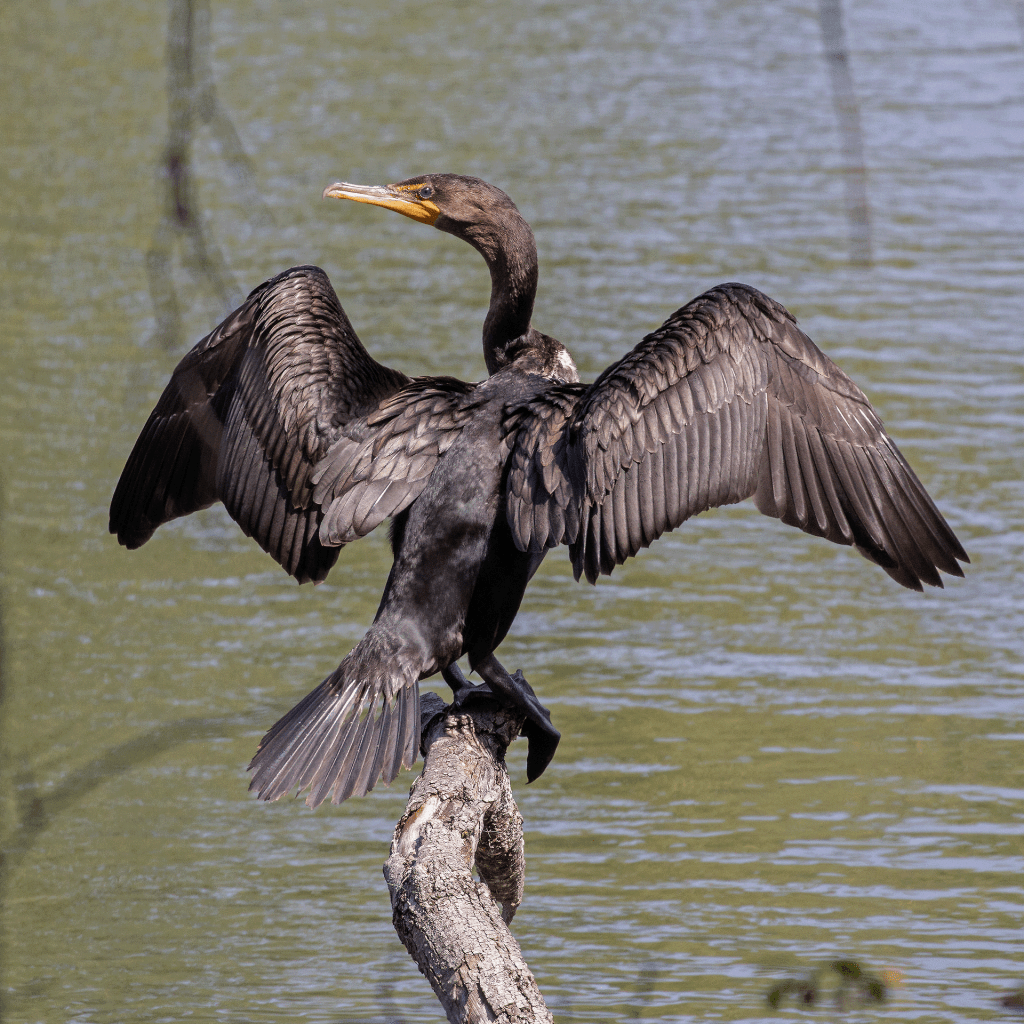
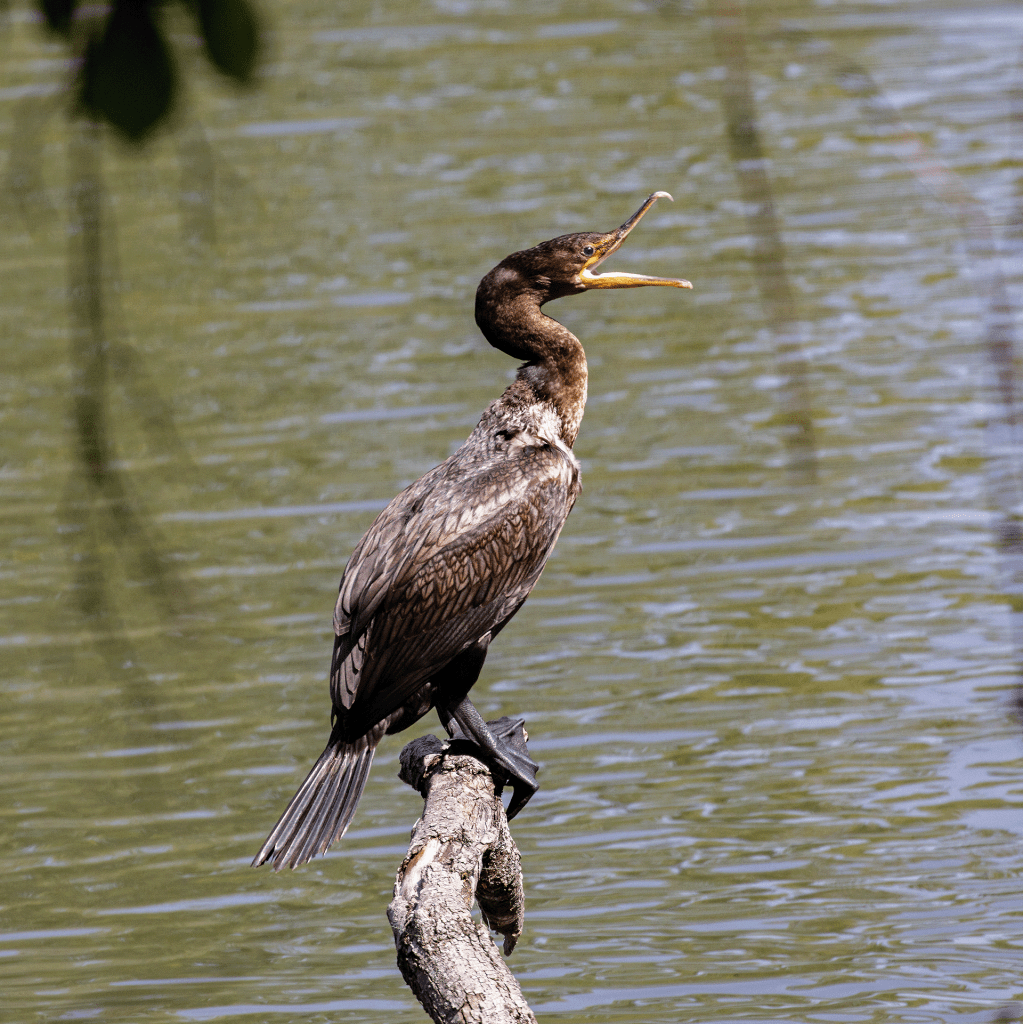
Recently I thought I’d caught glimpses of a cormorant flying over the far side of our pond but I couldn’t be quite sure. Yesterday, I noticed a large bird perched over the water on a fallen tree branch and there it was — a double crested cormorant! Not an uncommon bird but this is the first I’ve seen one here. The bird spent most of the day on that branch basking in the sun, looking around, occasionally swimming, mostly just hanging out. I haven’t seen it today.
A male Eastern Bluebird strikes an unusual pose atop the bend of a shepherd’s hook bird feeder hanger. Photo by James Guilford.
I glanced out the window this morning and spied this male Eastern Bluebird (Sialia sialis) looking all…. broken. The bird was perched atop the shepherd’s hook hanger for the bird feeder six feet off the ground, head cocked to one side, wings disheveled, and totally still. Sick? Injured? A little birdie weirdo? I don’t know! After what seemed a long time, he righted himself, shook himself back into shape, preened a bit, then briefly repeated the pose before flying off. Mrs. Bluebird paid a brief visit shortly after the mister left and she behaved normally. Thank goodness Mr. Bluebird stayed in place just long enough for me to capture a few frames through the window.
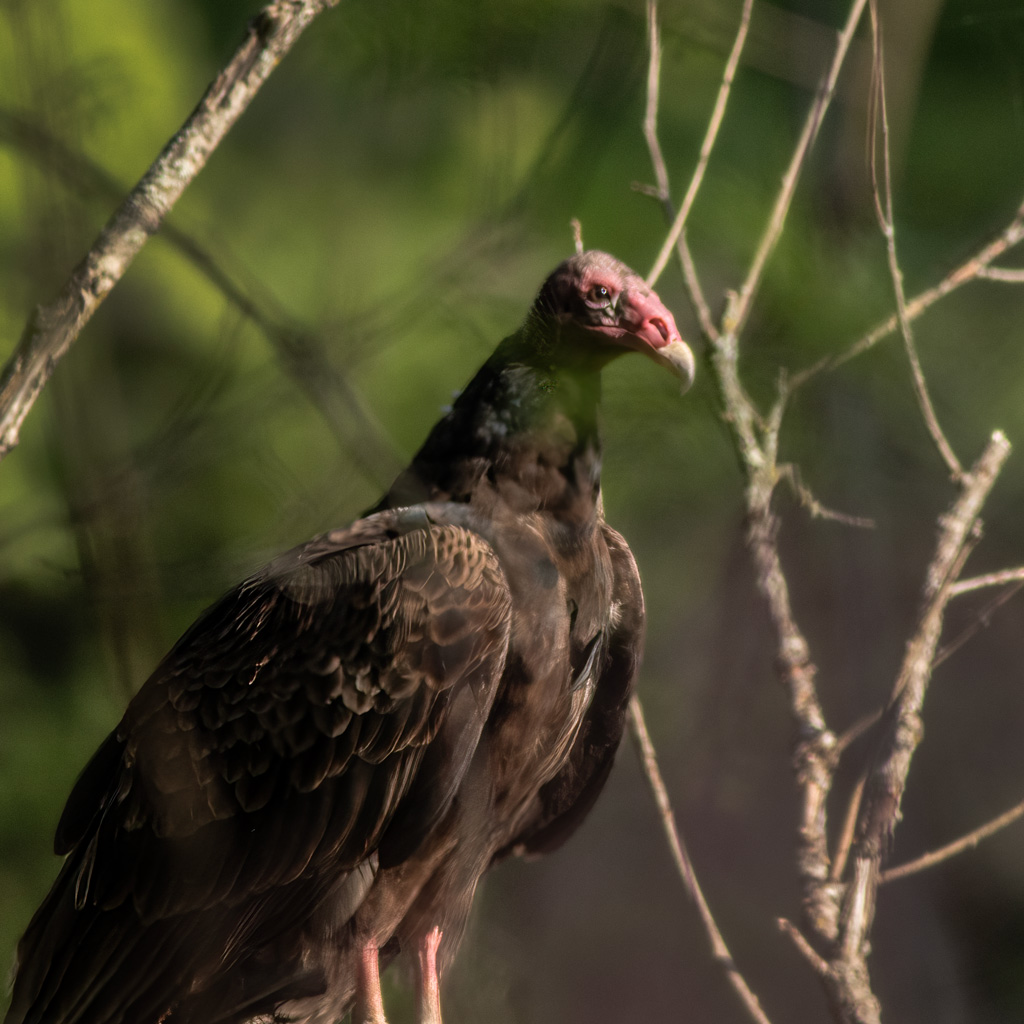
The Turkey Vulture (Cathartes aura) perched on a tree trunk this morning, surrounded by smaller branches of the same tree; its red head helps distinguish it from the Black Vulture. Photo by James Guilford.
We had visitors this morning! A Turkey Vulture was spotted first on a tree limb low above the pond. When I went to investigate, I spied second bird higher in the same tree. A second Turkey Vulture? No, it turned out to be a Black Vulture! I watched them both for some time before first, the Turkey Vulture, and then the Black Vulture, took off in different directions. It’s increasingly common to see Black Vultures in this area of Northern Ohio. It seems Turkey Vultures are quite adept at locating meals — usually carrion — which is something the Black Vultures aren’t so good at. The more aggressive Black Vultures are more skilled at opening thick-skinned carcasses. The complimentary abilities lead to the two types of bird being sighted together. The more common Turkey Vulture is annually celebrated in the neighboring town of Hinckley with springtime Vulture Days.
This morning’s visiting Black Vulture (Coragyps atratus) perched high in a backyard tree. Its featherless, grayish-black head and neck, help distinguish it from its red-headed “cousin”. Photo by James Guilford.
A pair of male Lesser Scaups swim on wind-riled pond waters.
Our annual visitation by migrating waterfowl was special this time: two pairs of “odd ducks”. The first photo shows what I believe are two male Lesser Scaups. The second shot is of a male and a female Bufflehead — the male is mostly white and has iridescent head feathers. All four are likely resting up on their way to their summer ranges in Canada. Safe travels, feathered friends!
A male and female Bufflehead. The male (L) is mostly white with head feathers that are iridescent showing purple and green coloration.
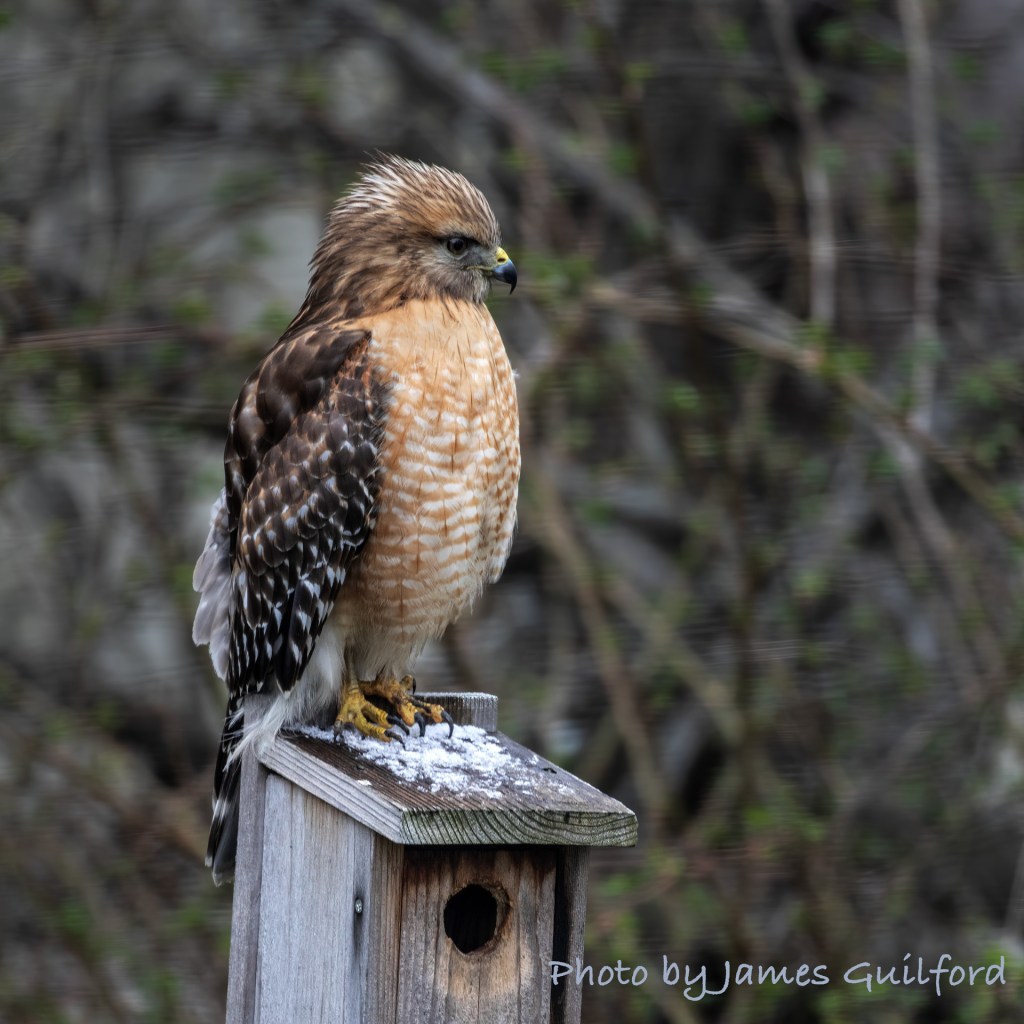
We had some excitement today as a pair of red-shouldered hawks paid repeated visits to our backyard! One of the birds is pictured here, puffed up against the cold. At one point the two raptors were perched side-by-side on a tree branch. Later, one of them — maybe this bird — bagged a small animal and devoured it on the ground. Are they mates? Will they / are they nesting nearby? We shall see (I hope).