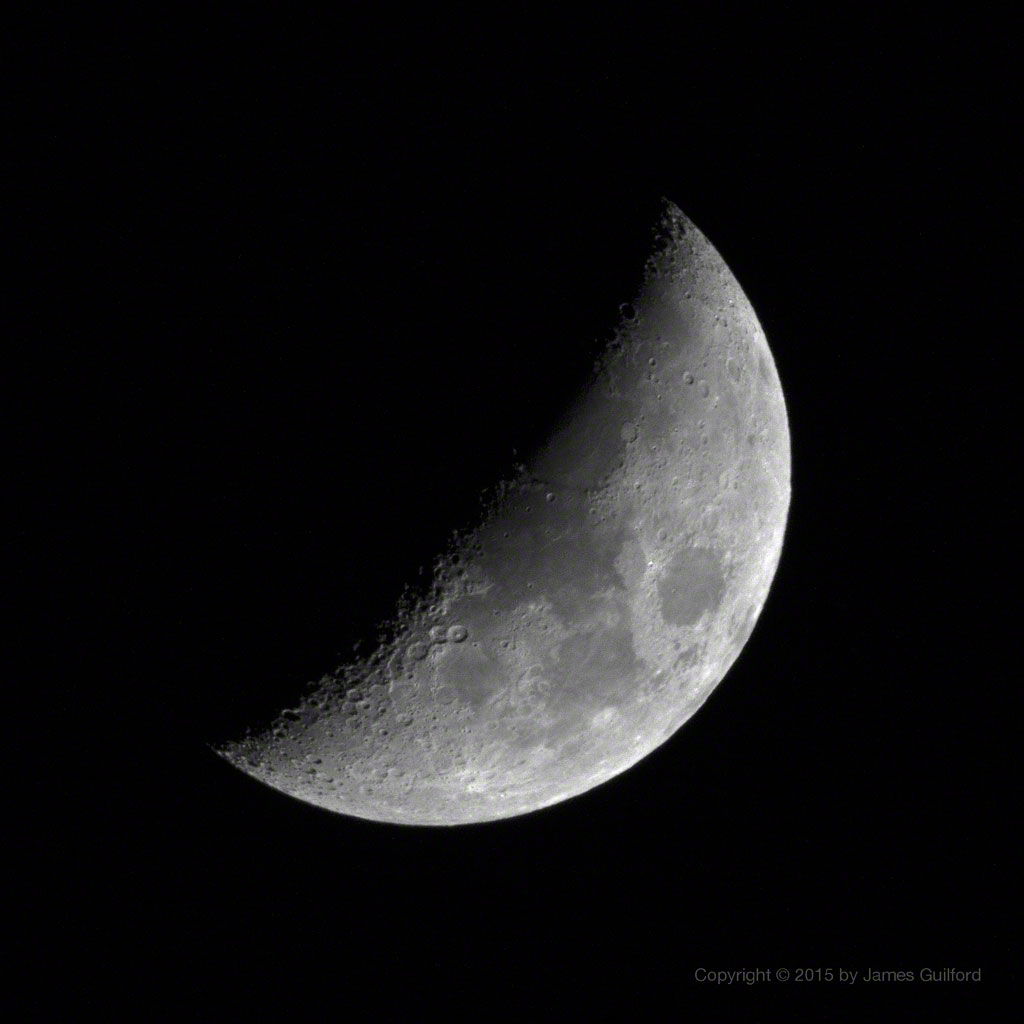
Tonight’s Not-Quite-Full Moon. The Moon will reach its full phase in a little over 24 hours but that doesn’t mean it wasn’t big, bright, and beautiful tonight (May 2, 2015)! Phase in this photo is Waxing Gibbous with about 99% illumination … notice the shadowy edge along the bottom-left.
astronomy
All posts tagged astronomy
The sky was beautiful tonight with the Moon, planets, and stars shining brightly. Continuing my experiments with telephoto astrophotography, tonight I attached my Canon 2X III Adapter to my 400mm lens, and EOS 7D Mark II body; the combination gives approximately 1,200mm of telephoto goodness! At that focal length camera vibration becomes a real issue if the system isn’t attached to a very heavy tripod. My tripod isn’t heavy. But the Moon was bright and with ISO 800 and a shutter speed of 1/400 I got decent, though not vividly sharp results. Next milestone will be to mount the camera and telephoto to the telescope’s heavy tripod and motorized mount. Why not use the telescope directly? Well, that works pretty well, but the optics of my telephoto lens are actually superior in quality to those in my telescope!
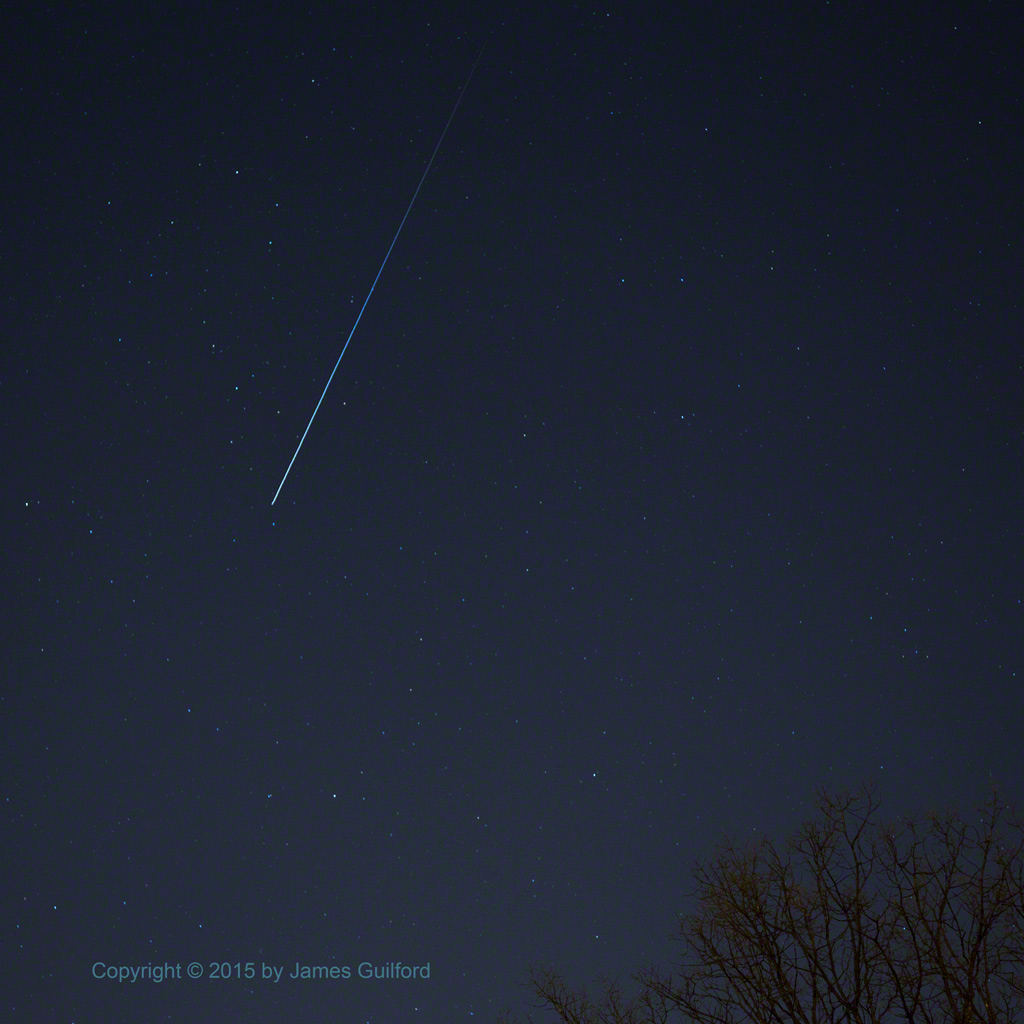
That’s no meteor! It’s a partial trace of the trail the International Space Station took tonight as it traveled upward, through constellation Perseus, and faded into Earth’s shadow. The exposure, and thus the trace, was shortened to avoid overexposure due to heavy light pollution in the Cleveland (Ohio) area.
April 11 presented a rare clear night just in time to see Venus draw very close to the Pleiades star cluster; nights lately have been cloudy and wet! Timing also put the Hyades cluster within the same camera field-of-view as Venus nightly progresses higher in the sky, relative to the stars. As the grouping sank into the trees to my west, I made several single-exposure images of the sight. This one using Canon EOS 7D Mark II: ISO 2000, f/5.6, 1.6 sec., 70mm, at 9:58 EDT.
I can’t say as I blame them, the people who didn’t show for our observatory open night Saturday. After all, the temperature was about 19 degrees (F), damned cold! But the sky was clear and the waxing Moon was high in the sky. Both Moon and Jupiter were sharing constellation Cancer with The Beehive star cluster (M44). Still, those sensible people who stayed home and warm missed a glorious view of old Luna, especially half-lit Mare Iridium — the Sea of Rainbows. In my idle time waiting for visitors, I tried out a little afocal astrophotography using the observatory’s 9-inch Warner and Swasey telescope (ca. 1901) and my little Samsung Galaxy Camera 2 all-in-one. Most shots were a little shy of sharp, and all had some degree of chromatic aberration, and all had a big chunk of image missing where our century-old star diagonal is missing a bit of glass. One shot, however, did work out well, especially after a little fix-up including conversion to monochrome to eliminate color fringing. Not long after our seven brave visitors left, I caught sight of the indistinct reappearance of Jupiter’s Great Red Spot and that was it… time to close up and go home. My toes needed to be thawed.
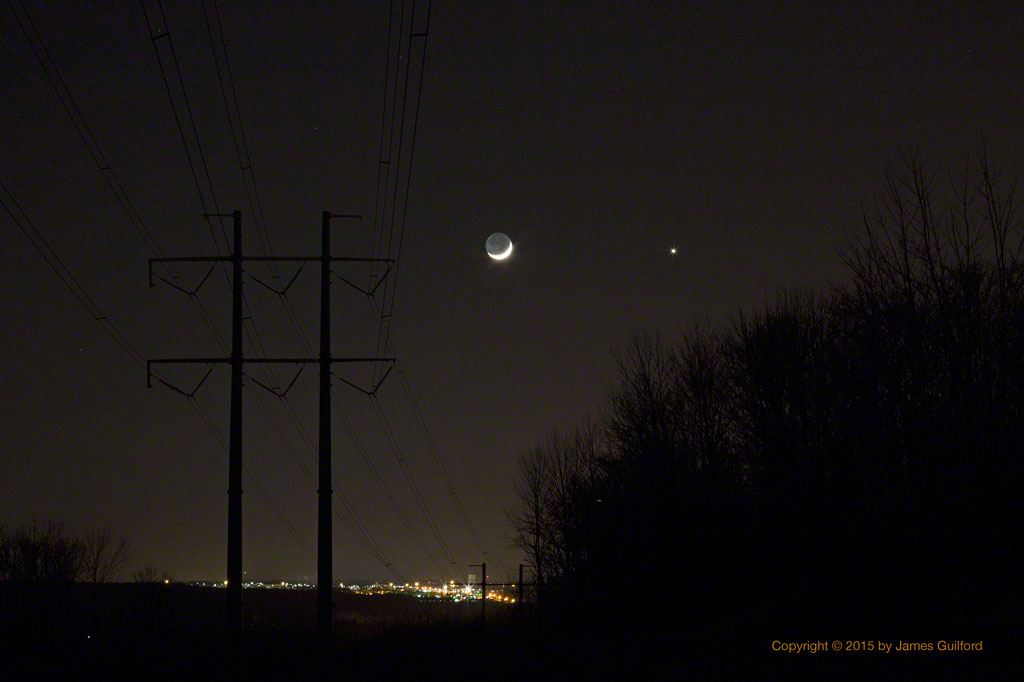
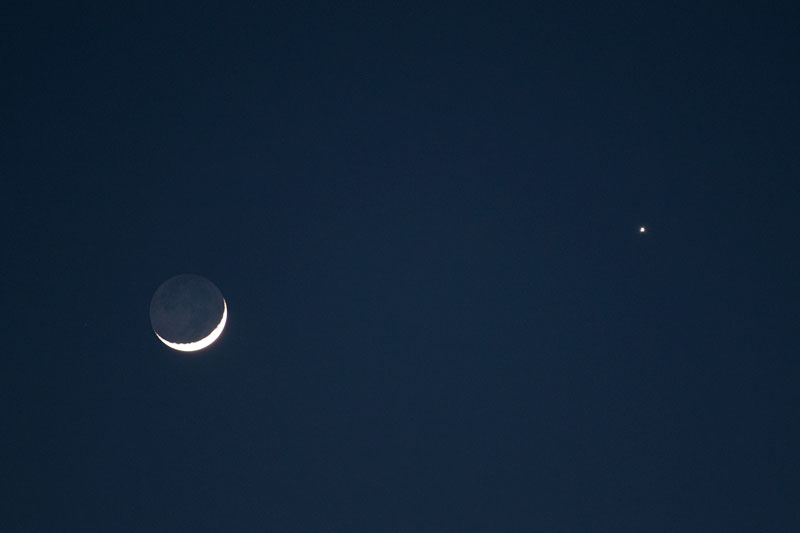
I was disappointed with my previous efforts at recording an earlier close passage of our Moon and Venus. The Moon’s orbit, however, gave me a second chance on a night when the sky was pretty clear. Pretty cold, too, at an unseasonable 23F.
But I braved the temperatures and, using two different Canon camera bodies, got shots of the combo first in twilight, later in a dark sky. Well, the sky here isn’t really all that dark, but it was pretty good.
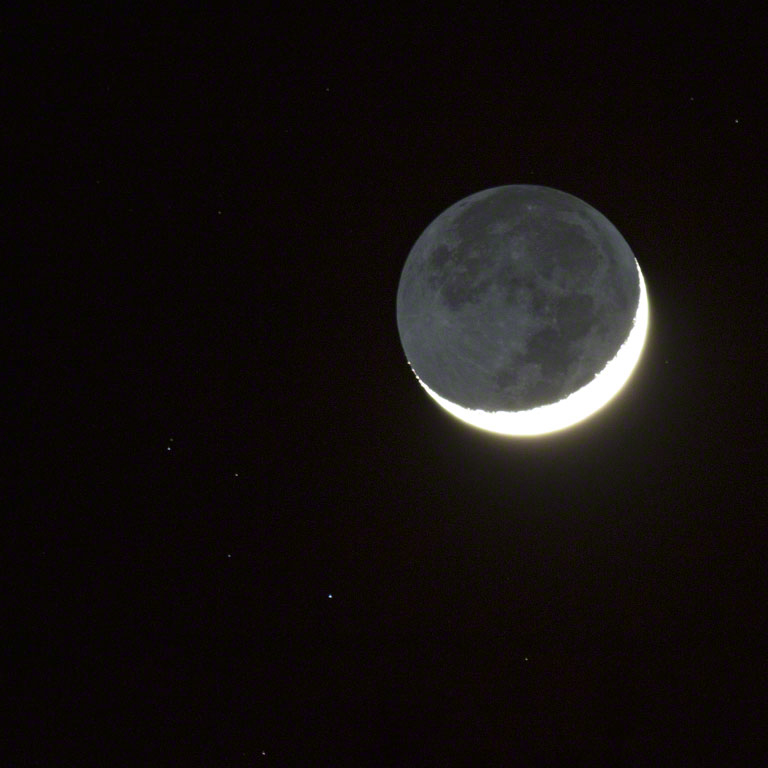
Some shots I exposed to get some detail in the lighted portion of the thin, waxing crescent Moon; others I exposed to record the Earthshine portion of Luna’s disk. The late shots I took from a vantage point that overlooked the lights of a nearby city whose glow put power lines and their towers into silhouette.
All-in-all, I’m pleased with the night’s efforts. Especially now that my fingers aren’t red from the cold air!
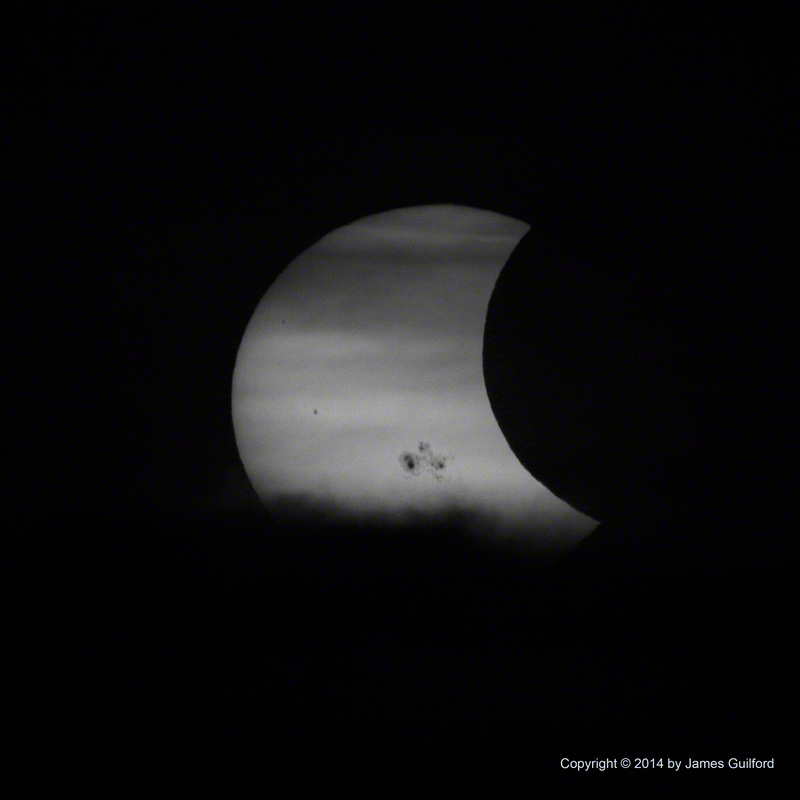
Due to the positions of Sun, Moon, and Earth, lunar and solar eclipses tend to be paired up. So it was that while we had a total lunar eclipse about two weeks ago, we enjoyed a partial solar eclipse this evening. As partial eclipses go, this one promised to be a good one. From our vantage point in Northeastern Ohio, we were to expect about 50 percent coverage of Sun’s bright face by Moon, a late-day event ending with sunset. After much deliberation, owing to the very low elevation of the eclipse over the western horizon, I decided upon a fishing pier on the south shore of Lake Erie. If we were lucky we would see a beautiful, crescent Sun sinking colorfully into the distance, reflecting off of the lake waters. That was the image in my mind, anyway.
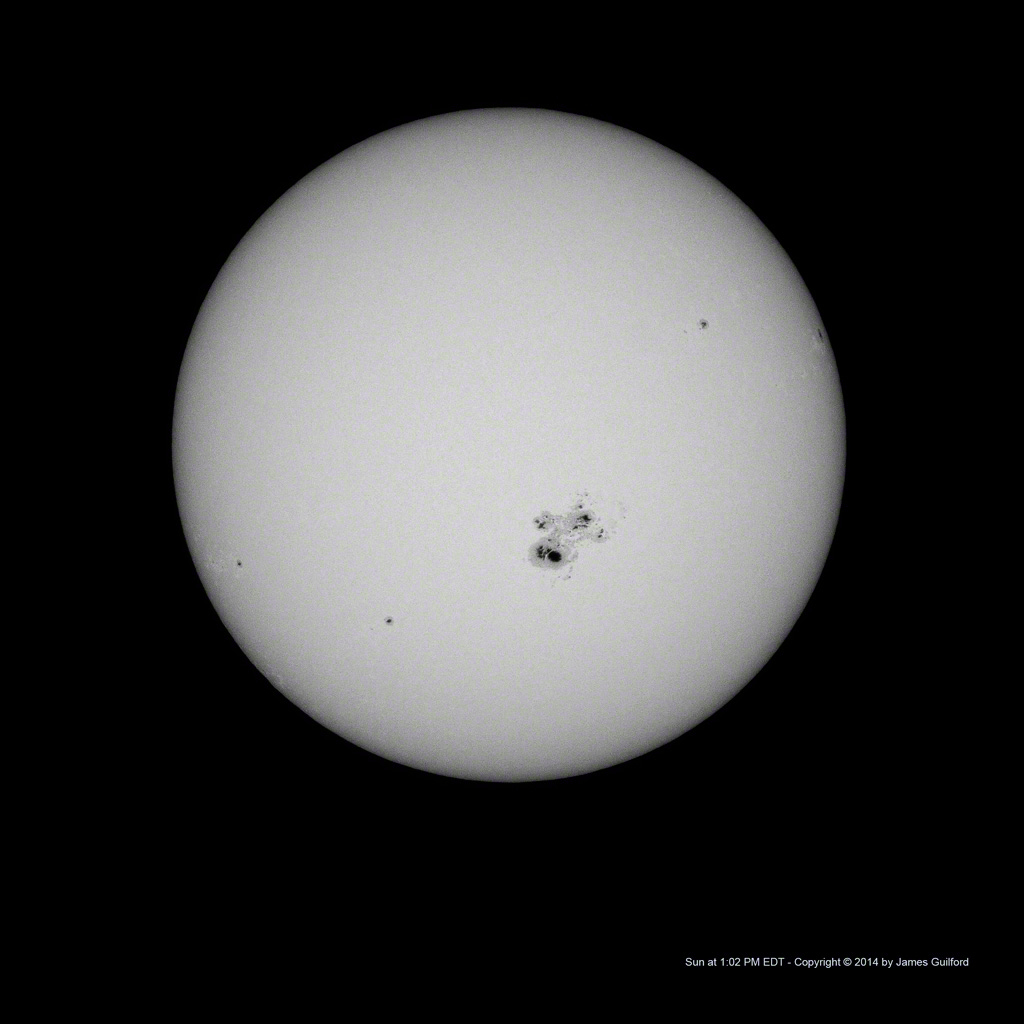
The pier became packed with eclipse watchers and I was happy I’d arrived early and staked out a corner! Yesterday was cloudy and I could not shoot a test image of Sun without Moon but did get the opportunity today. The image was very good and one of the best I’ve managed of the Sun. The solar disk was particularly striking because a massive sunspot cluster was visible … really massive, spanning nearly the distance from Earth to Moon (~ 250,000 miles) across the Sun! Very photogenic.
As I mentioned, the eclipse was taking place late in the day, beginning at 5:42 PM EDT local time and in progress at sunset, about 6:35 PM — low to the horizon and in the messiest part of Earth’s atmosphere. The evening’s photos showed the lunar limb nipping off bit after bit of the Sun until the bright disk looked like a cookie with a large bite missing; a raisin cookie, I think, due to the sunspots!
It wasn’t long, however, before we began to see streaks of cloud crossing that bright, chipped disk and before we knew it, the eclipse sank into distant clouds. There was no colorful sinking, no beautiful reflections, only a dark lake and fading cloud-obscured sunset.
Even with the sad ending, the crowd was excited and pleased to see what had transpired. Someone asked if they could review my images using the tiny LCD panel in the back of my camera. I was happy to oblige and soon drew a small crowd of departing spectators who thought the pictures looked great! (Some folks had arrived too late to see any of the eclipse.)
Later, processing the pictures on my computer, I could see that the eclipse images were nowhere near as good as I had hoped and didn’t compare well with the earlier tests. Why? Remember how I mentioned the low-t0-horizon position of the eclipse? The murk? The thick, wind-churned atmosphere robbed my images of their expected clarity. Am I disappointed? Yes, a little. Still, it was a fine little eclipse and I was delighted to have seen it!
I really ought to know better but the early signs were positive! I rented a Sigma 150-500mm telephoto zoom lens to try out before making a possible purchase. That model lens has been marked down in price, presumably because Sigma is introducing a 150-600mm lens in the near future. At just under $1,000 the rental lens features APO lens elements and optical image stabilization — quite a bargain, if it works well! So, my pre-purchase trial was to include a nature shoot and, contingent upon a pre-event test, photos of the October 8 total lunar eclipse!
I did some test shots of the Full Moon the night of October 7 and they looked quite good. There was, on close inspection, a light gray “halo” around a portion of the lunar disk but that mostly disappeared in processing. Despite the very bright Moon, there was no color fringing and that’s a good sign of optical quality. The image was acceptably sharp and contrasty. It looked like I’d be set for the next morning’s eclipse!
I rose from bed at 4:45 AM the morning of the eclipse, about a half-hour before the Moon was to enter the central portion of Earth’s shadow, the umbra. The penumbral phase of the eclipse sees the Full Moon dim, imperceptibly to most casual observers, and uninteresting to me. Walking in the moonlight to my car, I noticed the subdued light and by the time I reached my observation point I could see a chunk of the Moon falling into deep shadow — it had begun!
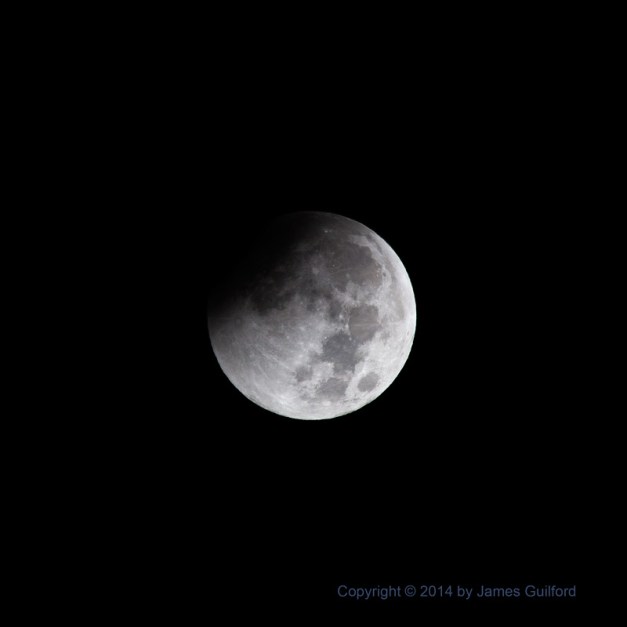
I quickly set up the camera and rented lens on my tripod, focused on the still-bright Moon, and began a long series of photographs, adjusting exposure as the eclipse progressed. Earth’s shadow, with its soft leading edge, crawled across the lunar surface. I shot image after image, checking exposures in the camera’s LCD panel. It looked like I had some excellent shots.
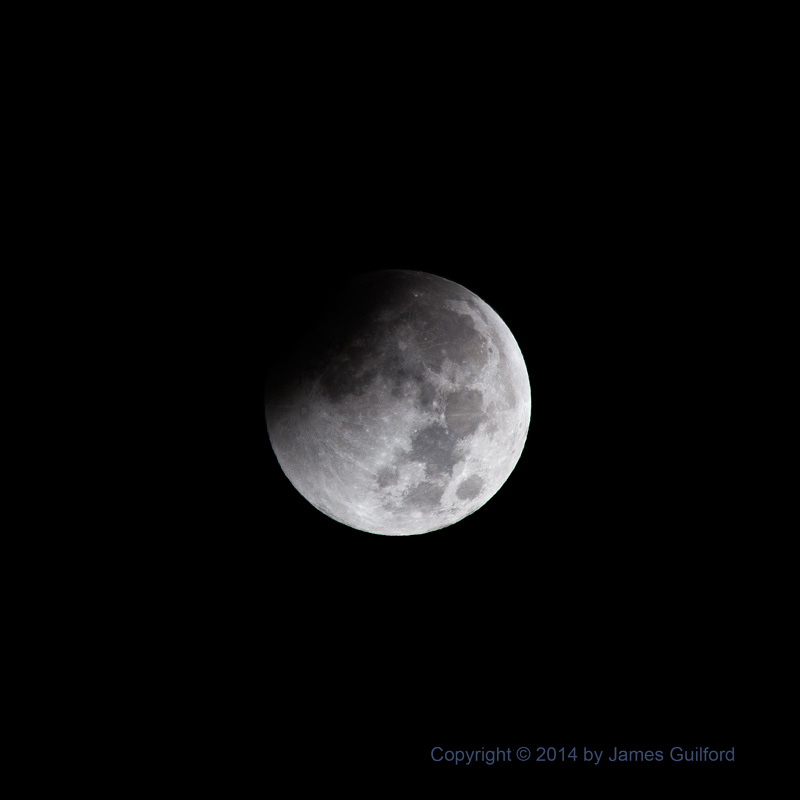
Totality in a lunar eclipse sees the Moon diminished to a dim ruddy coppery-red orb, requiring longish exposure and/or high ISO numbers to record. I could tell I had images but, critically, I could not tell just how good they were. I opted for shorter exposure times and higher ISOs which accounts for the “grainy” appearance of the images; I should have used a slightly lower ISO setting.
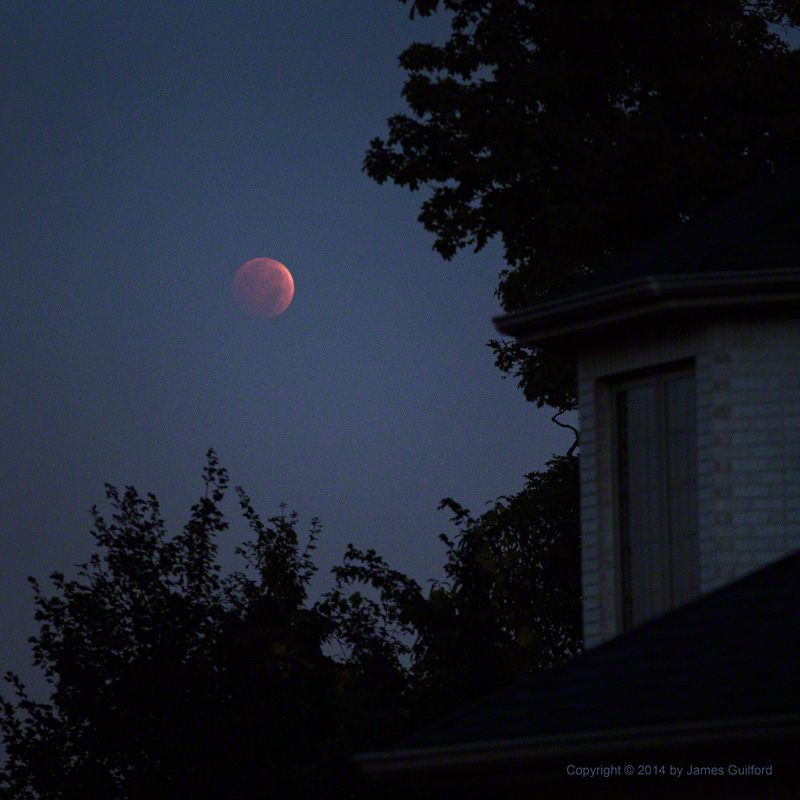
As totality continued and the sky began to show signs of pre-dawn twilight, I moved to a secondary location. I wanted to show the Moon as part of a landscape with city lights, trees, homes, something in the foreground or under the still-reddish eclipsed Luna. I switched lenses to my favorite, the Canon 70-200mm f/4 zoom telephoto — best glass I have ever owned. I shot the scenes until the Moon dipped into the morning mists of the western horizon and was washed out by approaching sunrise.
The eclipse itself was a great experience and something I haven’t seen one since 2008. Despite the chill air, light breeze, and cold-aching fingers, I was enthralled. The Sigma photos were another matter. Later, as I examined the images on my computer, I was very disappointed. The shots of the partially-obscured Moon were barely acceptable and images of the eclipsed Moon were a mess … kind of pretty and interesting, but a mess. I’m not sure the exact cause of the soft focus but it was the lens that was at fault.

That afternoon the wildlife shoot went well and the Sigma produced very good (though not excellent) images. Possibly the best shot of the afternoon was a Great Egret catching a small fish at the Sandy Ridge Reservation of Lorain County Metro Parks. The zoom lens extends when reaching its 500mm extent and, unfortunately, the mechanism is too “loose,” sliding outward when the camera is pointed downward. When being carried, the zoom lock did not work. When zoomed from one focal length to another, the lens did not appear to hold focus. The zoom slipping may have been the cause of loss of focus and my lunar imaging woes. I wondered what corners may have been cut to keep the massive Sigma optic price so low … I think I discovered some of them!
I won’t be purchasing that lens.
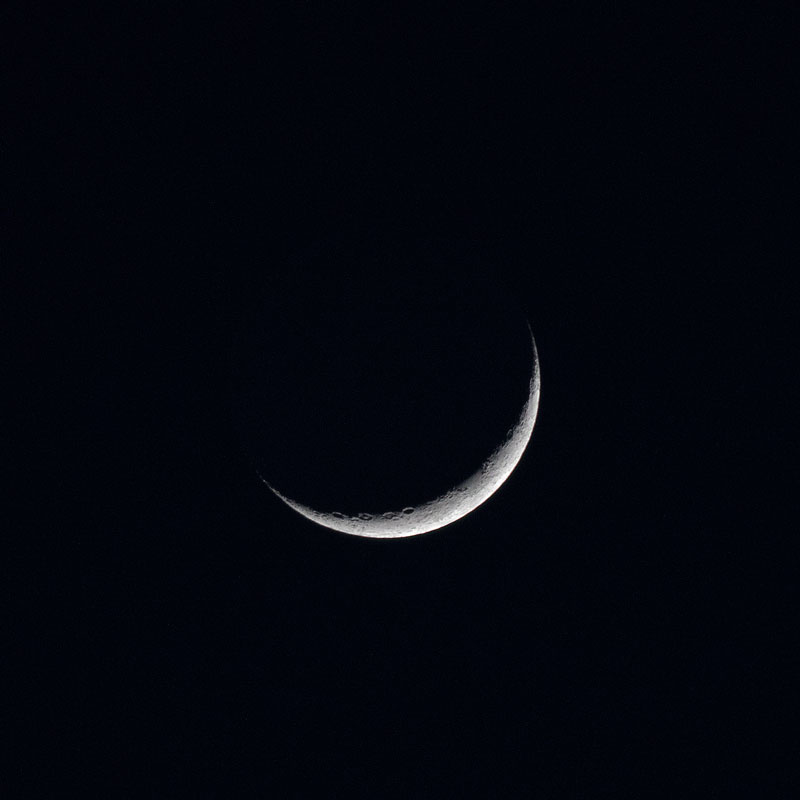
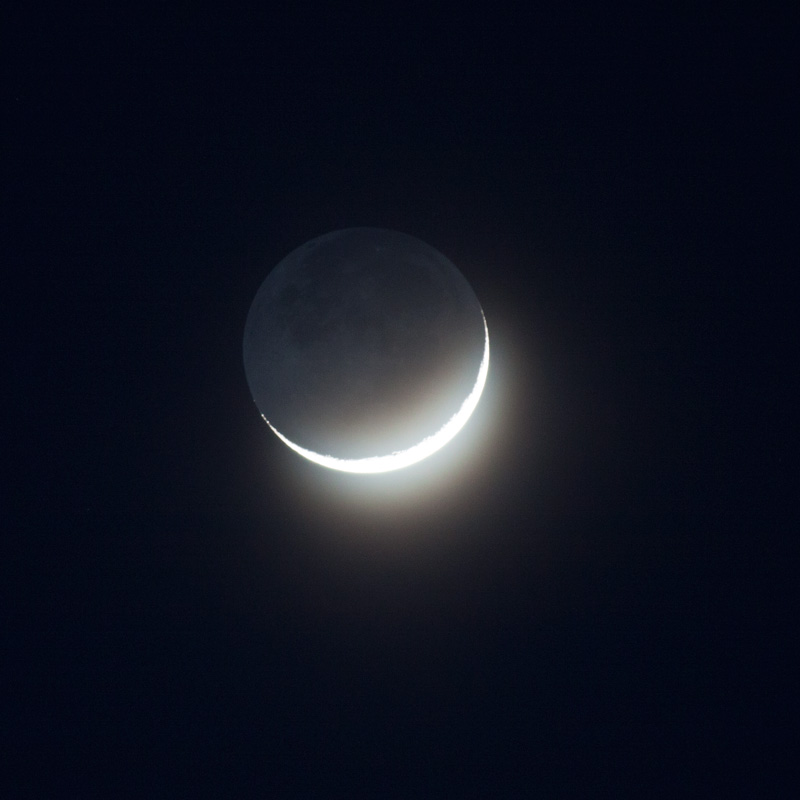
Tonight the western sky was adorned with a beautiful sliver of our Moon, shining in the twilight. I dug out my camera, tripod, and long lens to try a few shots, partly because I find the crescent Moon fascinating but also to practice for the total lunar eclipse that will take place the night of April 14 – 15. (Totality will occur here in Ohio in the wee hours before 3:00 AM on the 15th.) Tonight, thin clouds lightly veiled the sinking Moon but I was fairly happy with my results: the bright sliver of reflected sunlight, the cratered roughness of the terminator, and the mottled blue shadowed Earth-lit face of Luna all recorded. All but two of the images were in good focus and showed no blur from camera vibration. The eclipsed Moon will be much more colorful than tonight’s and I can only hope the skies will be clear for it!
UPDATE: Unfortunately clouds and bad weather moved in the night of the eclipse. With no prospects of seeing, much less photographing, the event I went to be. Sometime around 2:45 AM my internal clock woke me so I arose from bed, went downstairs to the landing where a wonderful window faces west, and looked up to where the Moon would be. Nope! Nothing but wet cloud-bottoms! Back to bed.
The waxing Gibbous Moon rises between trees of bare branches. Look closely and you will see that this is not a Full Moon — the lower-left portion of the disk is slightly darker, slightly irregular compared with the rest. In about two days Luna will shine brilliant and appear as a perfect circle … if our skies allow us to see!
Meanwhile, in the west, the Sun disappears in red-orange glory.