Sunspots AR3716, AR3713, and AR3712 are nearing the sun’s western limb or horizon to disappear for at least a couple of weeks or possibly forever. Vixen VC200L Cassegrain telescope with white light solar filter. Image Credit: James Guilford
Braving the already hot and humid morning today, I set up my telescope and made photos of three large sunspots. I’ve been checking on them daily since they made their appearance and wanted to bid them a fond farewell before they disappear to Sun’s far side. The close-up view is via my telescope while the full disk image is from my Canon 400mm telephoto lens; both images recorded using my Canon EOS 7D Mk. 2 DSLR camera body.
Full disk image of our nearest star via Canon EF 400mm 1:5.6 L lens with 2X extended and a white light solar filter used to prevent severe damage to the camera and to the photographer’s vision. Image Credit: James Guilford.
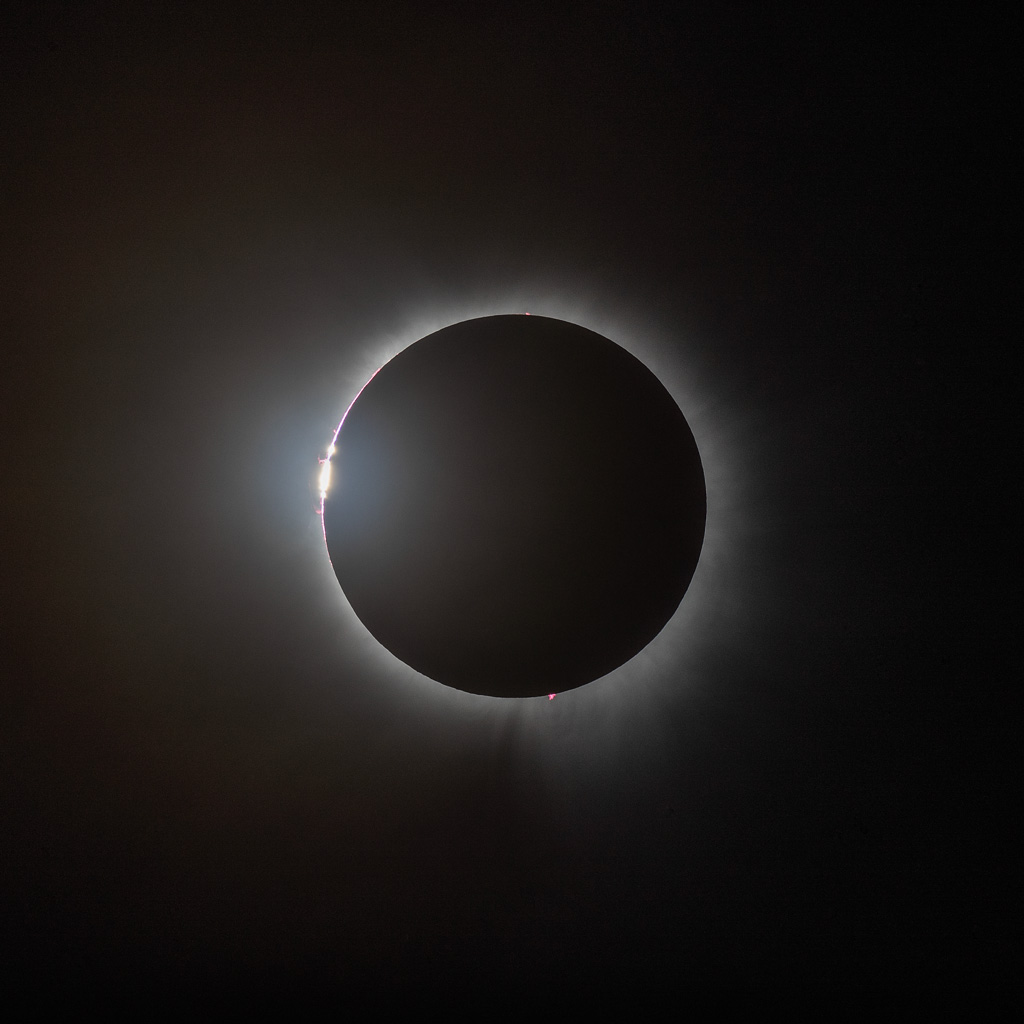
Prominences erupt and loop over the eclipsed Sun’s limb. This is only one of several locations along the edge where proms could be seen but the loop at center above was large and visible to observers with their unaided eyes. The red color is due to how hydrogen glows at extreme temperatures. Photo by James Guilford.
After days of negative weather forecasts, and spring’s reputation for cloudy skies, the clouds thinned Monday, April 8, leaving a milky film across most of the sky. We did, after all of the worry, get to see a very beautiful eclipse. Because the sun is so active right now, the dark disk of moon hiding sun was ringed with easily-seen prominences or “proms”, and surrounded by a fairly round corona.
I’d set up two telescopes in the driveway as I was concerned views from a backyard setup might suffer due to trees. I’d also hoped visitors might drop in to take a look. Only two neighbors visited, one during totality, but it was very nice to visit with them. Overall, since the eclipse was visible from people’s own backyards, we believe many, maybe most, simply stayed home and enjoyed the show; streets were quiet and, from what we could tell, crowds small.
The driveway telescope setup: In the foreground, the 9-inch Vixen Cassegrain telescope with solar filter, a Canon 400mm EF L lens and DSLR camera riding piggyback. In the background is the Askar 103 APO telescope with its solar filter, a DSLR at its focal plane. The eclipse totality images here came from the Askar and its Canon EOS 5D Mk. 4 camera. The solar halo in the clouds was not something I even noticed as I made this snapshot!
While I had hoped and planned for a sky clear enough to enjoy an expansive view of the solar corona, the aforementioned thin cloud cover successfully masked the delicate outer corona leaving only the brilliant inner level accessible. At first I was disappointed but was consoled by my images of prominences — something I did not expect to record in such detail — and that was rewarding indeed!
Baily’s beads show in this image as the moon nearly completes its coverage of the sun. Hints at the extent of prominences can also be seen around the dark circle of Moon.
As totality’s appointed hour neared, sunlight faded and took on an eerie quality seen, really, only during solar eclipses. Darkness began to set in and the breeze, as expected, turned cool. The world became quieter. A robin began singing its evening melody. When the last bit of sun winked out behind Moon, cheers rose from people gathered at a nearby public event. I removed the solar filters from my cameras and let them shoot photographs of totality. I looked at the eclipse, a bright light flared from the six o’clock position of the dark circle — a huge prominence that caused my visiting neighbor to ask about. Around three-quarters of the surrounding horizon was glowing in sunset color while the area under the ongoing eclipse was dark. One camera continued its slow count of shutter clicks. And then the world began its return to daylight. Quickly covering lenses I was gratified that I was able to, after days and weeks of concern and doubt, see the complete eclipse event.
I grafted together portions of two of my totality images to illustrate the number, size, and position of the prominences visible during the eclipse. One image was shot immediately after totality began, the second was recorded just before totality ended with Moon covering and exposing various portions of Sun’s limb as it swept across its shining disk.
It’s here that I confess that, in spite of my attempts to test and set up the cameras in advance of totality, I failed. My Canon EOS 6D Mk. 2 did not work as expected. I shot a few single images with it but ended up relying on the Canon 5D Mk. 4 for nearly everything. Even the 5D was not without issues as it did not automatically bracket exposures as I believed I set it — I’ll chalk that up to “operator error”. At least it “failed” with an excellent shutter speed to image the inner corona and those proms I’d wanted to catch!
Through a “white light” solar filter, Moon’s silhouette is seen as the orb progresses across the face of Sun, about to cover a sunspot.
Looking back on the day I can appreciate how lucky we were here at our Northeast Ohio home. Monday morning’s sky was covered in thick cloud and the forecast called for from 40 to 60 percent cloud cover. The sky later cleared to beautiful blue and, though a high thin cloud deck moved in, we saw and photographed a glorious natural phenomenon. This was only my second total solar eclipse, the first experienced in 1970, and it is quite likely my last since I’m not much of a “chaser”. Though I regretted my failings with my photographic plans, the results I did achieve delight me. It was indeed a day of luck and beauty.
1970 Total Solar Eclipse during totality as viewed from Virginia Beach, Virginia March 7, 1970. Photo by James Guilford, digitally scanned from film negative.
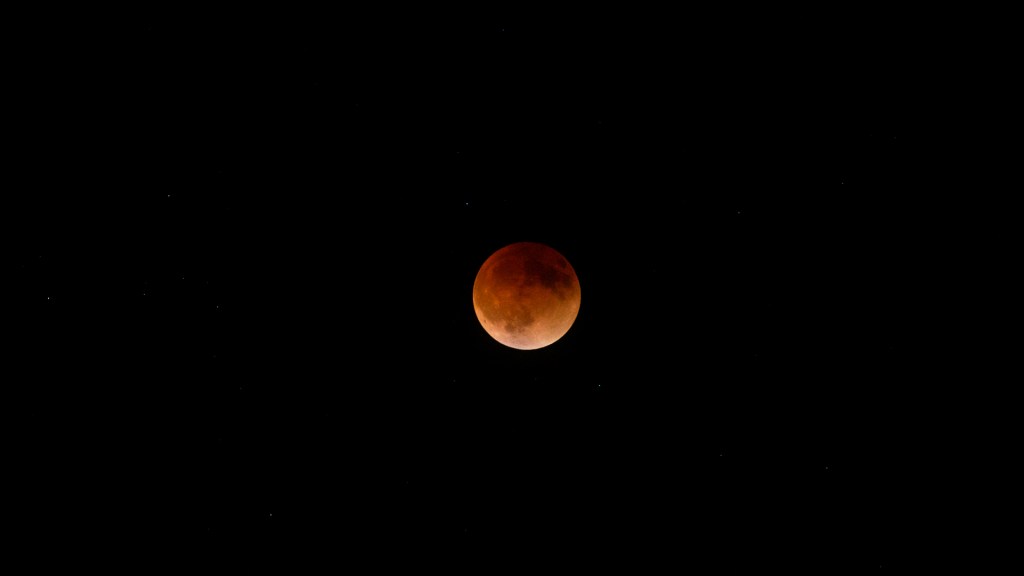
Total Lunar Eclipse of May 15 – 16, 2022, at 12:30 a.m., EDT. Some viewers may be able to see several white spots in the dark space around Moon — stars within the constellation Libra — better visible in the original photograph. Photo by James Guilford
It looked like a great opportunity to see and photograph a total eclipse of the Moon! Too often, it seems, lunar eclipses have been either just starting or in progress at moonset or sunrise, either curtailing what might be seen. The May 15 – 16 lunar eclipse was an exception.
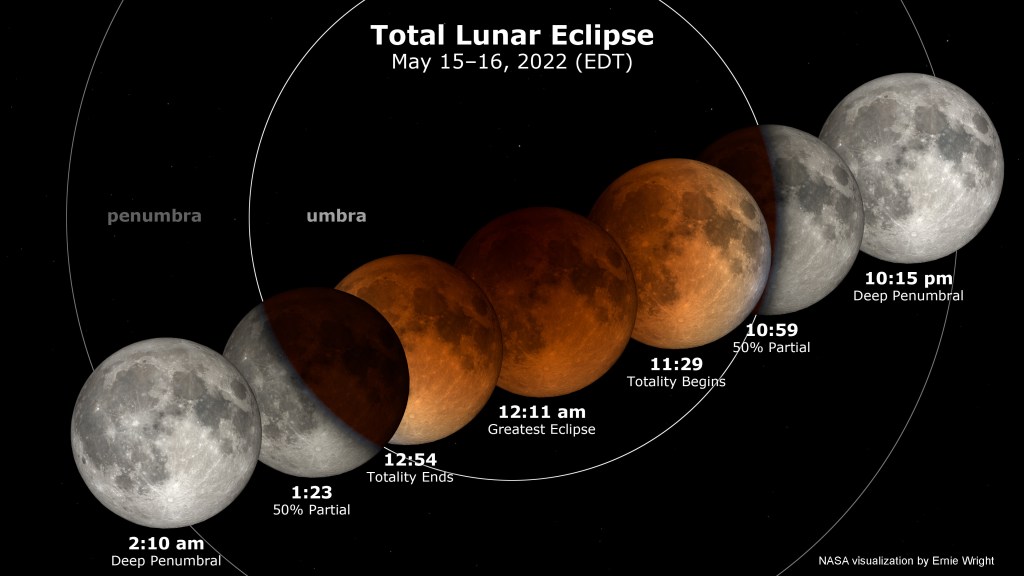
The entire eclipse sequence might be visible from my location with its peak — totality — at about midnight; not too late or too early a time for those who need sleep. Of course the big “IF” was IF the weather would allow viewing.
Lunar Eclipse Sequence. Credit: NASA
Early in the evening things looked good but forecasters called for an influx of cloud cover and, of course, just as the partial phase of the event began, clouds began to gather.
At first, the brilliant partially-eclipsed orb was easily photographed through thin overcast. The thin veil of clouds gave a mystical feel to the event. As the clouds thickened, however, the view worsened. At times, though the camera could pick it out, Moon was visible only as a smudge in the cloudy night sky.
Early in the partial eclipse period, Moon has a flat, indistinct appearance due to being in the subtle penumbral eclipse. Earth’s deep shadow crawls across the lunar disk from lower left to upper right. Photo by James Guilford.
Late in the partial eclipse, I could make out a trace of copper-red in the darkened portion of the lunar disk though that did not register with the camera.
Thickening clouds threatened to ruin the view and succeeded much of the time! Photo by James Guilford.
Just as totality was reached, Moon was covered with clouds thick enough to block the view entirely. Disappointment set in but the clouds had some streaks where a star or two could be seen.
A fingernail-thin sliver of the formerly full Moon remained marking the final portion of the partial eclipse phase. Faint red coloration was visible to the eye but, at this exposure, the camera did not record it. Photo by James Guilford.
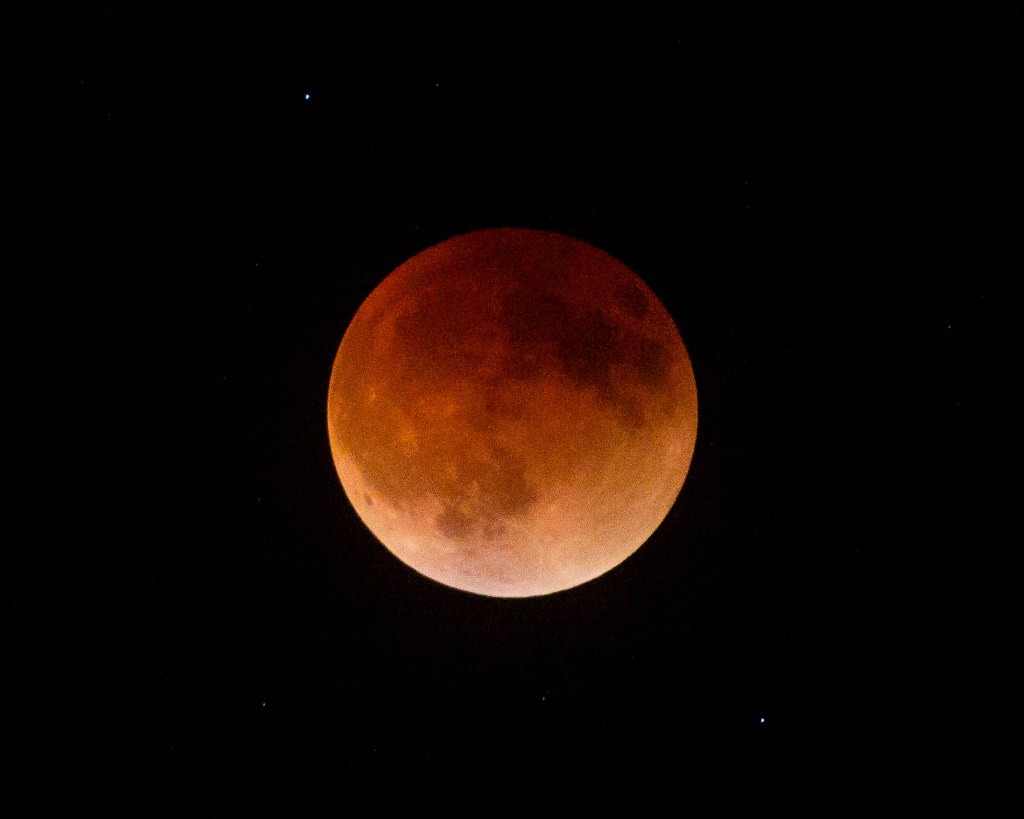
So while I missed the precise moment of peak eclipse at 12:11 a.m., EDT, I waited to see if the moving clouds would allow a peek at the still-red Moon. It happened!
Deep red and copper tones mark totality. No direct light from Sun reaches Moon during this period leaving only light scattered and filtered through Earth’s atmosphere — coloration from all of Earth’s sunrises and sunsets — to make Moon visible. The two bright dots in the blackness are stars in constellation Libra. Total Lunar Eclipse of May 15 – 16, 2022, at 12:31 a.m. EDT. Camera Info: Canon EOS 5D Mk. 4, 400mm lens, ISO 8000, f/5.6, 1/4-second. Photo by James Guilford.
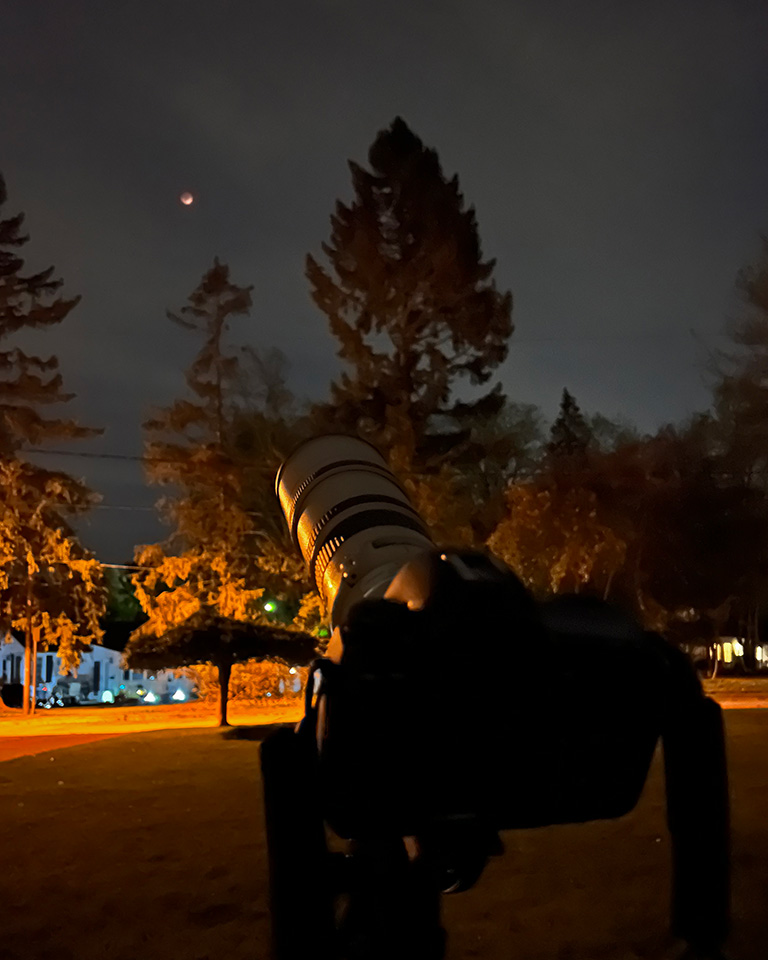
There, in a narrow slot between masses of cloud, appeared the beautiful eclipse I’d waited for in the damp chill. I got busy with my camera, stood and wondered at the sight my eyes enjoyed, took a picture of my camera setup, and after only a few wonderful minutes, heavy overcast set in — the red Moon disappeared.
Camera rig aimed at lunar eclipse. iPhone photo by James Guilford
With no visible openings in the cloud deck approaching, I packed up my gear and went indoors happy to have been able to enjoy the natural wonder.
As a postscript, I submitted an image of totality to the local newspaper and it didn’t show up there. Okay, maybe not something they wanted. A couple of days later, too late to I checked my email spam folder and, to my dismay, the newspaper editor wrote that he wanted to use the photo but at higher resolution.
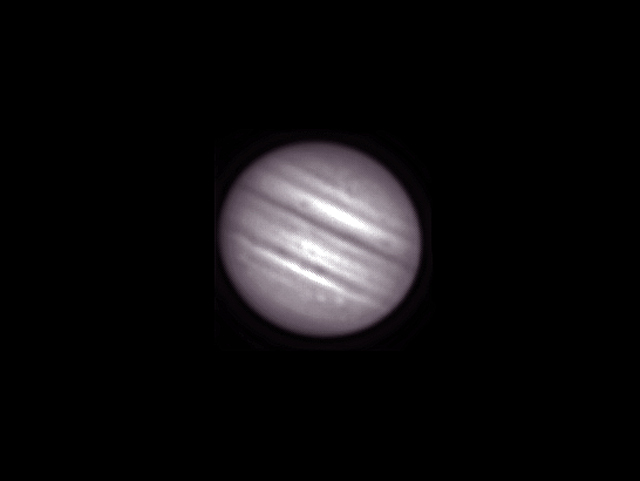
Planet Jupiter from a September 10 astrophotography effort. Several cloud bands and atmospheric disruptions, as well as the planet’s oblate spheroid shape can be seen despite the overall softness of the picture. From a stack of monochrome images, color added during editing.
Okay, I know this is ugly — a not-very-good image of planet Jupiter. I know, and yet I’m posting this because this humble effort is the best I’ve done thus far in my beginning planetary imaging efforts. I made a stack of images around 11:11 p.m., Friday, Sept. 10. Conditions were difficult with breezes, and high altitude haze and I found achieving good focus was hard. Maybe an electric micro focus would help? A longer native focal length telescope would also help by producing a bigger image on the camera’s sensor!
On the “up” side, even this crude attempt shows several of the planet’s cloud belts, even hints at major atmospheric disruptions; that makes me happy, or at least happier. Lost in processing were nearby Galilean Moons Io and Europa which would have appeared just to the right of Jupiter’s disk. My previous planetary effort was Mars one year ago! Between the sky conditions (rarely good, it seems), and my nighttime motivation, I sadly don’t get much practice.
To produce the image I used my Vixen 8-inch Cassegrain 1,800mm FL telescope (love the scope but need more focal length), ZWI ASI178MC planetary camera, Lynkeos Stacker processing software which is a native MacOS application. I shut down a bit after midnight Friday night and hoped for clear skies Saturday night — I wanted to try again and try a a piggybacked shot using my DSLR and telephoto lens, getting Jupiter and his family of moons. Alas, no. Clouds and smoke from western U.S. fires plus continued breezes played havoc with the sky. So I tore down the rig and stowed everything hoping good conditions come soon.
Purity and Pollution. Comet C/2020 F3 (NEOWISE) floats serenely above clouds illuminated by ground-level light pollution.
Comet C/2020 F3 (NEOWISE) was, for us in North America, a predawn object requiring exceptional dedication for observing. See a previous post. In the second week of July, the comet had moved enough in its orbit to become visible in the evening sky — from late twilight to about 11 p.m. Unfortunately, cloudy nights have been the rule lately so opportunities have been few.
On Wednesday night, July 15, the sky forecast was a bit shaky but it turned out the sky cleared enough to allow C/2020 F3 to be seen. I raced off to an observing site some 25 minutes away from home, popular with sunset watchers and, occasionally, comet spotters. Arriving at the site I found the place mobbed, the parking lot nearly full, by scores of would-be comet viewers. Unfortunately, the comet was pretty much at the low end of naked-eye visibility. Light pollution reduced contrast between comet and background sky to make the object nearly invisible. It’s likely most of those in attendance never saw the comet.
Binoculars quickly revealed “NEOWISE,” and a reference exposure I made of the area I expected to find the comet showed I was on target. I shot a number of photos but had problems with focus using the 400mm telephoto; I’m not happy with my “closeups.” As with my predawn photo experience, I found a wider view was much more interesting anyway and that’s what I’ve posted here.
Entitled “Purity and Pollution,” this picture (a single exposure of 8 seconds) shows a pristine wonder of the night sky floating serenely amongst the stars, clouds glowing brightly below illuminated by artificial light pollution. If we were only more careful with our artificial light, we’d save gobs of energy and gain back our starry skies as a bonus!
C/2020 F3 (NEOWISE) will be gracing our skies for the next week or so and I hope to have more than one opportunity to record the event before it is gone. The next apparition of this comet is expected in about 6,800 years.
November: Looking East. This is a view of the sky from our back yard. That little smudge just below and left of center is the Pleiades star cluster.
After months of searching and work (a story unto itself) we located and purchased an older ranch-style house on a large lot in Medina, Ohio. We had been living in the house for one week and I decided it was high time I take a look at the night sky! The weather was clear and cold Friday night — about 40 degrees when I ventured outdoors — so I had a look around.
The house is situated one mile from the old town square of this small city on a street lit by two orange, low-pressure sodium lights. A big-box shopping district is located about two miles north of the house with a neighboring city beyond. There’s plenty of light pollution and, to the unaided eye, the clear night sky is gray. I could make out the brightest stars of some constellations, however, and easily spotted the Pleiades star cluster rising in the east. I believe I also made out a wisp of Milky Way, as well! I set up my camera on its tripod and did some test shots to assess the photographic sky.
Stars Struggle to be Seen. Regional light pollution drowns out most of the night sky’s glory.
As you can see by the photos here, the camera easily detects stars we can’t visually pull out of the urban nighttime glow. As expected, more stars can be seen overhead — through less atmosphere and less illumination — than near the horizons. While this isn’t a very good spot for astronomy, it’s not impossible. And while the nighttime conditions may not support stargazing, they do offer some artistic potential.
Firetree. Light-polluted night sky, a neighbor’s bonfire, and a small pond combine to make a pretty scene with a touch of mystery. You work with what you’ve got! Photo by James Guilford.
The Moon: Mare Serenitatis (left) and Mare Iridium (right)
I can’t say as I blame them, the people who didn’t show for our observatory open night Saturday. After all, the temperature was about 19 degrees (F), damned cold! But the sky was clear and the waxing Moon was high in the sky. Both Moon and Jupiter were sharing constellation Cancer with The Beehive star cluster (M44). Still, those sensible people who stayed home and warm missed a glorious view of old Luna, especially half-lit Mare Iridium — the Sea of Rainbows. In my idle time waiting for visitors, I tried out a little afocal astrophotography using the observatory’s 9-inch Warner and Swasey telescope (ca. 1901) and my little Samsung Galaxy Camera 2 all-in-one. Most shots were a little shy of sharp, and all had some degree of chromatic aberration, and all had a big chunk of image missing where our century-old star diagonal is missing a bit of glass. One shot, however, did work out well, especially after a little fix-up including conversion to monochrome to eliminate color fringing. Not long after our seven brave visitors left, I caught sight of the indistinct reappearance of Jupiter’s Great Red Spot and that was it… time to close up and go home. My toes needed to be thawed.
Sunspots, including the group AR1476, blemish the face of the Sun.
Sunday, May 13 dawned reasonably clear and so, with cloudy skies anticipated, a few rushed photographic observations were made of our Sun. I had to fit that in before visiting Mom for Mother’s Day! Active Region1476 (a huge sunspot group) continued to dominate the solar disk though it had been joined by several smaller but notable sunspots blemishing old Sol’s face. Also visible in this photo are granulation and other disturbances — the chromospheric network — in the solar atmosphere. Notes on the photo, the best image I’ve done of the Sun so far: Canon EOS 50D, ISO 400, f/8, 1/1,250 sec., 400mm Canon telephoto, AstroZap white light film solar filter, May 13, 2012 at 9:15 AM. The sky was reasonably clear though this image was captured through a thin cloud, the remains of an aircraft’s vapor trail.








 PhotonStopper