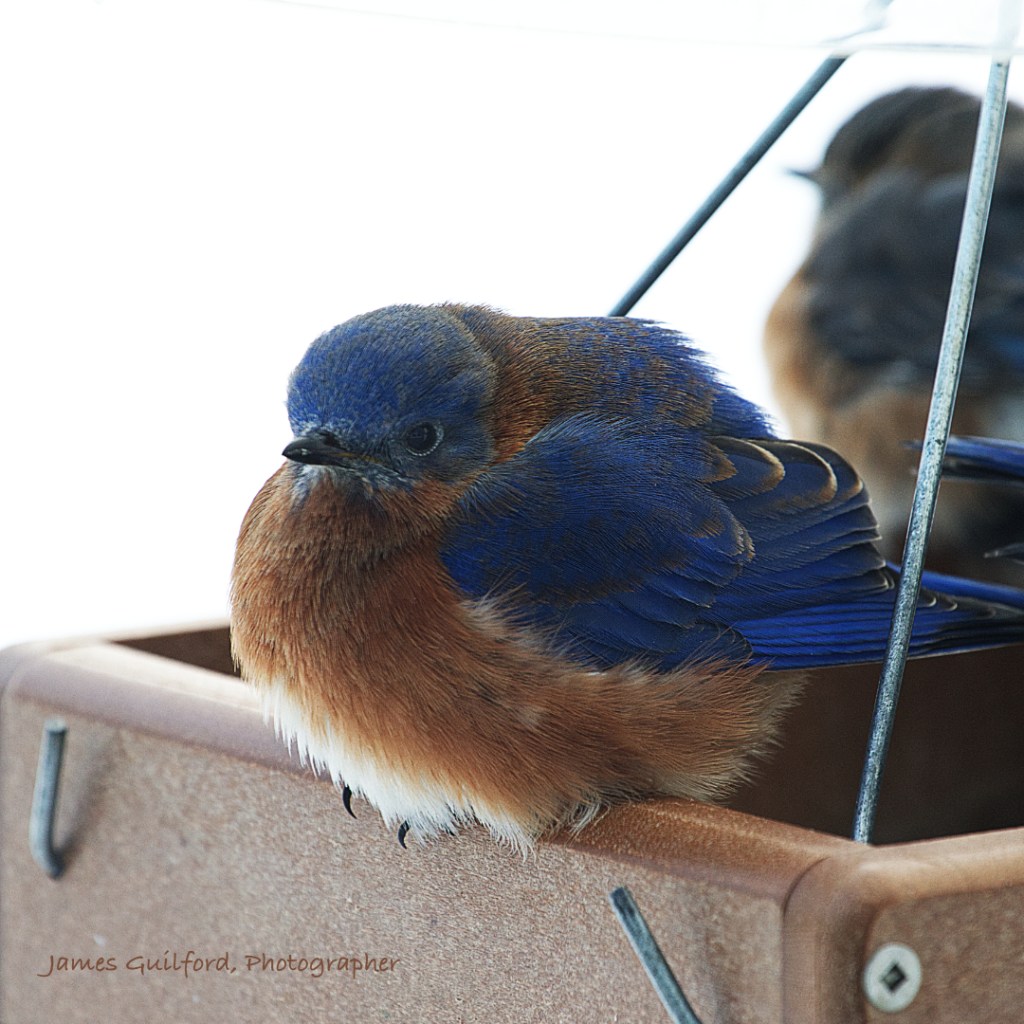
A group of Eastern Bluebirds perch along the edges of a box-shaped platform feeder enjoying the spread. Accumulated snow sits atop the plastic rain dome from which the feeder hangs. Photo by James Guilford.
Winter has been very cold, lately, with enduring snow cover. In these conditions we enjoy helping out the local birds. In the last couple of years we’ve seen a growing year ’round presence of Eastern Bluebirds both at our feeders and around the property. Today four to five of the little beauties showed up at the tray feeder — by coloration, all boys — enjoying the spread. As they busily picked away at the seeds the view was often blue bird butts. Sill in all, a welcome break from February’s shades of gray.
A Cooper’s Hawk perches on a tree branch, its eyes trained on nearby bird feeding stations. Heavy snow swirls around, as if in a snow globe. — Photo by James Guilford.
Early January and heavy snow was falling. Local birds were flocking to our bird feeders. Suddenly, the small birds disappeared. The local Cooper’s Hawk had showed up for lunch and our smaller feathered friends did not want to be lunch. Snow and blowing snow came and went as the raptor sat, observing from a tree branch. Sometimes the hawk could be seen clearly, sometimes snow completely hid it. The hawk watched for a while but, seeing no potential prey, flew off to hunt elsewhere.
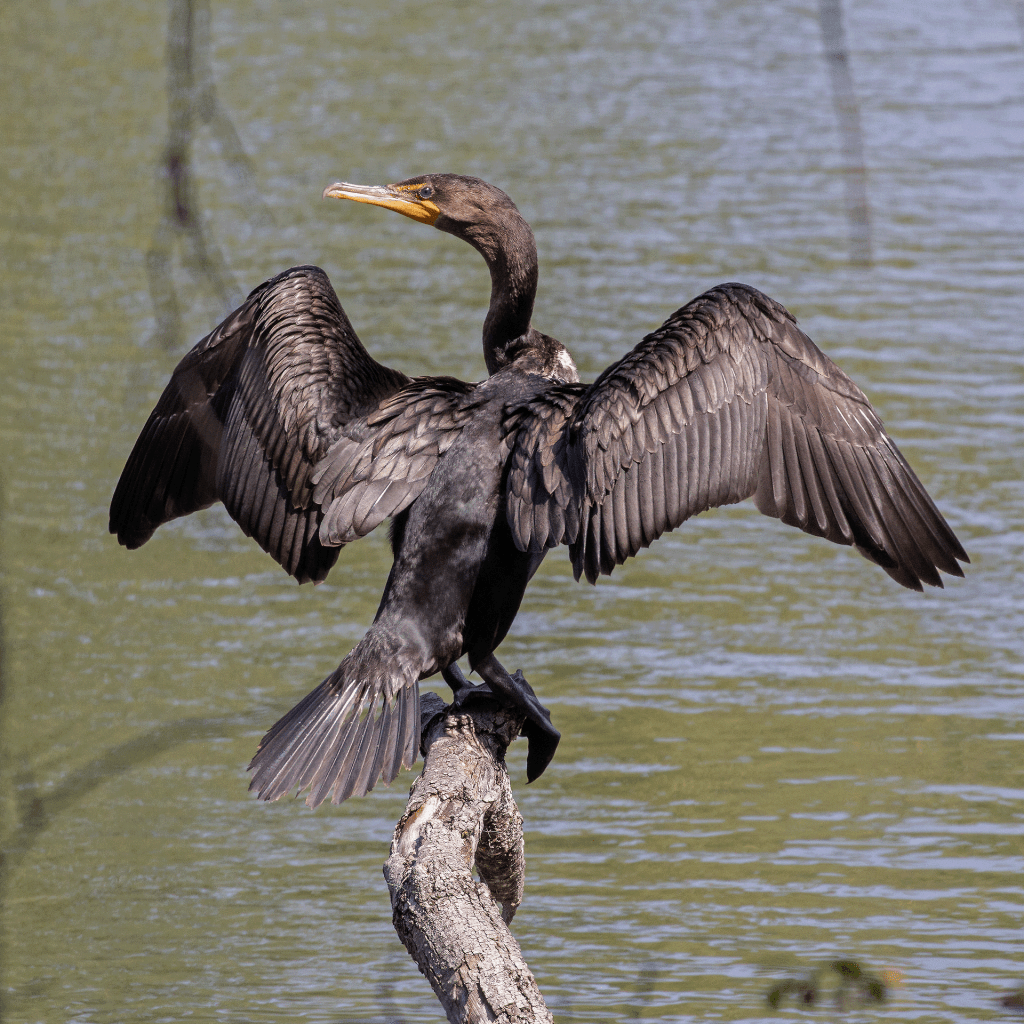
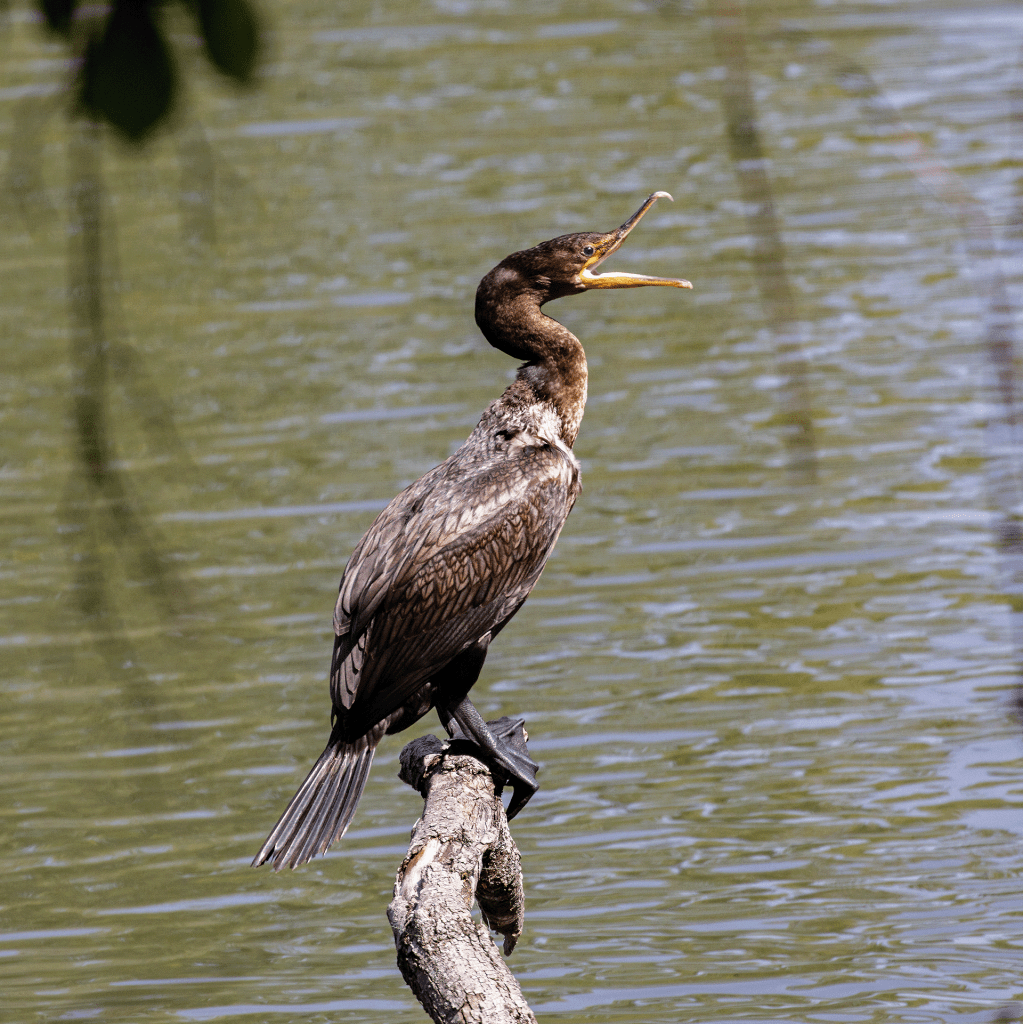
Recently I thought I’d caught glimpses of a cormorant flying over the far side of our pond but I couldn’t be quite sure. Yesterday, I noticed a large bird perched over the water on a fallen tree branch and there it was — a double crested cormorant! Not an uncommon bird but this is the first I’ve seen one here. The bird spent most of the day on that branch basking in the sun, looking around, occasionally swimming, mostly just hanging out. I haven’t seen it today.
A pair of male Lesser Scaups swim on wind-riled pond waters.
Our annual visitation by migrating waterfowl was special this time: two pairs of “odd ducks”. The first photo shows what I believe are two male Lesser Scaups. The second shot is of a male and a female Bufflehead — the male is mostly white and has iridescent head feathers. All four are likely resting up on their way to their summer ranges in Canada. Safe travels, feathered friends!
A male and female Bufflehead. The male (L) is mostly white with head feathers that are iridescent showing purple and green coloration.
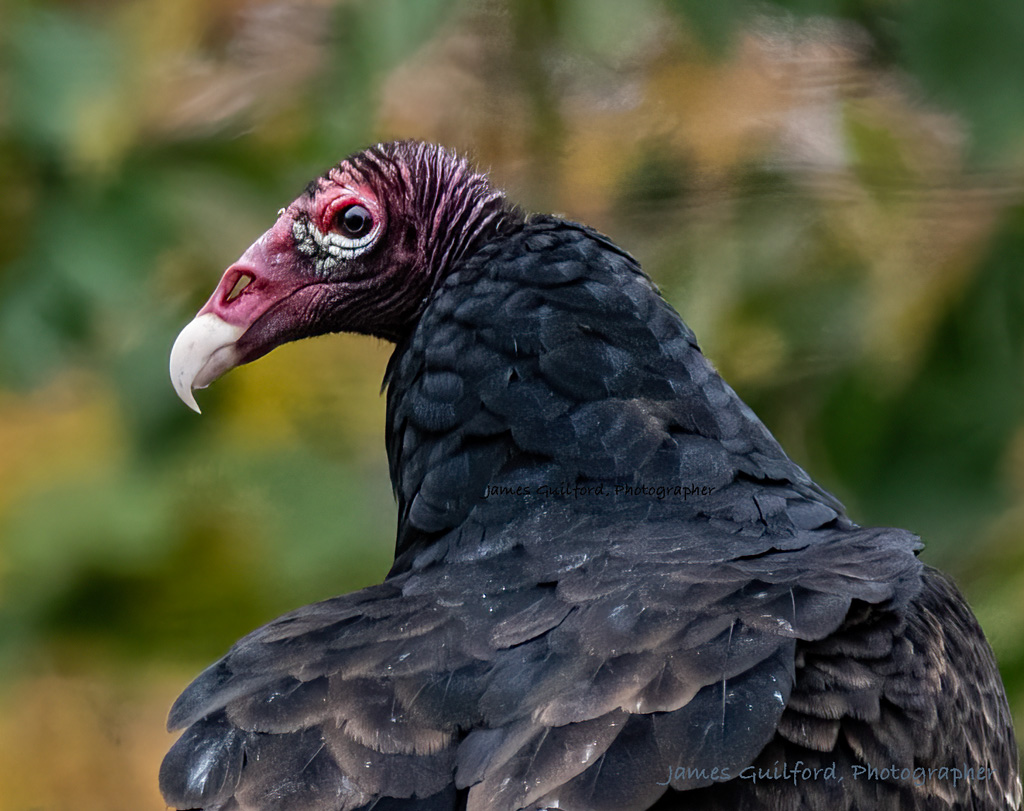
A close-up view of one of the day’s Turkey Vultures, commonly called buzzards. Note the see-through nostril opening in its beak. It is said that the opening allows the bird to clear out any materials that may gather there when it feeds by inserting its head into an animal carcass. Photo by James Guilford.
With fascination and puzzlement we watched a number of Turkey Vultures (Cathartes aura) aka “buzzards” zooming low over the house and in and out of our bare-limbed, backyard trees. From the trees they dropped down into the gully behind our house. What drew their interest? I don’t know. During a pause in their activity, I went out to peek into the area they were visiting, I was expecting to find a dead deer or other animal they’d been scavenging. I saw nothing. Still, they returned and stayed at least into dusk. The big birds (six-foot average wingspan) returned today but seemed content to remain perched ominously in the tree; at one point there were *13*. Happy Halloween, I guess!
A group of vultures in flight is called a “kettle”, a group of vultures that is feeding is referred to as a “wake”, while a group of vultures on the ground or in trees is called a “committee”
A turkey vulture begins spreading its enormous wings — averaging a span of six feet — as it prepares to take flight from a rooftop. Note the light-colored feathers on the underside of its wing, an identifier to look for when watching these magnificent flyers soar. Photo by James Guilford.
After a long absence, we returned to Sandy Ridge Reservation, a notable area for birders in the Lorain Metro Parks System, and were richly rewarded. We spotted and watched a Sand Hill Crane family as they explored the waters’ edge for food: the impressive adults escorted their colt (that’s what the young are called) watching humans watching them from the nearby path. The colt was allowed to explore a bit on its own but the mated pair were never far away. It was thrilling to see the family and a first for me; a wonderful surprise.
As we watched the Sandhill Cranes, Great Egrets, and dragonflies, an American Bald Eagle soared overhead. We could not see the eagle’s nest but behavior told us it was on hunting flights, probably feeding its young in the hidden nest.
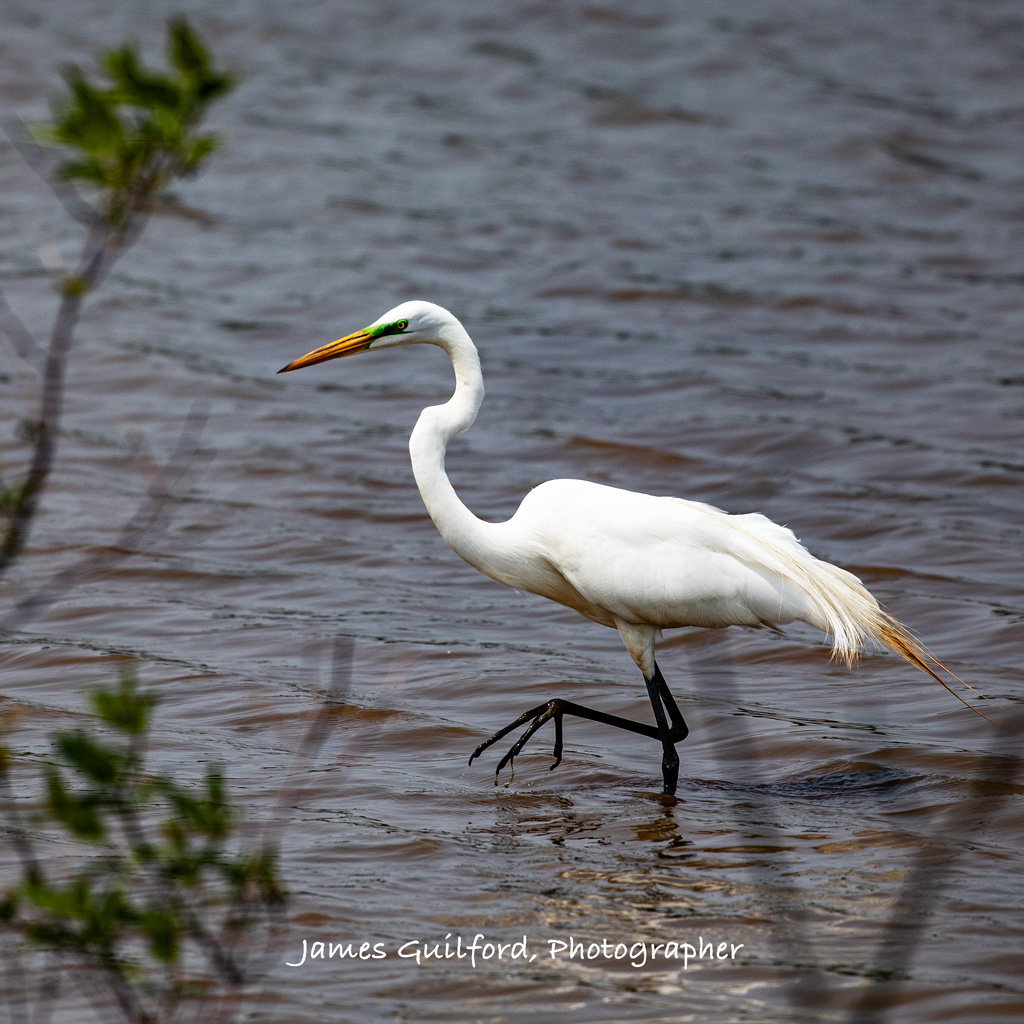
A Sandhill Crane colt combs the wetlands for food with one of its parents.A Common Green Darner (Anax junius) in flightBig Foot: This Great Egret was wading the shallow waters of the wetland searching for food, the vivid green patch marking at the base of its beak was particularly striking. Caught mid-stride in this photo, the span of the bird’s toes on its raised foot is impressive!
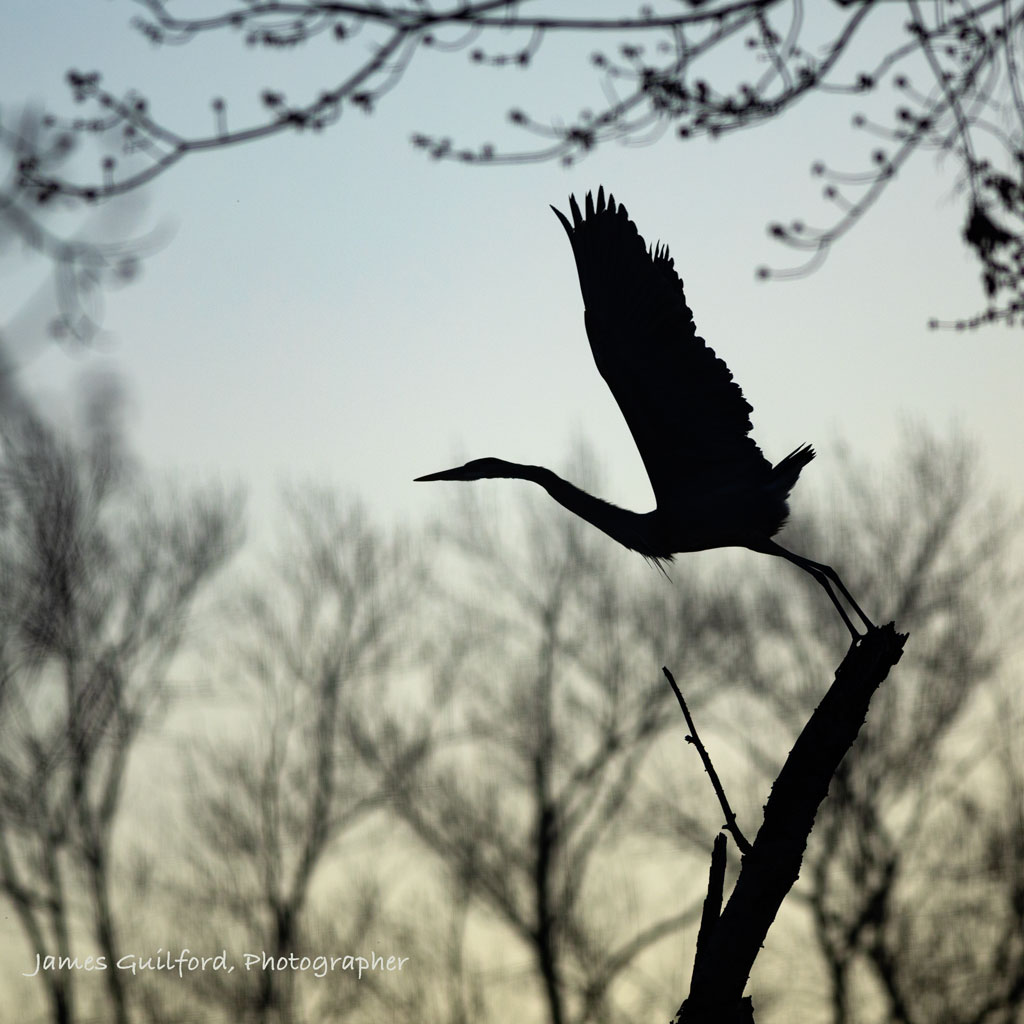
After a stormy night, it was a welcome surprise to look out the window and see the silhouette of a Great Blue Heron against a clear twilight sky! I watched the heron as it sat quietly for a long time at the top of a dead tree’s trunk, the lovely curvature of its long neck and smooth body evoking thoughts of Asian art. Finally the bird pulled back, lunged forward, and sprang into flight. A fine way to start the day and a new month.