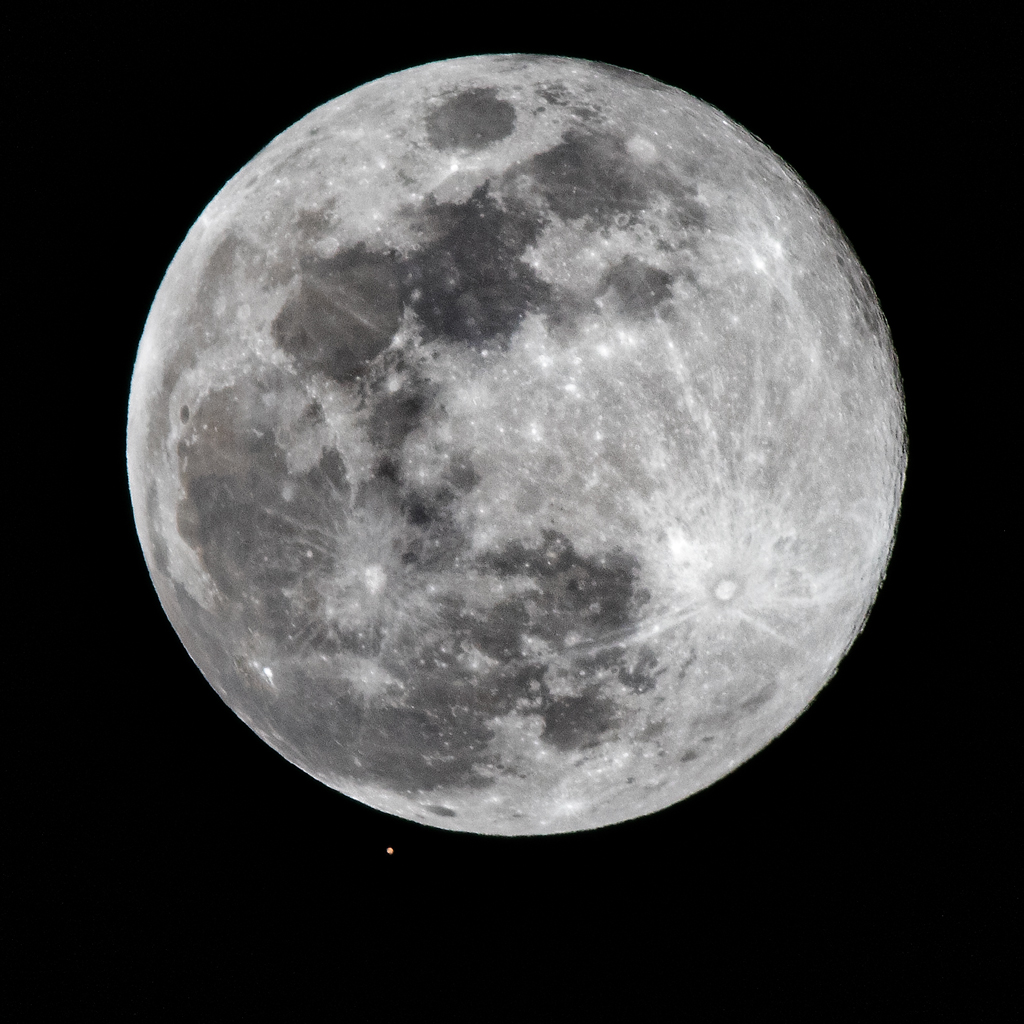
Only a few minutes from occultation, Mars is seen just off the lower edge of the lunar limb in this full-disk image recorded at 9:09 PM EST. The event only occurs with planet Mars about once every 14 years. Photo by James Guilford.
Passing clouds threatened to obscure the 2025 lunar occultation of Mars but thanks to gaps between those clouds, there was enough clearing for observation. Shortly after Mars vanished, so did those inter-cloud gaps. With Moon now cloud-covered, I did not return to the 13℉ night to watch for Mars to emerge.
A dull, ghostly lump is all that’s left as Mars disappears behind Earth’s Moon at 9:12 PM EST, January 13, 2025. Lunar basin Grimaldi is the dark oval just to the right of where Mars is seen here. Photo by James Guilford.
Clouds move across the face of the moon, two minutes ahead of maximum eclipse, lending color and mystery to the scene.
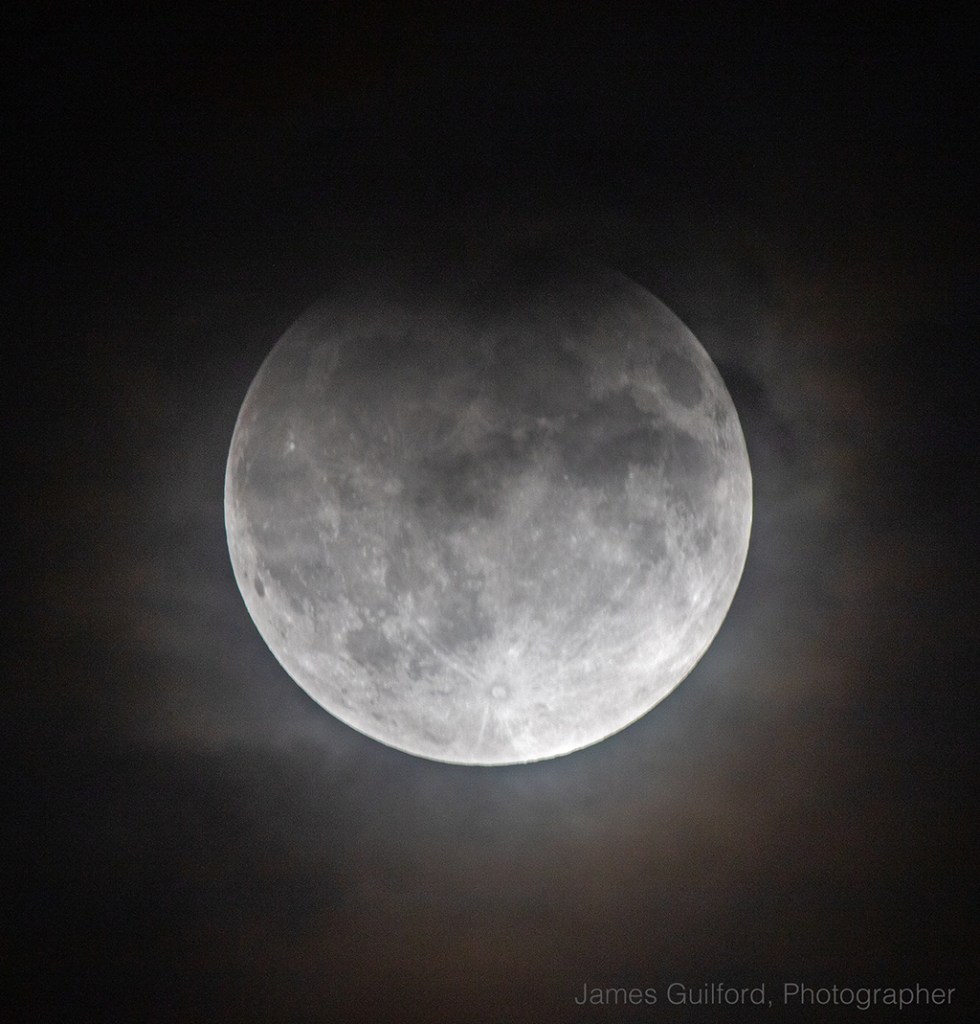
Tuesday, September 17 brought the opportunity to see a partial lunar eclipse without staying up all night. That’s the sort I call a prime-time event. The skies were partly to mostly cloudy through the evening but, as the time for maximum eclipse approached, breaks were appearing in the cloud cover. I set up my camera and tripod and, with about 15 minutes’ lead time, headed out to the patio. I made a few test shots using the Canon EOS 7D Mk. 2 camera, and then a few more to keep. One shot was made at 10:44 PM EDT simply to record maximum. My favorite images, and by-eye views for that matter, were of Moon as thin clouds passed across and near the glowing orb, lending color and mystery to the scene.
Partial lunar eclipse at maximum, September 17, 2024, at 10:44 PM Eastern Daylight Time, by James Guilford, Photographer.
That same night I made a copy of my “maximum eclipse” digital image and sent it off to the local newspaper. Too late for the next day’s edition, my photo showed up today (Thursday), not only on Page 1 but at three columns, huge! The paper’s rendering of the image lost a bit in the translation but still represented what was seen.
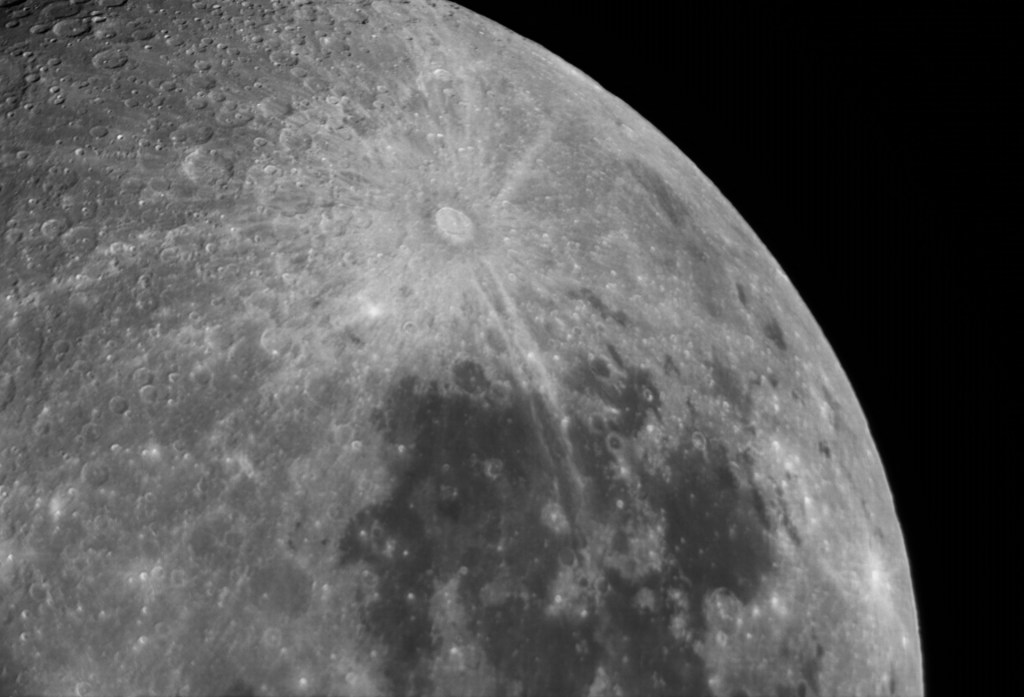
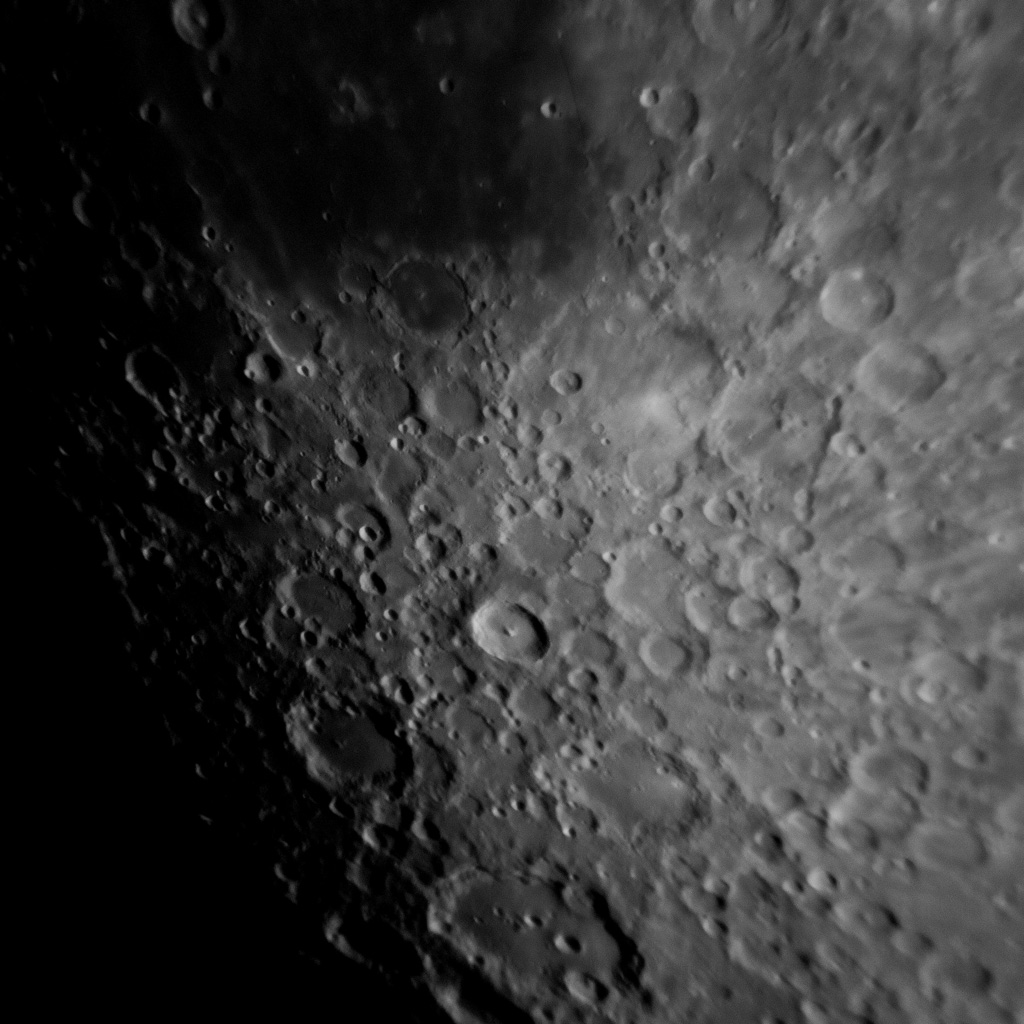
Crater Tycho is featured in this image, it’s ejecta rays fanning out across the lunar surface in all directions. Celestron C11 telescope with ZWO ASI 294MC Pro camera.
Taking advantage of what seem to be rare clear skies, last night (September 1, 2023) I ran first light trials on the Celestron C11 I was given, in combination with my ZWO ASI color astronomy camera. The results were largely disappointing with no good deep sky results, terrible results from Saturn, and not-so-good images of Jupiter. Even Earth’s Moon, usually an easy target, was barely in focus. I hope to try again this coming week when mild, clear nights are forecast.
On the positive side, polar alignment was excellent as was goto control alignment so telescope sky tracking was very good during my efforts — until something caused an unexpected reboot of the telescope controller. I don’t know if dew short circuited a connector or if something pulled loose from the hand control but it was disconcerting!
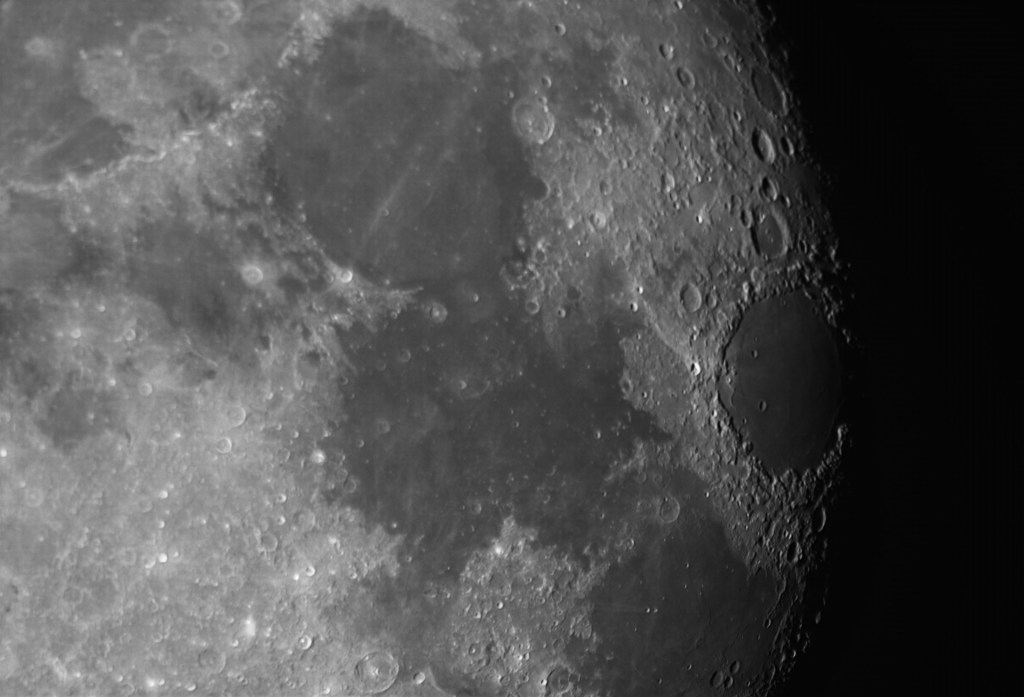
The images shown here are simply interesting to look at, though not the quality I’d normally want to show. The first is youngish Crater Tycho showing off its extensive web of ejecta rays. The second picture includes several lunar “seas” including the “C” shaped Sea of Crisis. Two craters are seen near the left edge of the circle; the lower of those craters is named Picard. No, Star Trekkers, not THAT Picard. Still, a fun fact.
Several lunar seas are visible in this image with the Sea of Crisis (C-shaped) at the right side of the picture. Crater Picard is the tiny lower circle in the dark floor of the Sea of Crisis. Celestron C11 telescope with ZWO ASI 294MC Camera.
Taking advantage of a string of “clear” rainless nights and days, I’ve been learning by doing. My first objective was to image the supernova that was discovered recently in Messier 101 — The “Pinwheel Galaxy”. The object has a low surface brightness and, in our light-polluted suburban skies (Bortle 6/7) made worse by Canadian forest fire smoke, it’s invisible to me by eye and a very challenging target for imaging. Add to that the steep learning curve I’m on using an astronomy camera instead of a DSLR and, well, let’s just say results were disappointing. So I turned to the waxing Gibbous Moon last night and got some experience and passable results. This same Moon, as its phase grows toward Full, is making the sky brighter nightly. At the same time the supernova is believed to be fading now.
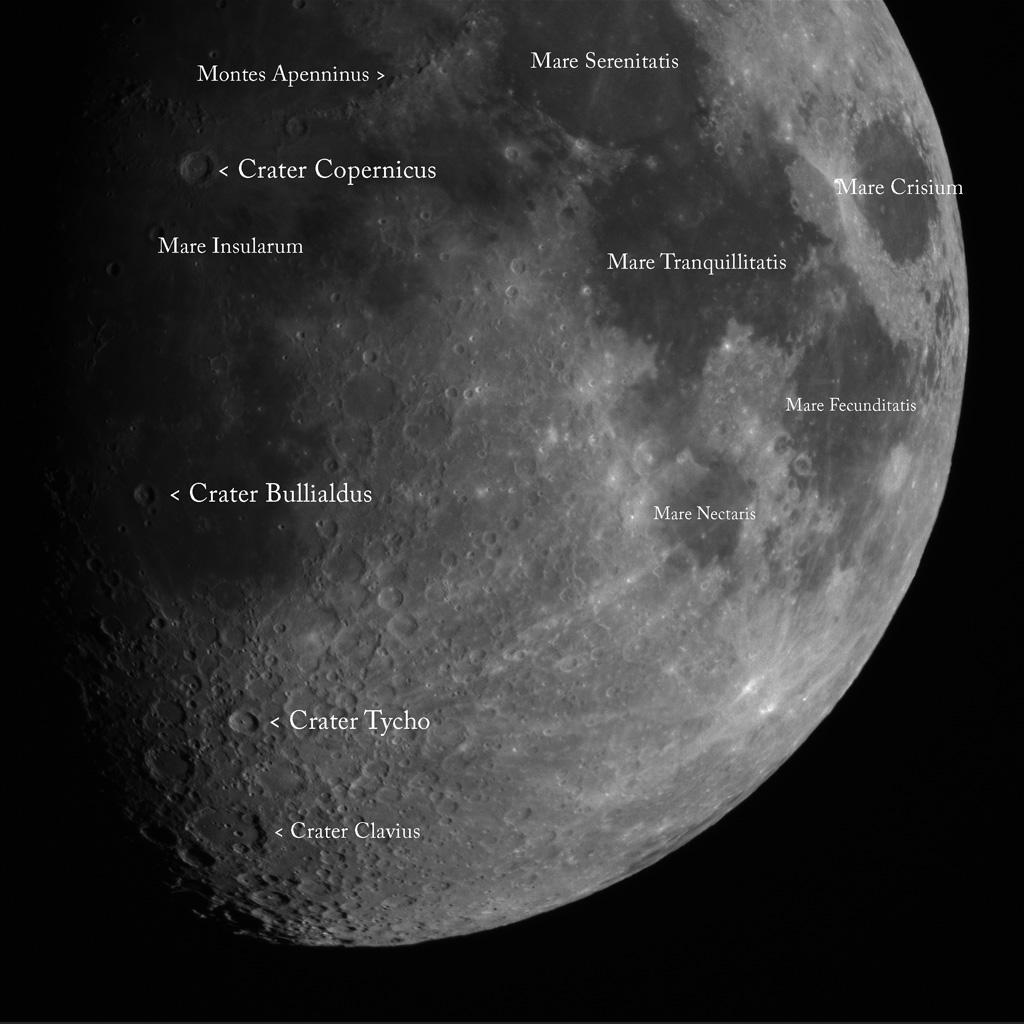
A portion of the 10-day-old, waxing Gibbous Moon as viewed from Medina, Ohio, USA the night of May 29, 2023. Crater Tycho is prominent among a heavily pockmarked area in the lower left of this image.The same lunar image as above but with some major featured labeled.
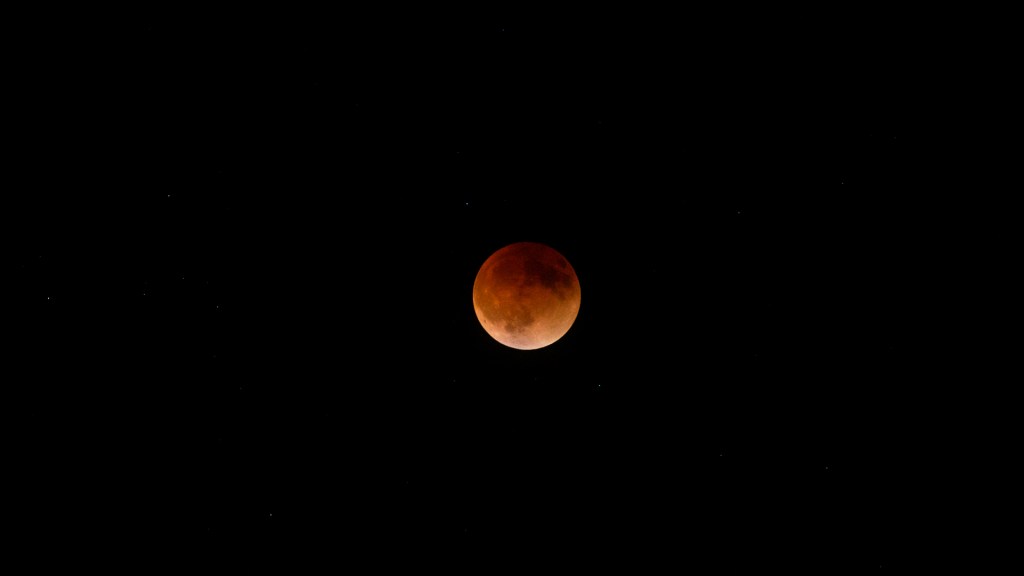
Total Lunar Eclipse of May 15 – 16, 2022, at 12:30 a.m., EDT. Some viewers may be able to see several white spots in the dark space around Moon — stars within the constellation Libra — better visible in the original photograph. Photo by James Guilford
It looked like a great opportunity to see and photograph a total eclipse of the Moon! Too often, it seems, lunar eclipses have been either just starting or in progress at moonset or sunrise, either curtailing what might be seen. The May 15 – 16 lunar eclipse was an exception.
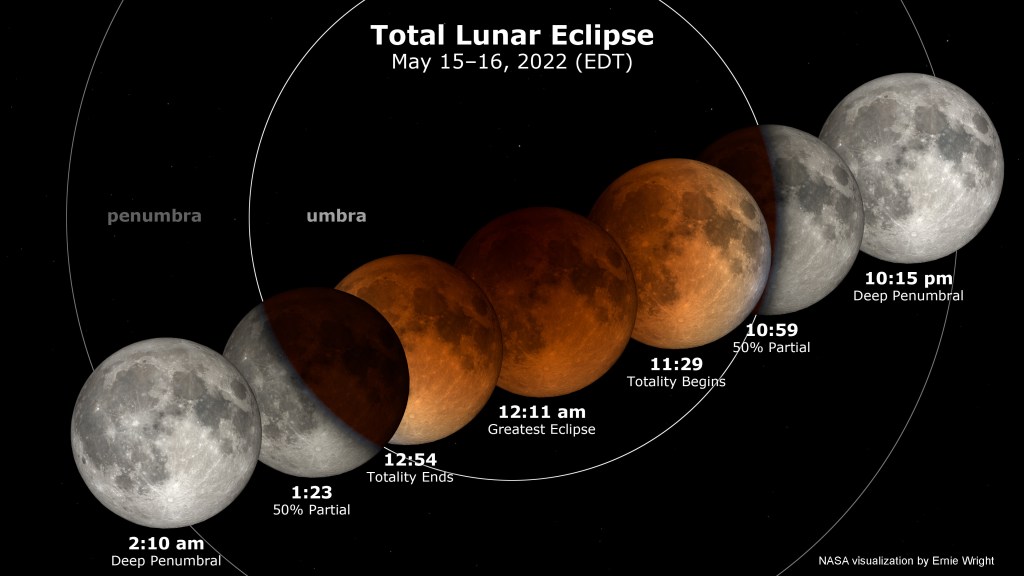
The entire eclipse sequence might be visible from my location with its peak — totality — at about midnight; not too late or too early a time for those who need sleep. Of course the big “IF” was IF the weather would allow viewing.
Lunar Eclipse Sequence. Credit: NASA
Early in the evening things looked good but forecasters called for an influx of cloud cover and, of course, just as the partial phase of the event began, clouds began to gather.
At first, the brilliant partially-eclipsed orb was easily photographed through thin overcast. The thin veil of clouds gave a mystical feel to the event. As the clouds thickened, however, the view worsened. At times, though the camera could pick it out, Moon was visible only as a smudge in the cloudy night sky.
Early in the partial eclipse period, Moon has a flat, indistinct appearance due to being in the subtle penumbral eclipse. Earth’s deep shadow crawls across the lunar disk from lower left to upper right. Photo by James Guilford.
Late in the partial eclipse, I could make out a trace of copper-red in the darkened portion of the lunar disk though that did not register with the camera.
Thickening clouds threatened to ruin the view and succeeded much of the time! Photo by James Guilford.
Just as totality was reached, Moon was covered with clouds thick enough to block the view entirely. Disappointment set in but the clouds had some streaks where a star or two could be seen.
A fingernail-thin sliver of the formerly full Moon remained marking the final portion of the partial eclipse phase. Faint red coloration was visible to the eye but, at this exposure, the camera did not record it. Photo by James Guilford.
So while I missed the precise moment of peak eclipse at 12:11 a.m., EDT, I waited to see if the moving clouds would allow a peek at the still-red Moon. It happened!
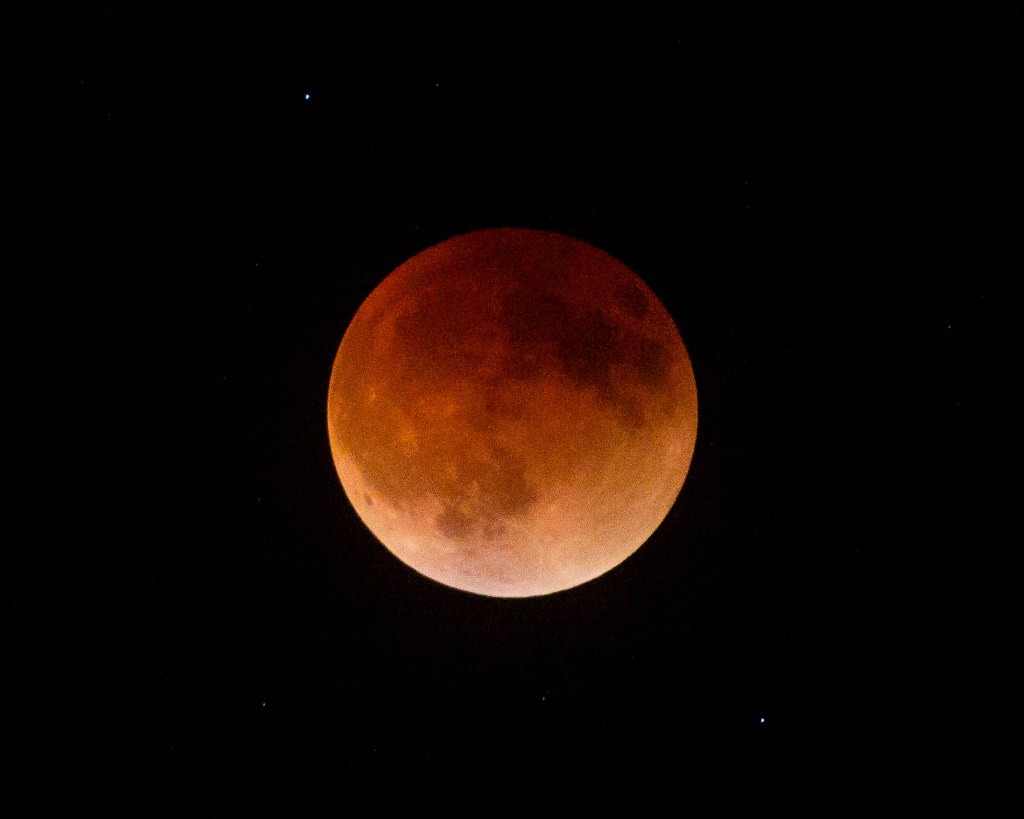
Deep red and copper tones mark totality. No direct light from Sun reaches Moon during this period leaving only light scattered and filtered through Earth’s atmosphere — coloration from all of Earth’s sunrises and sunsets — to make Moon visible. The two bright dots in the blackness are stars in constellation Libra. Total Lunar Eclipse of May 15 – 16, 2022, at 12:31 a.m. EDT. Camera Info: Canon EOS 5D Mk. 4, 400mm lens, ISO 8000, f/5.6, 1/4-second. Photo by James Guilford.
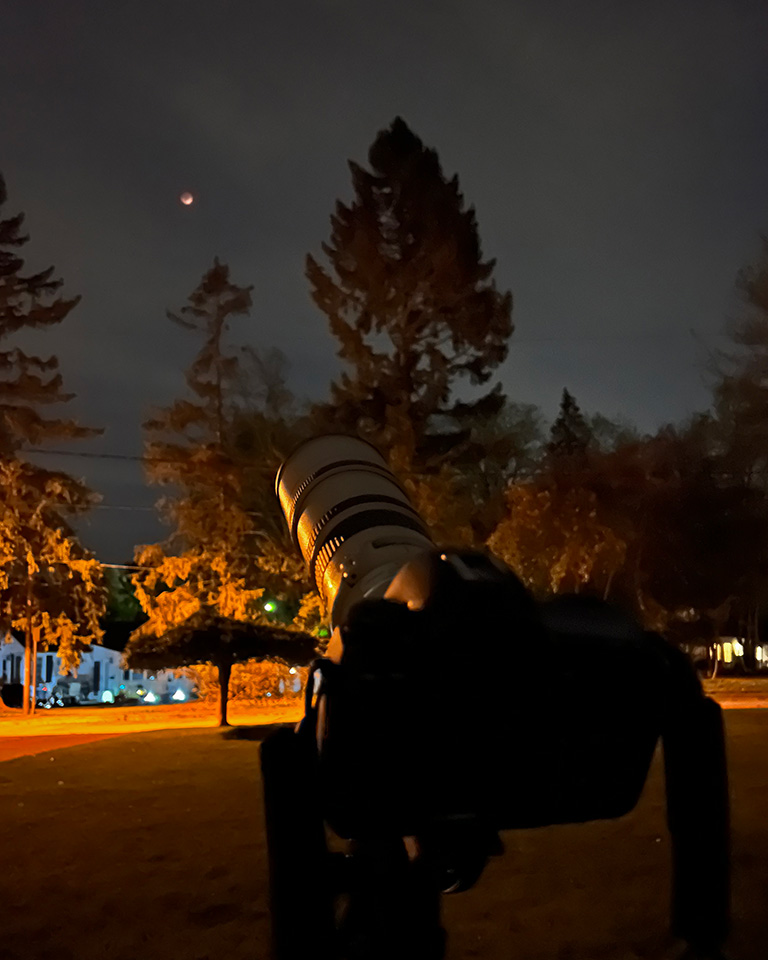
There, in a narrow slot between masses of cloud, appeared the beautiful eclipse I’d waited for in the damp chill. I got busy with my camera, stood and wondered at the sight my eyes enjoyed, took a picture of my camera setup, and after only a few wonderful minutes, heavy overcast set in — the red Moon disappeared.
Camera rig aimed at lunar eclipse. iPhone photo by James Guilford
With no visible openings in the cloud deck approaching, I packed up my gear and went indoors happy to have been able to enjoy the natural wonder.
As a postscript, I submitted an image of totality to the local newspaper and it didn’t show up there. Okay, maybe not something they wanted. A couple of days later, too late to I checked my email spam folder and, to my dismay, the newspaper editor wrote that he wanted to use the photo but at higher resolution.
Though high in July 19th’s sky, our waxing Gibbous Moon was decidedly orange. Smoke, high in the atmosphere from North American wildfires, tinted what should have been a bright white Moon in the colors of moonset. Ruddy or not, I love that we can see mountain peaks and crater edges peeking up from the darkness just left of the sunlight terminator line. A friend commented on the sunrise-illuminated mountain peaks, “Mons Pico at 8,000 feet and Mons Piton at 7,500 feet are two solitary mountain peaks sticking up out of the lava plain in the northeast corner of Mare Imbrium.“
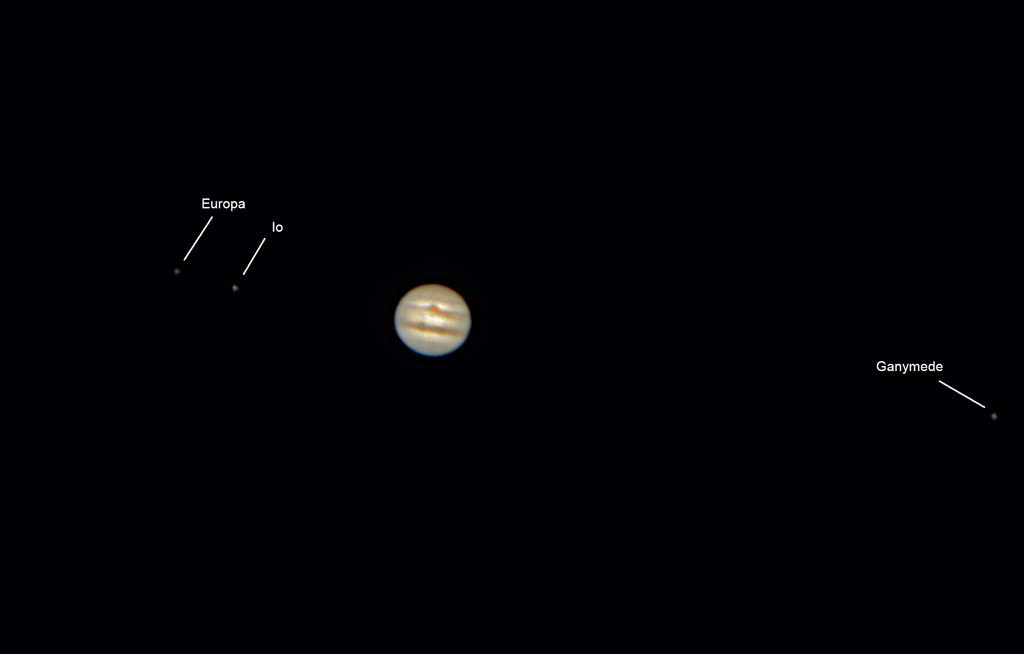
Planet Jupiter and three of the four Galilean Moons are shown here, as imaged in the early morning hours of July 5, 2020. First Light for a new astronomical camera. And early efforts on new approaches to astrophotography for me.
I purchased a modest dedicated astronomical camera (ZWO-ASI178MC) recently, mostly for eventual autoguiding of my telescope during long-exposure imaging. The ZWO is described as a “planetary camera” so I thought why not? With Jupiter and Saturn near opposition and in good viewing position, let’s get first light tests using those beauties?
The penumbral eclipse of July 4- 5, 2020 was barely noticeable, even via telescope. The Full Moon, however, was impressive. Photo by James Guilford.
July 4 – 5 was the night of the very weak penumbral lunar eclipse and everything was set up in my yard for that. I had also made significant progress getting the new computerized telescope mount functional. Using SkyWatcher’s Wi-Fi module and my iPhone, helped immensely, providing precise GPS location and time information to the mount. Finder scope alignment helped, too!
So after finishing with the Full Moon and removing the DSLR camera from the telescope, I installed the little ZWO.
Planet Saturn shown here, as imaged in the early morning hours of July 5, 2020. First Light for a new astronomical camera. And early efforts on new approaches to astrophotography for me.
The camera worked well and I was quickly able to record images of Jupiter and Saturn. As a bonus, Jupiter’s Great Red Spot happened to be on the Earth-facing side of the planet. As for Saturn, I could see the image swimming on the computer screen so I didn’t expect much and didn’t get much. You can tell it’s Saturn and even begin to see some atmospheric banding.
Backyard telescope setup for the July 2020 penumbral lunar eclipse and later planetary imaging. This is an iPhone photo shot by the light of the Full Moon.
I still have much to learn about operating the camera control software and post-processing. As crude as the resulting images are, for first efforts the results are encouraging.
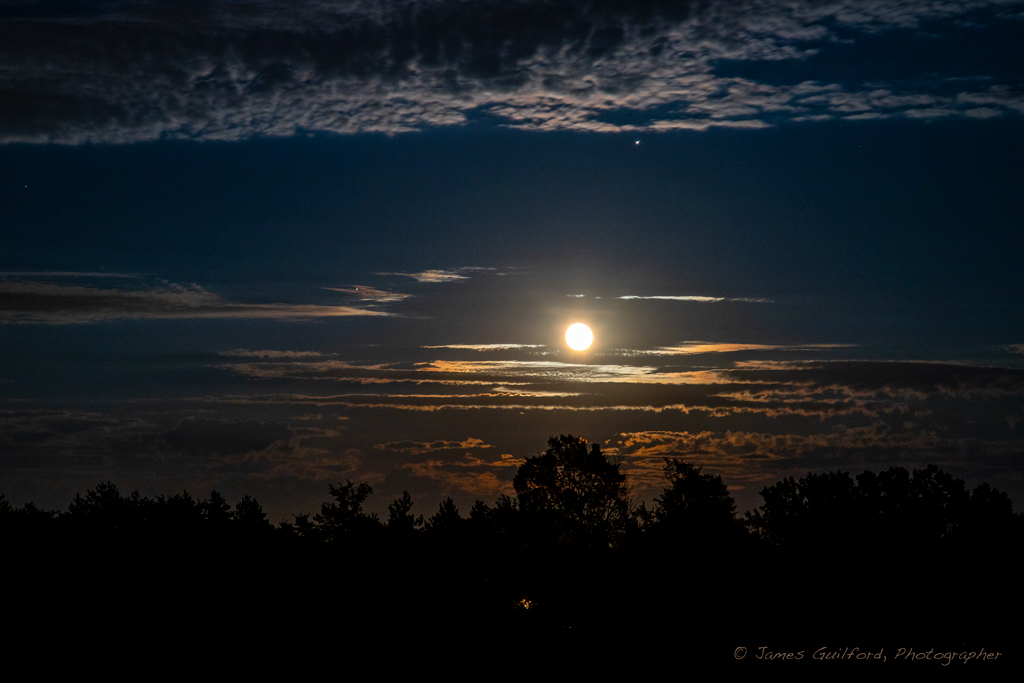
The night of July 5, 2020 brought Earth’s Moon, and planets Jupiter and Saturn together in the night sky in what is known as a conjunction. The bodies
Conjunction of Moon, Jupiter, and Saturn the night of July 5, 2020. Jupiter is the bright “star” above the Moon and just below the clouds, Saturn is the tiny dot next to the cloud to the far left of the Moon. Photo by James Guilford.
didn’t appear all that close together, but because Jupiter is at opposition — its nearest orbital position to Earth — it was particularly bright. Much dimmer Saturn was off at an angle from the Moon forming a sort of triangle, if one drew lines between them. Humans love to connect the dots. At any rate, I went out to the countryside to photograph the gathering, first to a favorite storm viewing site. I shot an assortment of images, watching the motion of a few clouds around the Moon and planets. The clouds, I thought, added to the scene. From my first stop, I headed farther west hoping to capture an imagined scene with Moon and planets reflected in the waters of a small lake. By the time I arrived at the second stop, what I thought would be my prime location, slow-moving clouds had rolled. I stayed on location for quite some time, listening to bullfrogs and shooing mosquitoes, while watching the clouds. After some time I called it quits, packed up the gear, and headed home. I am, however, very pleased with the “consolation prize” seen above.
Venus and a few of the stars of the Pleiades cluster the night of April 3, 2020. Canon EOS Mark 2 and Cassegrain telescope.
Early in April the planet Venus made an approach and passage through the Pleiades star cluster, also known as the Seven Sisters. Many, even most nights were cloudy but we had a couple of clear evening skies that allowed a bit of astronomy and picture-taking. It’s notable that Venus makes the Pleiades transit only once every eight years so this was a limited opportunity to view and record.
Venus and Pleiades stars with labels.
Our Moon was also quite lovely the nights of the transit though it did provide quite a lot of bothersome intrusive light. Nonetheless, Moon remains a favorite target of mine….
Moon in its waxing Gibbous phase. Canon EOS 6D Mark 2 and Cassegrain telescope.
I was messing around with my recent soft-focused “antique” image of Moon’s Crater Tyco when I discovered a Photoshop sharpening feature I’d never used. I reprocessed the image using that setting and got a “better” result: sharper appearance of the crater itself but with more grain. I think I like this new one better than the one I originally posted. Here they both are: Reprocessed Above / Original Below.











 PhotonStopper