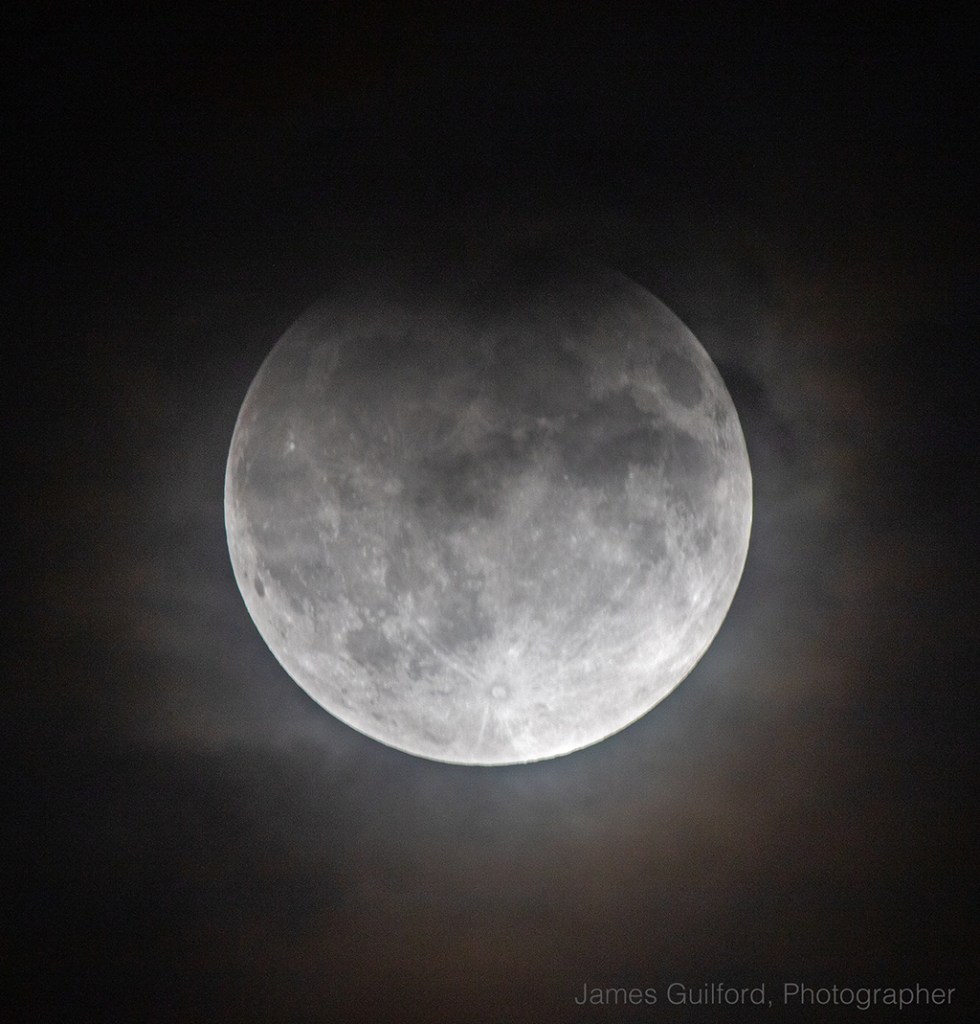
Clouds move across the face of the moon, two minutes ahead of maximum eclipse, lending color and mystery to the scene.
Tuesday, September 17 brought the opportunity to see a partial lunar eclipse without staying up all night. That’s the sort I call a prime-time event. The skies were partly to mostly cloudy through the evening but, as the time for maximum eclipse approached, breaks were appearing in the cloud cover. I set up my camera and tripod and, with about 15 minutes’ lead time, headed out to the patio. I made a few test shots using the Canon EOS 7D Mk. 2 camera, and then a few more to keep. One shot was made at 10:44 PM EDT simply to record maximum. My favorite images, and by-eye views for that matter, were of Moon as thin clouds passed across and near the glowing orb, lending color and mystery to the scene.
Partial lunar eclipse at maximum, September 17, 2024, at 10:44 PM Eastern Daylight Time, by James Guilford, Photographer.
That same night I made a copy of my “maximum eclipse” digital image and sent it off to the local newspaper. Too late for the next day’s edition, my photo showed up today (Thursday), not only on Page 1 but at three columns, huge! The paper’s rendering of the image lost a bit in the translation but still represented what was seen.
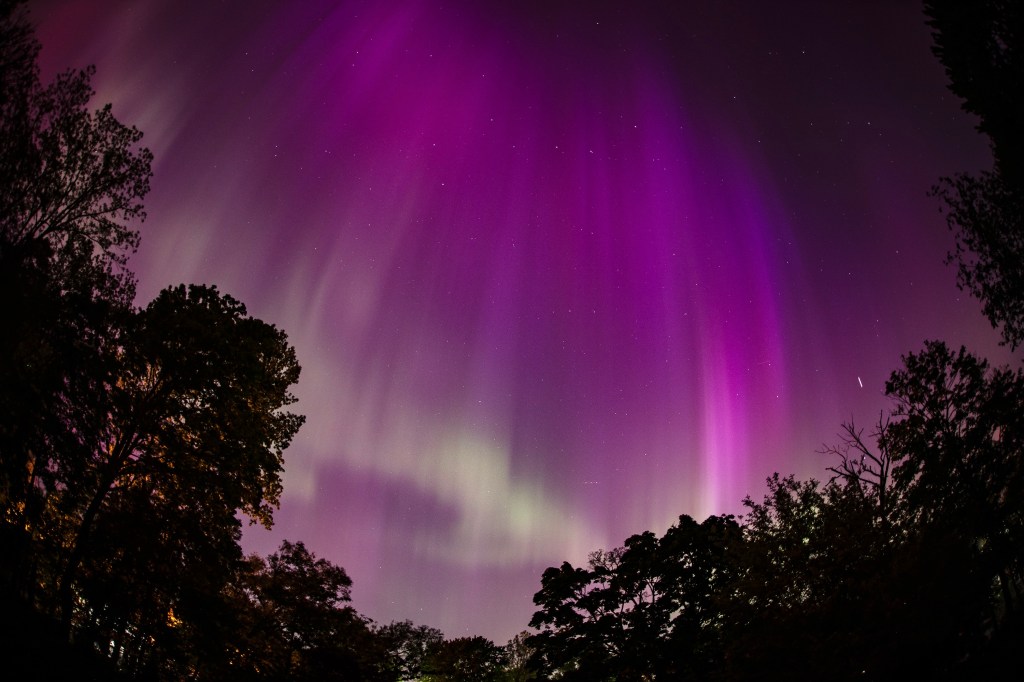
My first DSLR shot of the night turned out to be the most spectacular. This is a view looking northward from the city of Medina, Ohio.
It turned out to be a stronger impact than forecast, and the strongest thus far of this solar activity cycle; the geomagnetic storm of May 10 – 11, 2024 produced auroras (Northern and Southern Lights) visible at night from locations nearly pole to pole.
The forecast of possible aurora prompted me to step outside at about 10 PM (EDT), when twilight had faded, to check the skies. At first I saw what I thought might be clouds but knowing auroras can be feeble, I watched. Sure enough, there was movement in those “clouds”.
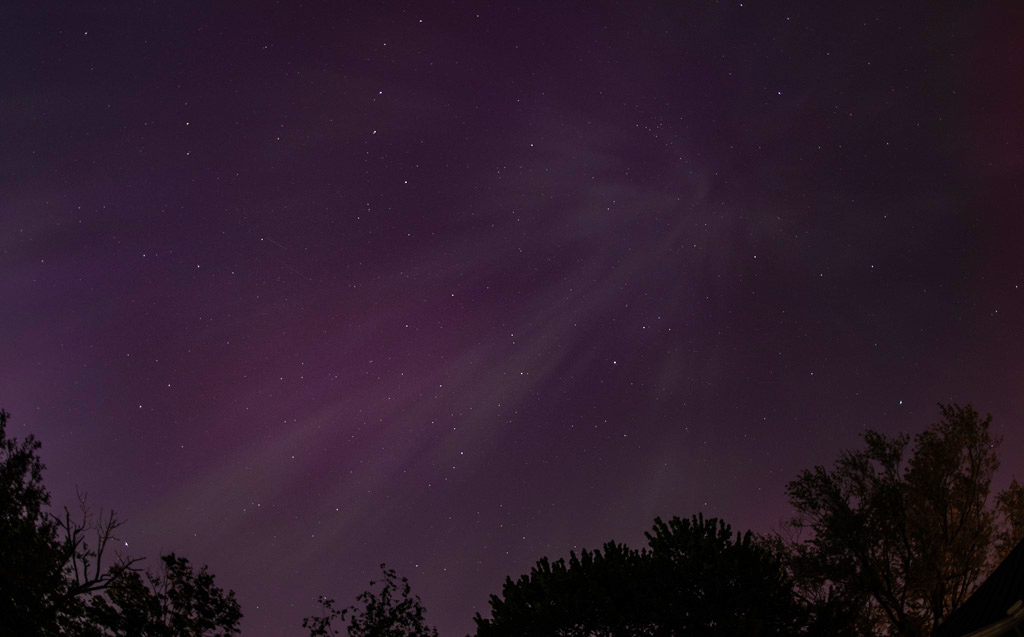
To the unaided eye, the great aurora of May 10 looked like this — streaks of “cloud” with a bit of color. Watching the streaks closely, however, the observer could see them changing in size and shape more rapidly than simple cirrus.
Glancing overhead I saw what I found hard believe — aurora ray features directly overhead … at 41º latitude, a rare sight, indeed! Rushing back indoors, I pulled together camera, fisheye lens, and tripod and headed back out.
My first image of the night was from my iPhone 13. So little effort to see and record such an amazing view! It was exciting to be able to share this with the world in real time via social media!
The aurora still presented itself as cloudy streaks with, perhaps, hints of color. Now also armed with my smartphone, I activated its camera and aimed it at the sky. There on the screen, light amplified by the phone’s electronics, glorious, eye-popping colors filled the sky! I’d never before experienced an aurora like it.
A rare sight indeed is an aurora borealis streaking down from directly overhead at 41 degrees latitude! I’ve never before witnessed such a display.
Only occasionally, during the time I was out, did the aurora’s color become visible to me; apparently being just below the limits of my, and others’ visual perception. Another local observer noted color was more visible shortly before I stepped outside to check on things — the actual peak of the display must have happened as twilight was ending and before 10 p.m.
Colorful curtains lit the northeastern sky as the aurora re-surged from a quieter moment.
I observed and photographed the aurora from shortly after 10:00 until about 11:30 EDT and in that hour or so, the intensity faded and then re-surged before fading away which was my signal to shut down.. I might have stayed out longer but had a commitment for the next day — sleep was needed — so, satisfied I’d seen the phenomenon at its best, I put away the camera gear.
Looking north, find the “Big Dipper” tipped over as if pouring watercolors down on the land. The single dot visible near the center of this picture is the North Star, Polaris. Note how one can find Polaris by looking where the two stars of the dipper’s bowl point.
Knowing it would be all over the news, I submitted my most spectacular shot of the night to the local newspaper — a daily that publishes on Saturday but not Sunday. It was too late for the Saturday edition but the editor gave my photo a three-column, Page 1 spot on Monday.
Our Sun is still in its peak activity period, by some accounts it won’t hit solar maximum until some time in 2025, so there may be more auroras in our near future but this was one for the history books!
I stayed up late, anticipating the arrival of a powerful storm system the night of June 13. The MCS (mesoscale convective system) tracked to the south of its predicted path, leaving me at the northern end of storm activity. I thought I was out of luck but saw some lightning and decided to try for some photos. My persistence and resulting sleep deprivation was rewarded. I witnessed several impressive displays of “anvil crawler” lightning — cloud-to-cloud discharges along the cloud base — but missed a couple. At midnight, however, this amazing crawler filled my visual field and the view from the camera. The strong horizontal bolts steal the show but look closer. Even in this reduced-resolution web version of the photo, streaks of lightning reach up and down across the bottom of the storm cloud. I remember seeing the motion of the light, almost like an advertising sign, luminescence racing along those fine lines. The MCS blasted across our region, downing trees and utility poles along its path. Here, the storm passed dropping only a little rain with virtually no wind, allowing me to make this capture (a single exposure). The local newspaper surprised me by using the image — full-frame, in color — huge on their front page! It’s hard for newspapers to hold the finest details in print but the e-version looks pretty good.




 PhotonStopper