A little experiment involving the waxing crescent Moon, our pond, and the lights from neighboring properties….
Uncategorized
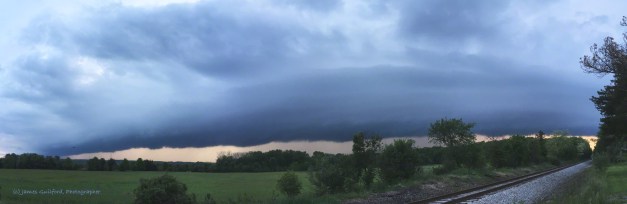
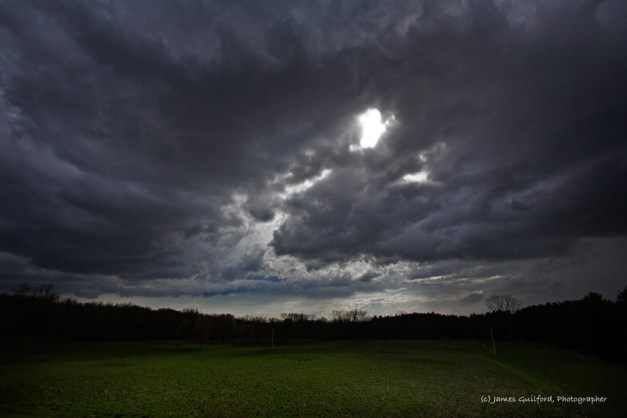
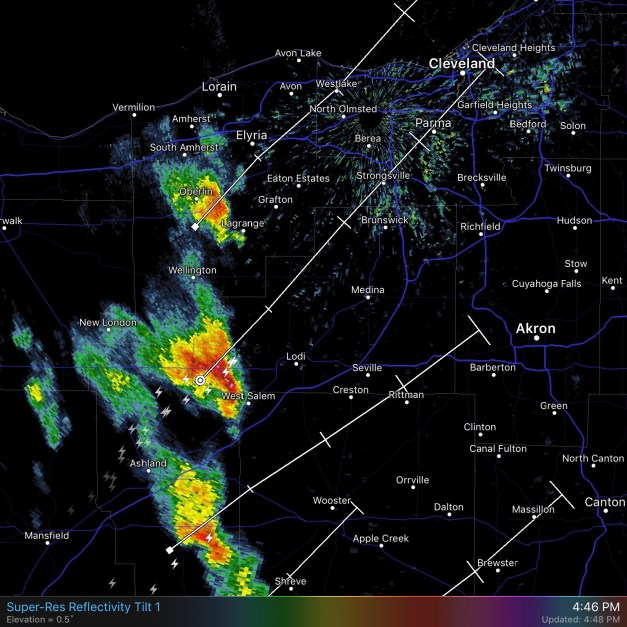
I have loved weather-watching since I was a young boy and I believe that love has grown as I have grown older. I am now located in an area where, with a little head start, I can reach open country — away from town — to observe and photograph weather phenomena. My current favorites are lightning, and shelf clouds. (BTW: I don’t shoot lightning from open country!) Lately I’ve had two successes resulting from interpretation of weather radar that allowed interception of storms. I drove to places in the path of oncoming storms, waited, and photographed the developing scenes. In each case, once the storm shelf clouds appear, there are a very few minutes to set up the shot, record images, and then duck out of the rain as it arrives fast and furiously! The first picture (below) did not turn out as well as I’d have liked. I simply cannot seem to process the image in a way that pleases me and represents what I saw; and it’s way too blue! The second picture (above) is much better, in my opinion, depicting the leading edge of a thunderstorm as it barreled towards me. Both experiences were exciting, great fun, and rewarding in themselves. I’m working on photo techniques that will better depict the wondrous scenes.
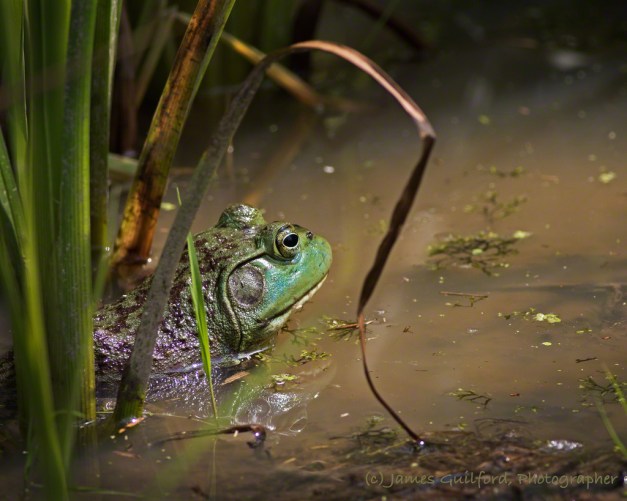
The weather hasn’t been very conducive to nature walks of late, that is if you don’t like getting stuck in mud! Over several recent days, however, there has been enough break in the rain to make trails more passable and skies a bit more cheerful. On a walk on the Buckeye Woods Park, Chippewa Inlet Trail we heard and encountered a number of birds I’d not seen before; most escaped my lens. My shot of the day, however, didn’t bear wings: it was a common American Bullfrog (Lithobates catesbeianus). I was delighted by the position of the frog amongst wetland reeds and how the scene led from light to shadow — a beautiful arrangement. The frog, perhaps to avoid being noticed, held perfectly still while I photographed. I’m quite pleased with the results.

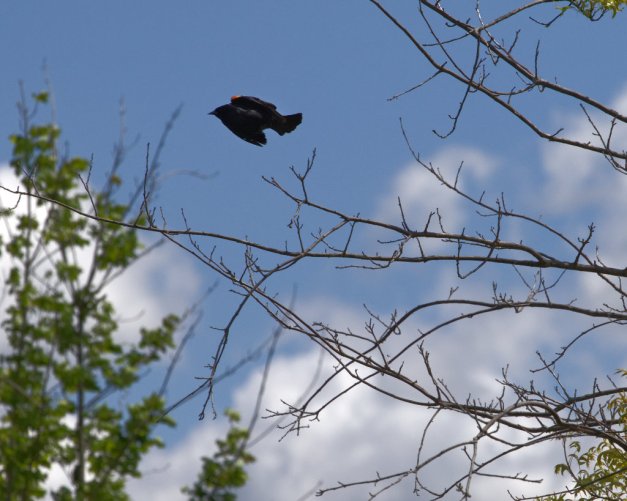
A female Red-winged Blackbird (Agelaius phoeniceus) at Sheldon Marsh State Nature Preserve, Huron, Ohio
On Memorial Day we visited the Sheldon Marsh State Nature Preserve — a spit of land in Huron, Ohio that extends into Lake Erie. Wetlands line the paved trail and the area, though small, provides habitat for many varieties of bird, and a rest and refueling stop for migrants. Bird songs filled the woods, and wildlife was easy to see, including two snapping turtles laying their eggs in holes they excavated along the paved footpath! My shot of the day at Sheldon Marsh was a beautiful female Red-winged Blackbird (Agelaius phoeniceus). The bird alighted on a low bush and furiously shook and preened itself while I watched and shot photos. Then, all sorted off, the blackbird shot into the woods to go about her business. It was wonderful, in the truest sense of the word, to get out and explore everyday natural beauties.
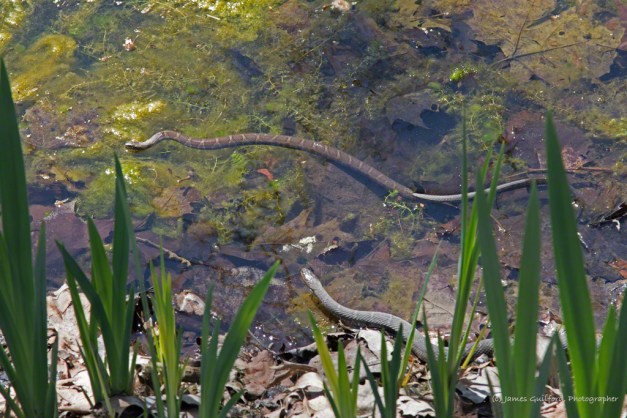
At Lorain County MetroParks’ Schoepfle Garden last Sunday, I spied two snakes sunning themselves on the bank of a pond. The snakes became aware of me but unpanicked, moved into the water and away at a leisurely pace. As they submerged and wriggle-swam, the pair changed from dark and dusty — nearly black — to their true shades of brown, revealing beautifully-patterned skins. As the larger of the two reptiles turned to meet its (apparent) mate which had gone in the opposite direction, it passed by a large bullfrog. Wary of the possible danger the frog, though too large to be swallowed, held perfectly still as the water snake passed.
Scattered thunderstorms were roaming the area. Watching radar, I spied a “gust front” — the leading edge of encroaching cold air — that could be visually interesting. So I headed out to a favorite spot with a fairly good view to the southwest and over Medina. I thought I was well ahead of my target clouds but arrived at the site with clouds already overhead. In this shot a “roll cloud” can be seen in the distance — the actual leading edge of the front. As it passed overhead winds picked up from a breeze to probably 25 MPH and higher … and chilly! My burgeoning interest in weather has led me to get National Weather Service Skywarn Spotter training and, because I had to guess the wind speed I’ve ordered a handheld anemometer. Yeah, I love this stuff!
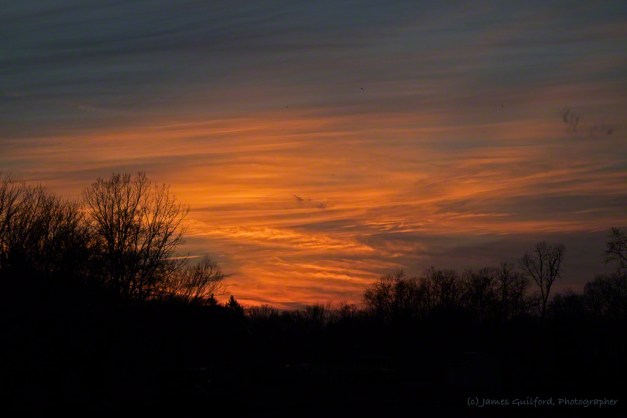
I took a late-day stroll Friday, exploring the neighborhood and enjoying the warm spring air. As the sun sank low in the west, I could see it had potential for a beautiful sunset — streaked cirrus clouds aligned north and south across the sky. So I waited. The air grew cool. The cirrus seemed to disappear. And then warm color rose, first lighting a few scattered cumulus and then revealing the missing cirrus. Just after sunset the sky turned orange, glowing clouds reflected in water, ducks made ripples as they found their nighttime moorings.
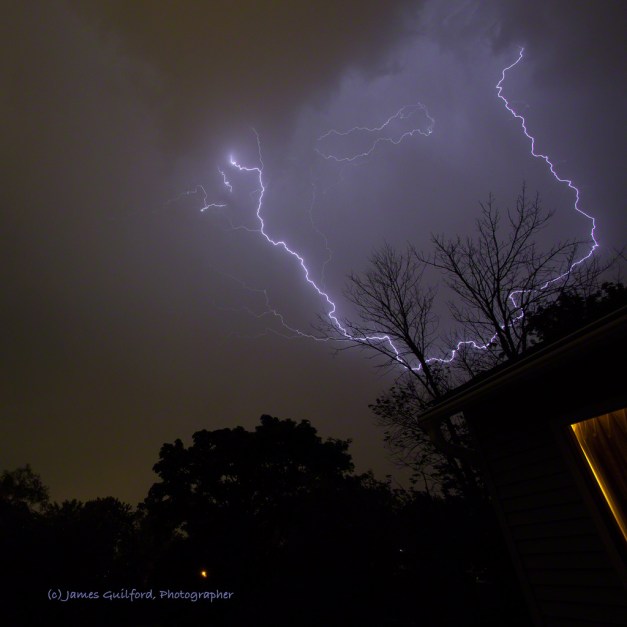
A powerful thunderstorm rolled through the area the night of February 24 – quite unusual, as was the general weather, for winter in Northeastern Ohio.

Lightning arcs in February Thunderstorm – Cloud-to-Cloud and Cloud to Ground in the same space of time!
The storm approached from the southwest and, as it rolled in it was dry at first. I set my camera up in a sheltered patio area and waited for the occasional flash of lightning. Then, as so often happens, rain started and drove me indoors.

Lightning arcs in February Thunderstorm Bursting forth and spreading along the underside of the cloud – a “crawler.” The crawler was weaker, not as bright, as other flashes.
There, thanks to a beautiful new picture window with excellent glass, I was able to continue the shoot from the dry safety of my living room! Unfortunately, most discharges were out of my line of sight or low to the horizon; I did, however, get a couple of decent images.
For wildlife, springtime is usually when family life begins. The hard winter is nearly gone, spring’s warmth is moving in, and the hope of a summer plentiful with food is ahead; so it is with the Great Blue Herons. Large numbers of herons annually nest together at their rookery in Cuyahoga Falls, at the edge of the Cuyahoga Valley National Park. The big wading birds build nests of twigs and some surprisingly large branches, pair off, and raise their young. On Sunday, the herons were mostly quiet, little mating, nest building, or flying, and no vocalization at all. The sky was milky white with cirrus — not the best conditions for bird photography. Still, a silhouette can tell a story of the ancient rite of spring,