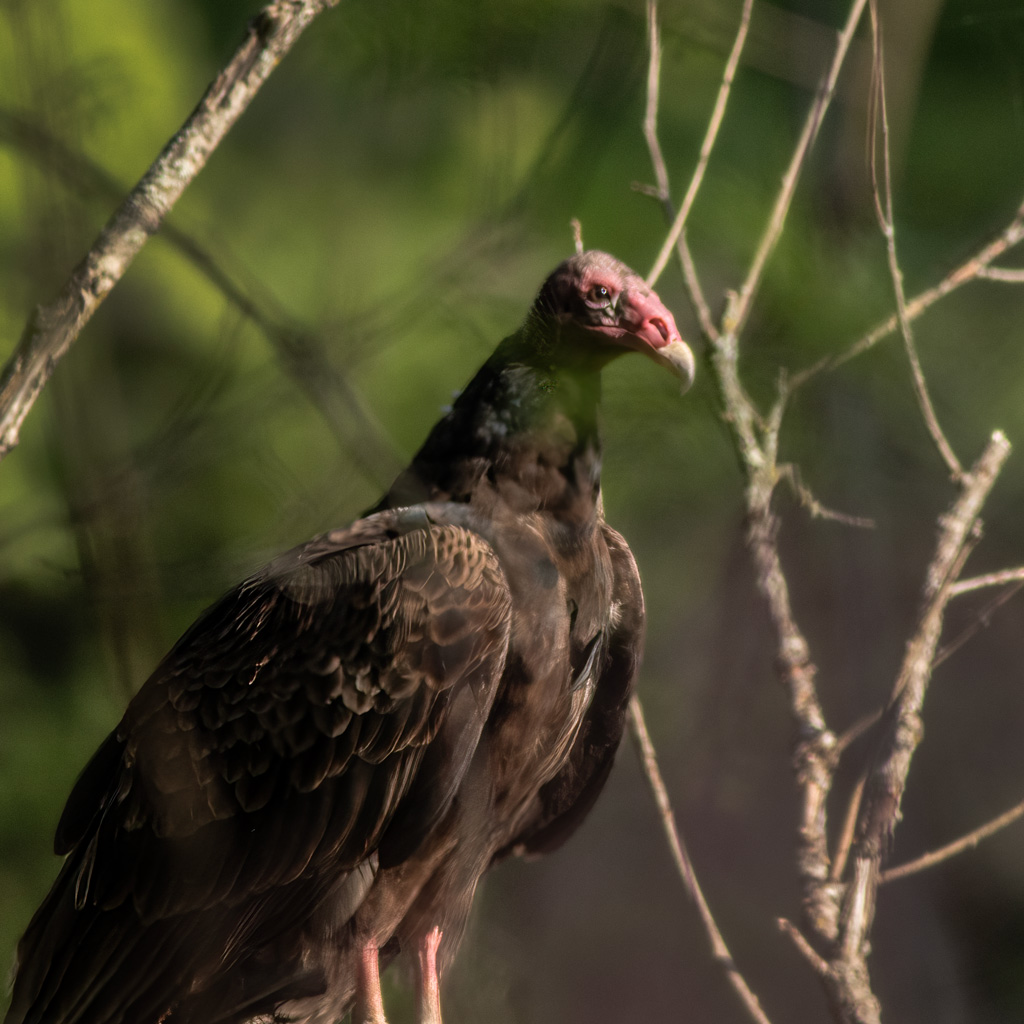
The Turkey Vulture (Cathartes aura) perched on a tree trunk this morning, surrounded by smaller branches of the same tree; its red head helps distinguish it from the Black Vulture. Photo by James Guilford.
We had visitors this morning! A Turkey Vulture was spotted first on a tree limb low above the pond. When I went to investigate, I spied second bird higher in the same tree. A second Turkey Vulture? No, it turned out to be a Black Vulture! I watched them both for some time before first, the Turkey Vulture, and then the Black Vulture, took off in different directions. It’s increasingly common to see Black Vultures in this area of Northern Ohio. It seems Turkey Vultures are quite adept at locating meals — usually carrion — which is something the Black Vultures aren’t so good at. The more aggressive Black Vultures are more skilled at opening thick-skinned carcasses. The complimentary abilities lead to the two types of bird being sighted together. The more common Turkey Vulture is annually celebrated in the neighboring town of Hinckley with springtime Vulture Days.
This morning’s visiting Black Vulture (Coragyps atratus) perched high in a backyard tree. Its featherless, grayish-black head and neck, help distinguish it from its red-headed “cousin”. Photo by James Guilford.
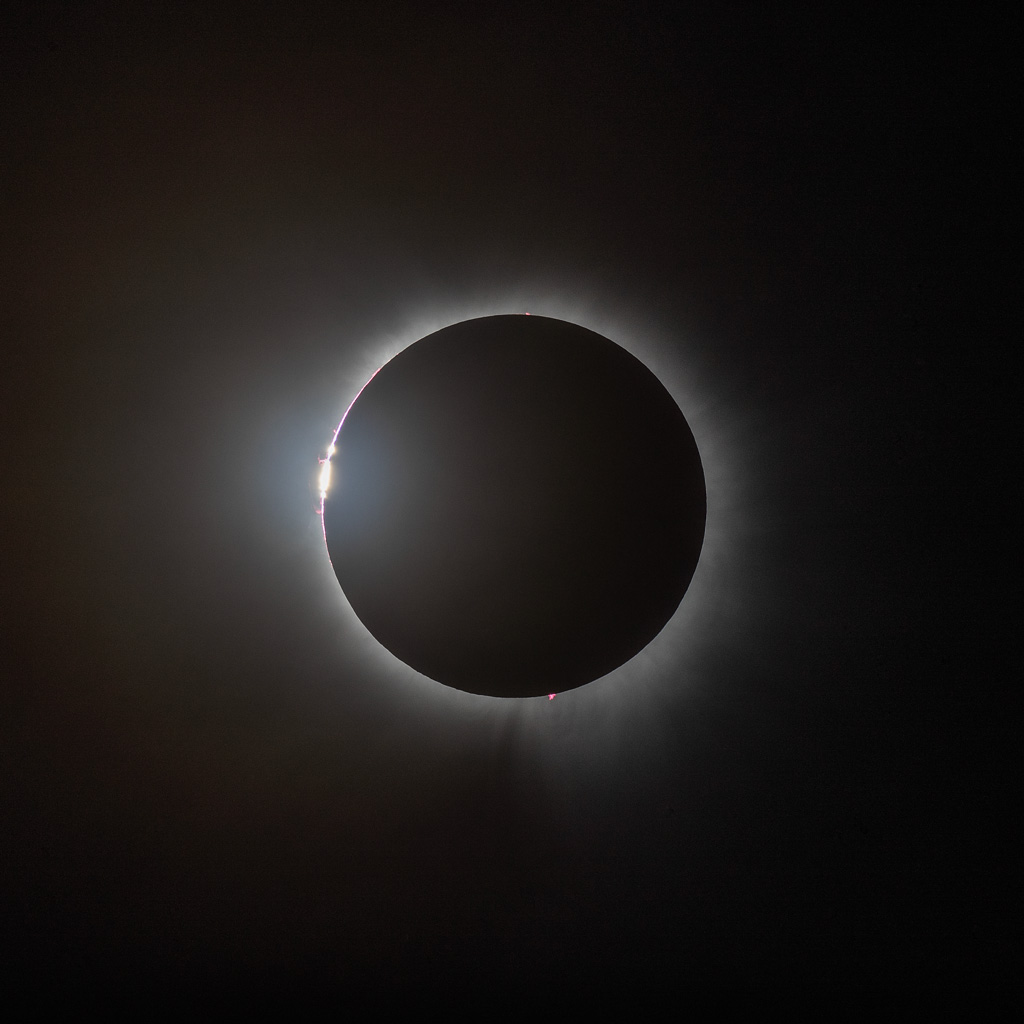
Prominences erupt and loop over the eclipsed Sun’s limb. This is only one of several locations along the edge where proms could be seen but the loop at center above was large and visible to observers with their unaided eyes. The red color is due to how hydrogen glows at extreme temperatures. Photo by James Guilford.
After days of negative weather forecasts, and spring’s reputation for cloudy skies, the clouds thinned Monday, April 8, leaving a milky film across most of the sky. We did, after all of the worry, get to see a very beautiful eclipse. Because the sun is so active right now, the dark disk of moon hiding sun was ringed with easily-seen prominences or “proms”, and surrounded by a fairly round corona.
I’d set up two telescopes in the driveway as I was concerned views from a backyard setup might suffer due to trees. I’d also hoped visitors might drop in to take a look. Only two neighbors visited, one during totality, but it was very nice to visit with them. Overall, since the eclipse was visible from people’s own backyards, we believe many, maybe most, simply stayed home and enjoyed the show; streets were quiet and, from what we could tell, crowds small.
The driveway telescope setup: In the foreground, the 9-inch Vixen Cassegrain telescope with solar filter, a Canon 400mm EF L lens and DSLR camera riding piggyback. In the background is the Askar 103 APO telescope with its solar filter, a DSLR at its focal plane. The eclipse totality images here came from the Askar and its Canon EOS 5D Mk. 4 camera. The solar halo in the clouds was not something I even noticed as I made this snapshot!
While I had hoped and planned for a sky clear enough to enjoy an expansive view of the solar corona, the aforementioned thin cloud cover successfully masked the delicate outer corona leaving only the brilliant inner level accessible. At first I was disappointed but was consoled by my images of prominences — something I did not expect to record in such detail — and that was rewarding indeed!
Baily’s beads show in this image as the moon nearly completes its coverage of the sun. Hints at the extent of prominences can also be seen around the dark circle of Moon.
As totality’s appointed hour neared, sunlight faded and took on an eerie quality seen, really, only during solar eclipses. Darkness began to set in and the breeze, as expected, turned cool. The world became quieter. A robin began singing its evening melody. When the last bit of sun winked out behind Moon, cheers rose from people gathered at a nearby public event. I removed the solar filters from my cameras and let them shoot photographs of totality. I looked at the eclipse, a bright light flared from the six o’clock position of the dark circle — a huge prominence that caused my visiting neighbor to ask about. Around three-quarters of the surrounding horizon was glowing in sunset color while the area under the ongoing eclipse was dark. One camera continued its slow count of shutter clicks. And then the world began its return to daylight. Quickly covering lenses I was gratified that I was able to, after days and weeks of concern and doubt, see the complete eclipse event.
I grafted together portions of two of my totality images to illustrate the number, size, and position of the prominences visible during the eclipse. One image was shot immediately after totality began, the second was recorded just before totality ended with Moon covering and exposing various portions of Sun’s limb as it swept across its shining disk.
It’s here that I confess that, in spite of my attempts to test and set up the cameras in advance of totality, I failed. My Canon EOS 6D Mk. 2 did not work as expected. I shot a few single images with it but ended up relying on the Canon 5D Mk. 4 for nearly everything. Even the 5D was not without issues as it did not automatically bracket exposures as I believed I set it — I’ll chalk that up to “operator error”. At least it “failed” with an excellent shutter speed to image the inner corona and those proms I’d wanted to catch!
Through a “white light” solar filter, Moon’s silhouette is seen as the orb progresses across the face of Sun, about to cover a sunspot.
Looking back on the day I can appreciate how lucky we were here at our Northeast Ohio home. Monday morning’s sky was covered in thick cloud and the forecast called for from 40 to 60 percent cloud cover. The sky later cleared to beautiful blue and, though a high thin cloud deck moved in, we saw and photographed a glorious natural phenomenon. This was only my second total solar eclipse, the first experienced in 1970, and it is quite likely my last since I’m not much of a “chaser”. Though I regretted my failings with my photographic plans, the results I did achieve delight me. It was indeed a day of luck and beauty.
1970 Total Solar Eclipse during totality as viewed from Virginia Beach, Virginia March 7, 1970. Photo by James Guilford, digitally scanned from film negative.
A pair of male Lesser Scaups swim on wind-riled pond waters.
Our annual visitation by migrating waterfowl was special this time: two pairs of “odd ducks”. The first photo shows what I believe are two male Lesser Scaups. The second shot is of a male and a female Bufflehead — the male is mostly white and has iridescent head feathers. All four are likely resting up on their way to their summer ranges in Canada. Safe travels, feathered friends!
A male and female Bufflehead. The male (L) is mostly white with head feathers that are iridescent showing purple and green coloration.
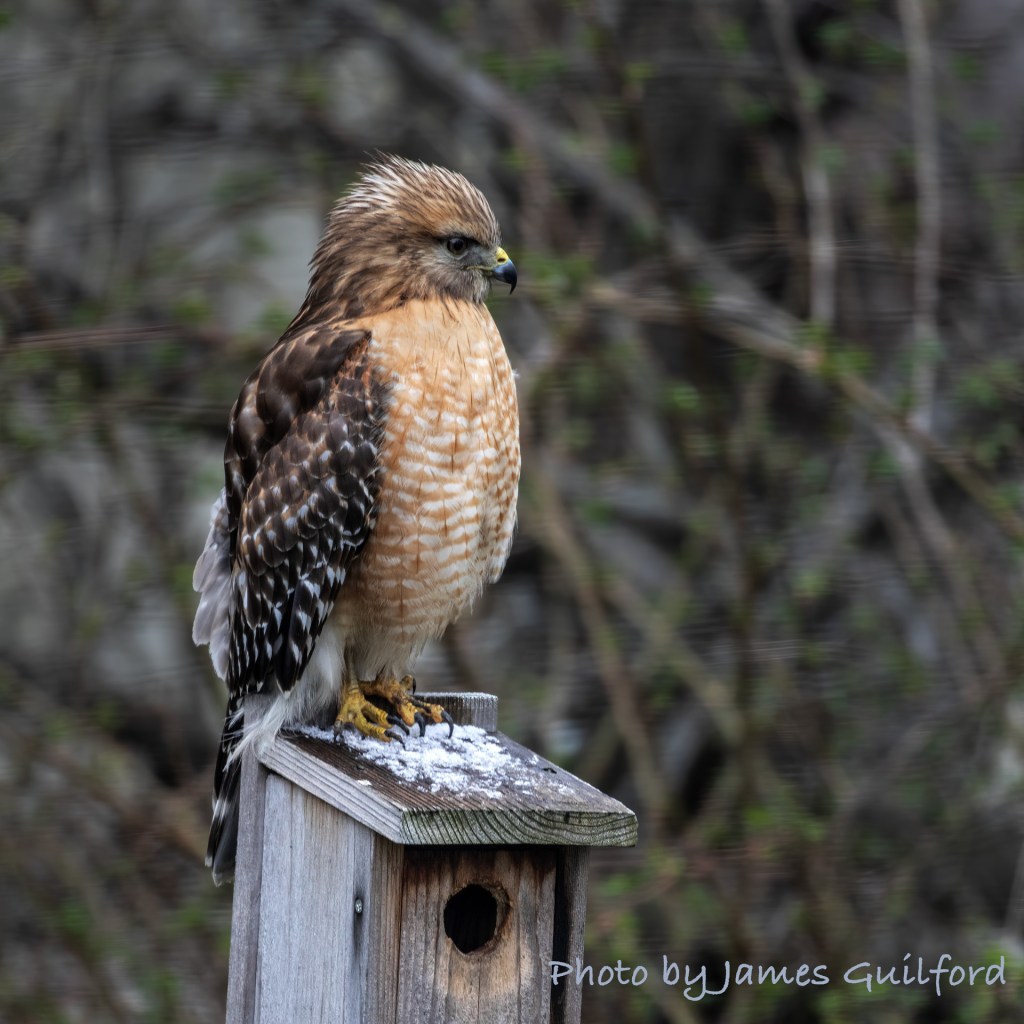
We had some excitement today as a pair of red-shouldered hawks paid repeated visits to our backyard! One of the birds is pictured here, puffed up against the cold. At one point the two raptors were perched side-by-side on a tree branch. Later, one of them — maybe this bird — bagged a small animal and devoured it on the ground. Are they mates? Will they / are they nesting nearby? We shall see (I hope).
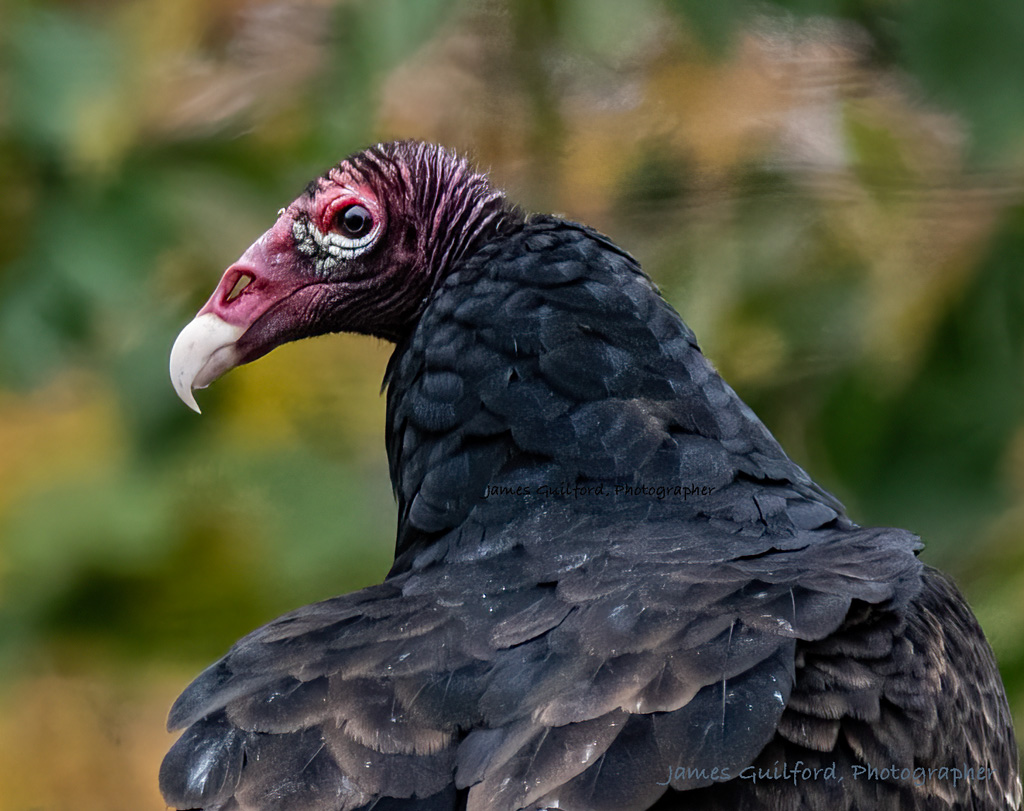
A close-up view of one of the day’s Turkey Vultures, commonly called buzzards. Note the see-through nostril opening in its beak. It is said that the opening allows the bird to clear out any materials that may gather there when it feeds by inserting its head into an animal carcass. Photo by James Guilford.
With fascination and puzzlement we watched a number of Turkey Vultures (Cathartes aura) aka “buzzards” zooming low over the house and in and out of our bare-limbed, backyard trees. From the trees they dropped down into the gully behind our house. What drew their interest? I don’t know. During a pause in their activity, I went out to peek into the area they were visiting, I was expecting to find a dead deer or other animal they’d been scavenging. I saw nothing. Still, they returned and stayed at least into dusk. The big birds (six-foot average wingspan) returned today but seemed content to remain perched ominously in the tree; at one point there were *13*. Happy Halloween, I guess!
A group of vultures in flight is called a “kettle”, a group of vultures that is feeding is referred to as a “wake”, while a group of vultures on the ground or in trees is called a “committee”
A turkey vulture begins spreading its enormous wings — averaging a span of six feet — as it prepares to take flight from a rooftop. Note the light-colored feathers on the underside of its wing, an identifier to look for when watching these magnificent flyers soar. Photo by James Guilford.
Portrait of Cleveland radio personality “Count” John Manolesco, made in the 1970s. Photo by James Guilford
“Cleveland radio has had more than its share of characters. Take “Count” John Manolesco, for example, who hosted a show on news/talk WERE. Manolesco, who claimed to be a physic from Romania, went so far as to perform a live, on-air exorcism.” — Kabir Bhatia, Ideastream.org
I was assigned by a local magazine to shoot photos of Manolesco for a feature article on the Cleveland talk radio personality. I did make the usual photos of him but shot one or two using a low-angle flash — a proven technique to introduce a spooky mood to an image. This is my favorite shot from the job.
John Manolesco was born December 3, 1918 in Timisoaka, Romania, and died January 10, 1983 in Cleveland, Ohio at 65 years of age.
Honorable Mention for my entry entitled “Northward” in the September/October issue of Weatherwise, a respected meteorological journal.
Well would you look at that! One of my pictures received an Honorable Mention in the 2023 Weatherwise Photo Contest! I found out about the honor when the September/October issue arrived today. Weatherwise is the respected meteorological journal featuring “The Power, The Beauty, The Excitement” of weather. You may know I don’t generally enter photo contests. To be selected for even honorable mention from among thousands of entries is, yes, an honor.
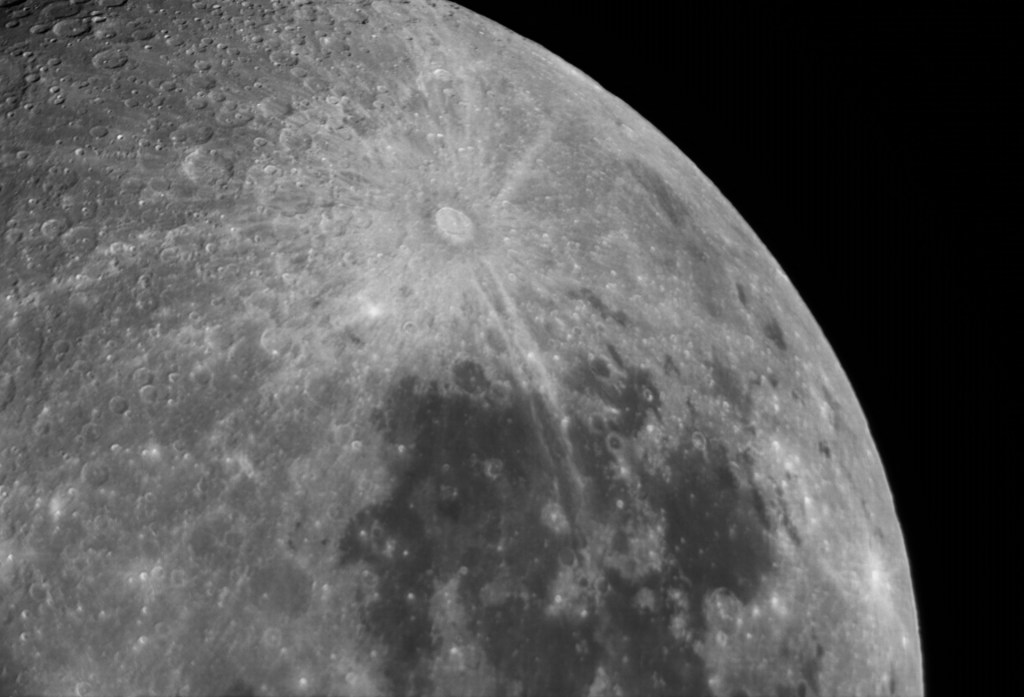
Crater Tycho is featured in this image, it’s ejecta rays fanning out across the lunar surface in all directions. Celestron C11 telescope with ZWO ASI 294MC Pro camera.
Taking advantage of what seem to be rare clear skies, last night (September 1, 2023) I ran first light trials on the Celestron C11 I was given, in combination with my ZWO ASI color astronomy camera. The results were largely disappointing with no good deep sky results, terrible results from Saturn, and not-so-good images of Jupiter. Even Earth’s Moon, usually an easy target, was barely in focus. I hope to try again this coming week when mild, clear nights are forecast.
On the positive side, polar alignment was excellent as was goto control alignment so telescope sky tracking was very good during my efforts — until something caused an unexpected reboot of the telescope controller. I don’t know if dew short circuited a connector or if something pulled loose from the hand control but it was disconcerting!
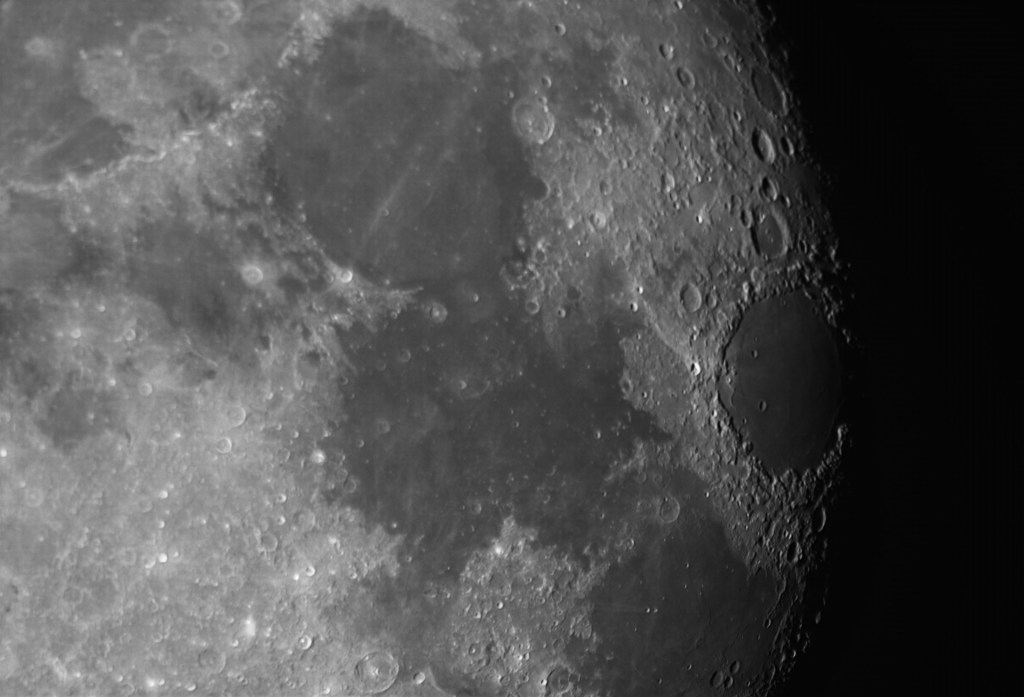
The images shown here are simply interesting to look at, though not the quality I’d normally want to show. The first is youngish Crater Tycho showing off its extensive web of ejecta rays. The second picture includes several lunar “seas” including the “C” shaped Sea of Crisis. Two craters are seen near the left edge of the circle; the lower of those craters is named Picard. No, Star Trekkers, not THAT Picard. Still, a fun fact.
Several lunar seas are visible in this image with the Sea of Crisis (C-shaped) at the right side of the picture. Crater Picard is the tiny lower circle in the dark floor of the Sea of Crisis. Celestron C11 telescope with ZWO ASI 294MC Camera.
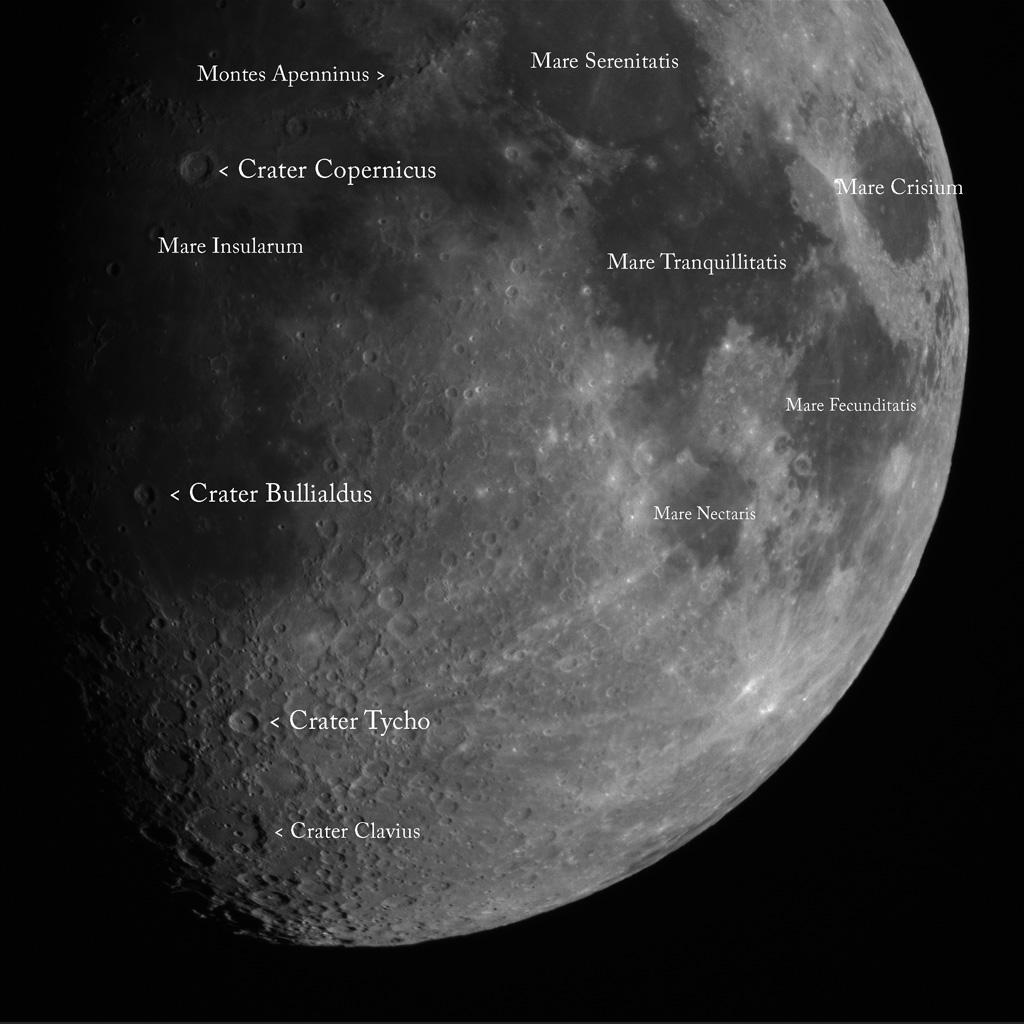
Taking advantage of a string of “clear” rainless nights and days, I’ve been learning by doing. My first objective was to image the supernova that was discovered recently in Messier 101 — The “Pinwheel Galaxy”. The object has a low surface brightness and, in our light-polluted suburban skies (Bortle 6/7) made worse by Canadian forest fire smoke, it’s invisible to me by eye and a very challenging target for imaging. Add to that the steep learning curve I’m on using an astronomy camera instead of a DSLR and, well, let’s just say results were disappointing. So I turned to the waxing Gibbous Moon last night and got some experience and passable results. This same Moon, as its phase grows toward Full, is making the sky brighter nightly. At the same time the supernova is believed to be fading now.
A portion of the 10-day-old, waxing Gibbous Moon as viewed from Medina, Ohio, USA the night of May 29, 2023. Crater Tycho is prominent among a heavily pockmarked area in the lower left of this image.The same lunar image as above but with some major featured labeled.







 PhotonStopper