Tasha and I went to visit Dr. G Wednesday morning to get a followup blood test for her thyroid condition and her annual checkup. She did excellently well in most regards. She was an agitated patient but, when screening results came in the following day, everything looked good. Dr. G told me every tested factor in her blood panel returned “normal” results including (of course) the thyroid. Tasha had gained .7 lbs. since her last visit and Dr. G thought that was so good she drew a little smiley face next to the number on the patient report! The only concern was blood pressure. Tasha’s BP was high during the thyroid episode, a result of the hyperthroidism itself. It has persisted, however, and in the absence of other causes such as kidney trouble, her hypertension is considered a geriatric condition. It may also have already damaged the retina of one of her eyes. Tasha (about 65 in “human years”) now takes human blood pressure medication! So we’re back to giving pills again {ugh!}. I’m hoping to order up tiny tablets from a compounding pharmacy as the worst part of preparing the once-a-day dose of Amlodipine Besylate is cutting an already small tablet into quarters — they always seem to crush or break. We go back to see Dr. G for a followup BP measurement in two weeks though I may see if I can borrow a blood pressure cuff … the “white coat” syndrome may be a considerable factor in driving Tasha’s pressure high.
Uncategorized
Sunday morning we set off to visit the Old Woman Creek State Nature Preserve, just east of Huron, Ohio. This beautiful place, according to the Ohio Department of Natural Resources Web site,” is protected as a State Nature Preserve and National Estuarine Research Reserve because it is one of Ohio’s best remaining examples of a natural estuary.” The visitor center was recently remodeled and offers fun and interesting educational exhibits in a clean and comfortable, “green” indoor environment. What’s outdoors is what really counts, however, so we spent most of our time under open sky. Marked hiking trails conduct walkers (no dogs allowed, by the way) through quiet woodland settings and to views of the open wetlands of the estuary.
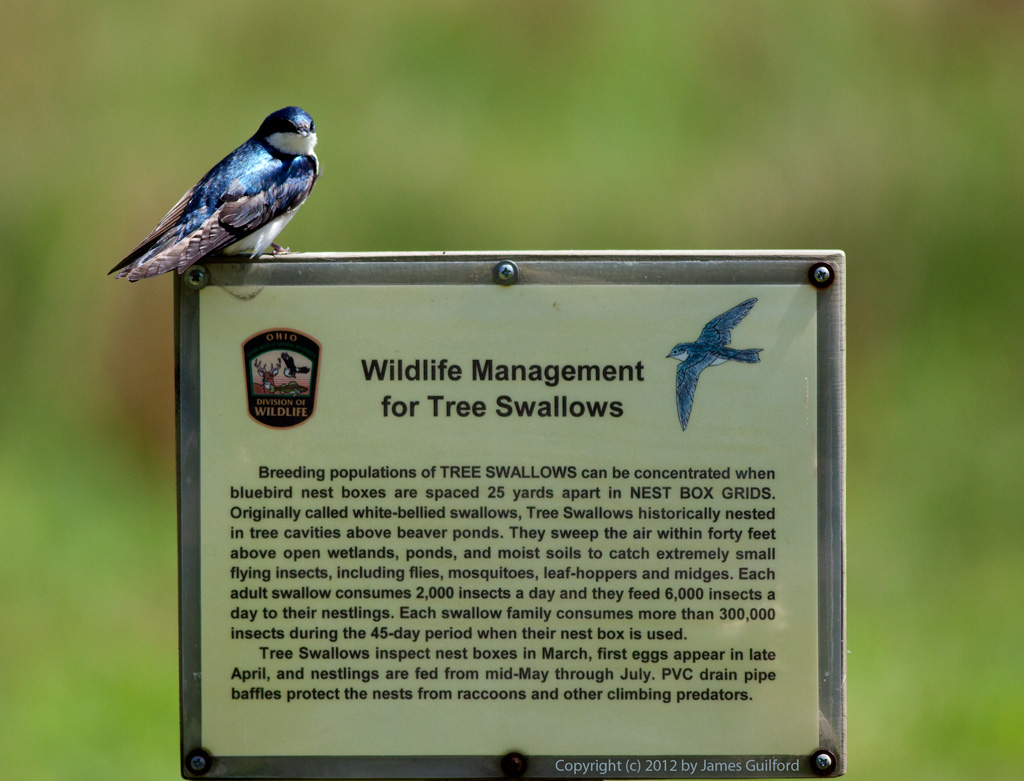
Attracting much attention from visitors was activity in an open prairie field across from the visitor center, site of many nesting boxes for Tree Swallows (Tachycineta bicolor). The boxes and the skies above them were busy with the aerial maneuverings and activities of resident swallows. The birds were living their lives there before us: mating (no “bird porn” here), catching insects, setting up housekeeping, all at incredible speed. Bird watchers of every ilk stopped by to enjoy the show and take in the brilliant iridescent blue plumage of the small birds.
The birds, the water, the animals of the forest were all wonderful to see. It doesn’t hurt, however, to look up towards trees, sky, and sun… you never know what beauty may await.
We spent Sunday afternoon on a lovely nature walk in the Sheldon Marsh State Nature Preserve outside Huron, Ohio. Public access is along a paved drive flanked by woodland paths that heads straight out into Sandusky Bay. It’s a prime birdwatching spot in the spring and autumn: birds use it for rest and refueling for the hop across Lake Erie between the US and Canada. The wetlands also provide habitat for longer-term residents making the preserve an excellent place for nature-loving hikers all year ’round.
Along the way we discovered and usually photographed many scenes, both still-life and wildlife, including ducks, a Baltimore Oriole, squirrels, chipmunks, turtles, snakes, and a Great Egret (Ardea alba). The egret was hunting in the shallows of the preserve’s beach area, along a wooded shore. The big bird knew where to find fish and I watched as, in rapid succession, it caught and quickly swallowed two. At some point it decided to move closer to shore and that’s when I got a few images of the egret in flight.
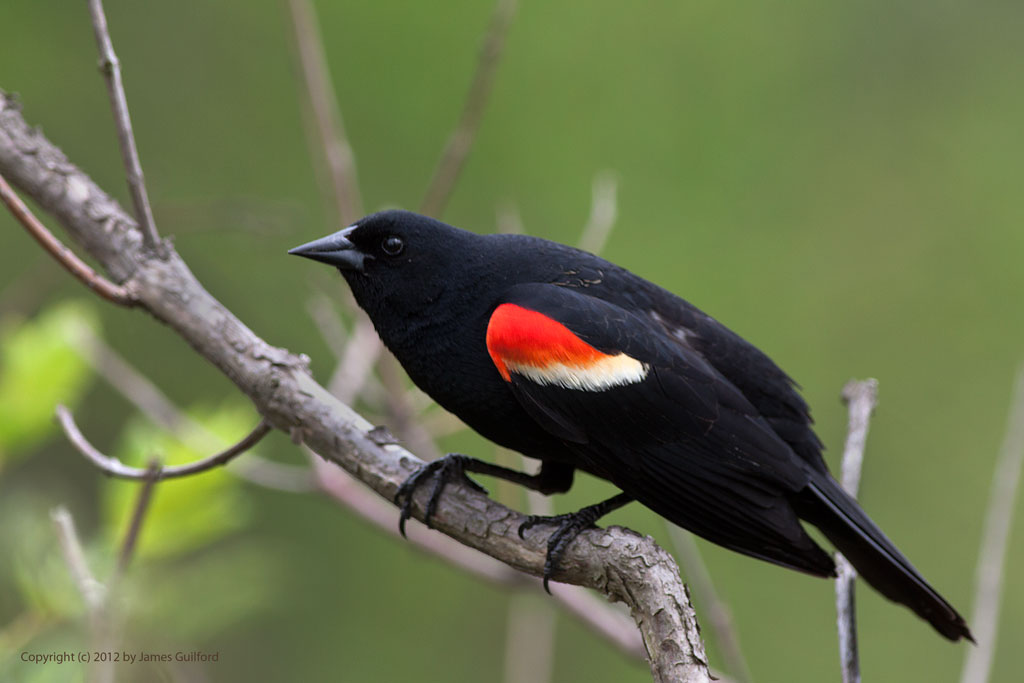
Redwinged Blackbirds (Agelaius phoeniceus) have marked my springs and, especially, summers for as long as I can remember. Their jet-black plumage accented with large red shoulder spots, their aggressive nature and raucous calls, make for an interesting bird to watch and listen to. There were many redwings in the preserve, darting in and out of the wetlands’ tall reeds — presumably nesting there. Occasionally there were territorial disputes, raucous and aggressive as would be expected. I spotted one bird picking at seed dropped by a visitor on the walkway. As I drew closer, the bird popped up into a neighboring tree. The redwing warily watched as I came a bit closer and shot a few photos of it perched on a branch. I stayed a bit too long so Mr. Redwing flitted into the woods.
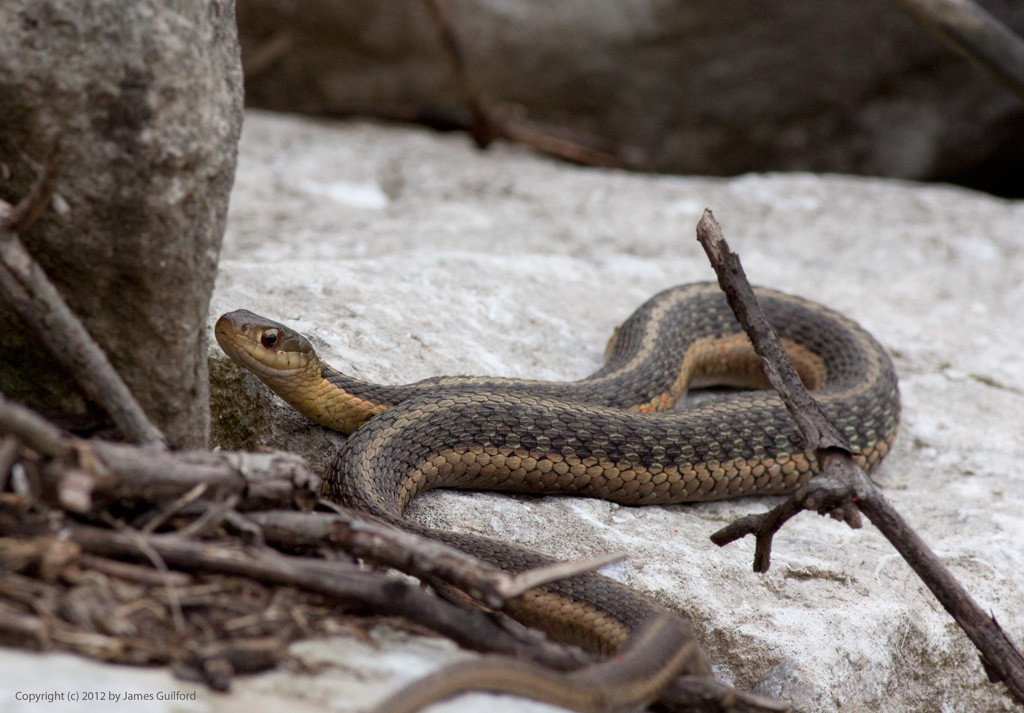
I had been looking around mostly at birds and (wet)landscapes and hadn’t really noticed but we were, it seems, surrounded by snakes! An enthusiast, accompanied by his family, was spotting snakes sunning themselves among the rocks of a breakwall. He would hop on to the stones and deftly grab resting snakes! At first I worried he might do the reptiles some harm but he seemed mostly out to admire them, maybe prove his courage and skill, and then safely release. Once cued in, we began seeing the snakes. We spotted and photographed a Northern Water Snake (Nerodia sipedon) apparently ready to molt and, later, a Garter Snake (Thamnophis sirtalis) along the breakwall.
We had a fine, relaxed time enjoying nature, a lovely day, and a walk at the marsh.
It was a damp, dark, chilly morning this Sunday. After breakfast and lounging around the house we could stand it no more and decided to take our changes… we’d head to the heron rookery! We arrived just as a large hole in the thick overcast delivered blue sky and warming sunlight. The scene along Bath Road was much quieter today. Nest building appeared to be done and the Great Blue Herons were mostly sitting on or perched near their nests. We presume, at this point, the birds are sitting on clutches of eggs. The homey scene was marred, however, by a sad sight. Somehow one of the adult birds had died, its lifeless body dangling from branches near a nest. Occasionally another, presumably its mate, would alight nearby and remain nearby perhaps wondering why there was no greeting, no reaction from its partner. I recorded a few cheerier scenes of birds flying or occupying their nests. All too soon the sky closed up again, drizzle returned, and we sought the warm shelter of our car.
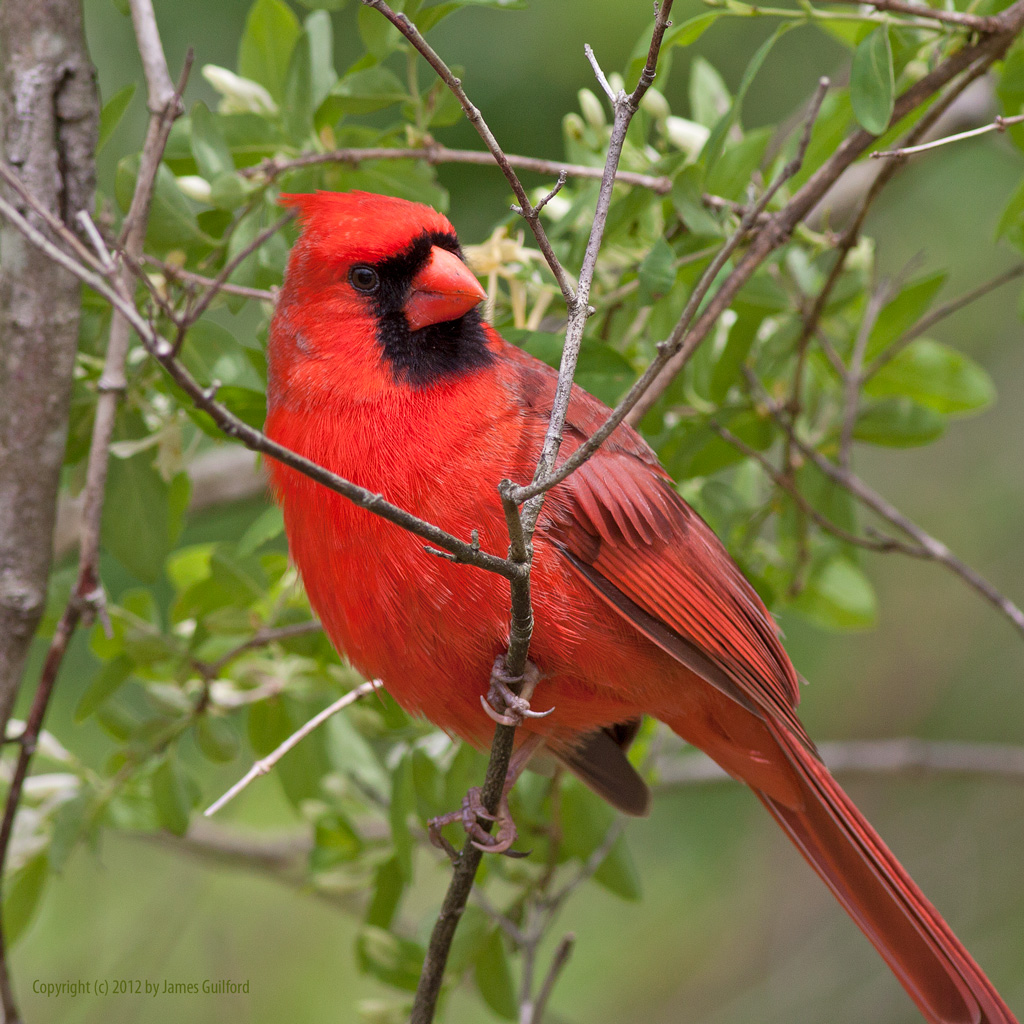
We’d set out today with the intent of also exploring the Ira Road Trailhead, an access point to a long boardwalk crossing a wetland area only a short distance north from the rookery. By the time we reached the parking lot, the drizzle had nearly ended and we set out for the boardwalk. We were greeted with lovely, dark scenes of lily pads, ducks and geese plying the water, Redwing Blackbirds, a turtle on a log, a Great Blue Heron slowly fishing along a neighboring shoreline. I got many more images to my liking from the Ira Road area than from the rookery today. My favorite was a Cardinal. I stalked the cardinal as I walked along the edge of the parking lot. First he was high in the trees, red feathers ruffled by the cold wind. Then the bird dropped into lower trees and shrubs. Finally he disappeared into the leafing brush. Fingers stiff and aching from exposure (we both shot big batches of photos), we made our way home happy that we had spent time with nature on a fine miserable day.
Appropriate wishes to all for a happy Earth Day every day!
It was an interesting Sunday. This morning we viewed the “Rembrandt in America” exhibit showing at the Cleveland Museum of Art. It’s amazing how good some 300+ year-old paintings can look! The exhibit also shows what can happen when a great artist becomes commercially successful in his own time. Works by or contributed to by Rembrandt’s workshop staff, students, and others can be and often have been attributed to the artist himself. The years and the treatment of the paintings by their successive owners have had huge influences upon what we see today. So what does “a Rembrandt” look like? Well… I know what some of them look like but left the show knowing that looks can be deceiving.
After lunch we went home, changed to suitable clothes, and headed to Hinckley Lake to take advantage of the bright and warm (now 78 degrees F) afternoon. I carried about 20 pounds of DSLR camera gear. She Who Must Be Obeyed carried her new, lightweight Canon one-piece camera with an extraordinary built-in zoom that can range from macro to 800 mm equivalent telephoto! Walking along we merrily shot photos of flowers and plants, water and bark. Then I spotted a big, dark bullfrog resting upon a piece of wood at water’s edge. A few photos. Then She said, “look!” I looked where she was pointing and, to my surprise, saw a nice-sized Northern Water Snake (Nerodia sipedon) coiled up sunning itself… about six feet above the water in a tree! The snake posed patiently for photos and when we’d had enough, we moved on. Snake stayed put. Not much farther along we spotted another water snake suspended in the branches. Some way farther, another though this one stretched out along a log jutting from the water. We also encountered one large and one baby garter snake, though they were not nearly so impressive as the tree-climbers.
At home, She had me take a look at her photos. Several were quite wonderful in technical quality — solid focus with beautiful detail of the snakes and the frog. With all my fancy gear, I have to say this wasn’t my best day. {sigh}
Still in all, it was a fine day looking at old paintings and shiny new snakes.
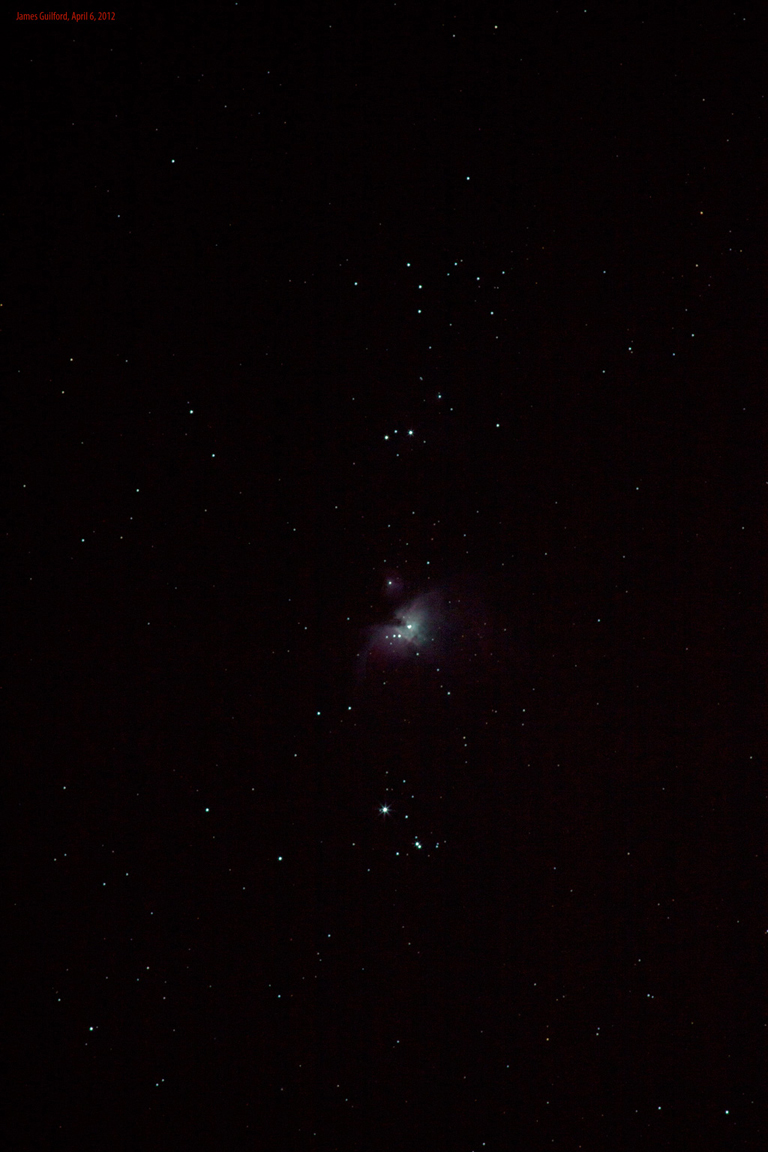
A few nights ago I did a bit of fixed-tripod astrophotography to attempt to capture the conjunction of Venus and the Pleiades. I had to work pretty hard to salvage the conjunction photo but wasn’t all that pleased with the results. Since I had a decent clock-drive sitting mostly unused, I decided to mate my camera to that and see what I could get. Not a pioneering venture, to be sure, but I’ve actually never piggybacked a camera to a telescope before! A quick trip to the local Ace Hardware store produced the stainless steel quarter-inch screw and a pair of rubber automotive washers I’d need to mate the telephoto lens tripod mount to the telescope’s dove-tail mounting bar. Shortly after dark on this clear but full Moon-lit night, I toted the Orion SkyView Pro tripod and mount out to the sidewalk. After a rough alignment with Polaris, I attached the camera rig to the mount and did 10 exposures: about five each of Orion’s sword and the Pleiades star cluster — both in the twilight western sky. I’ll definitely need to use the DSLR’s advanced feature that allows its view finder mirror to flip up before beginning exposure — several shots were ruined by vibration. Focus was a bit more of an issue than I expected. Tracking? Well, I expected it to not be perfect but it appeared good enough for exposures of up to 15 seconds. Given all that, I’ll share my results here. I know they’re not very good but I also know that, using this same camera gear with better mount and alignment, I’ll be getting some very nice images of the stars in the not-too-distant future!
I had the day off to attend to some personal business. Thing is, it wasn’t all-day business and with the morning dawning clear and bright, I headed back to the heron rookery we enjoyed a bit more than a week ago. The community nesting site is alongside Bath Road south of Peninsula, Ohio.
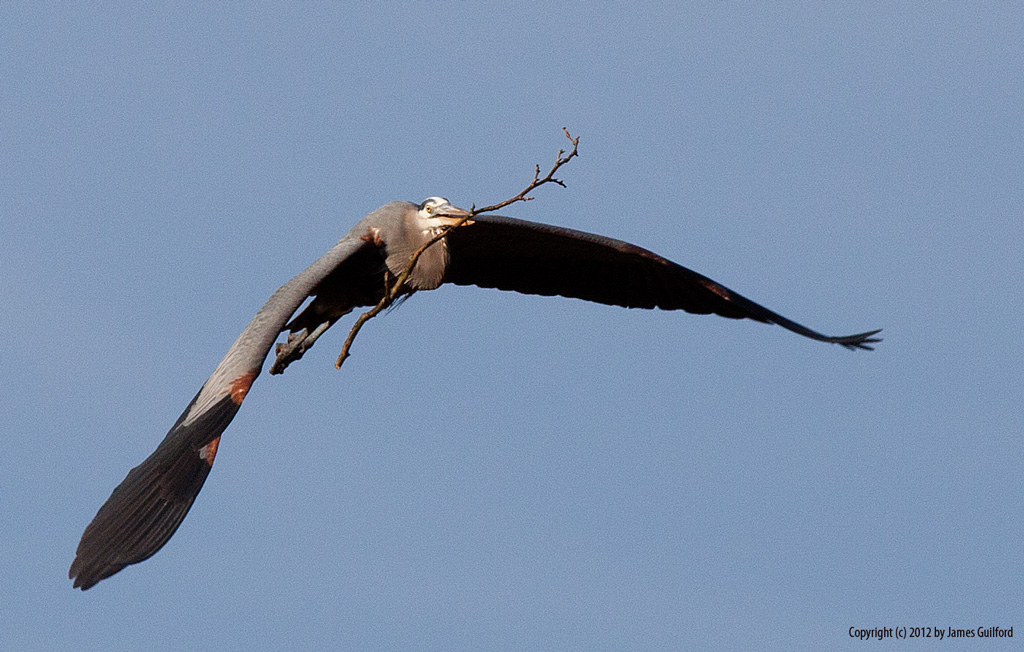
The Great Blue Herons were still at their nest building with big birds swooping down from the trees, collecting twigs, branches, and other materials, then lofting to the treetops.
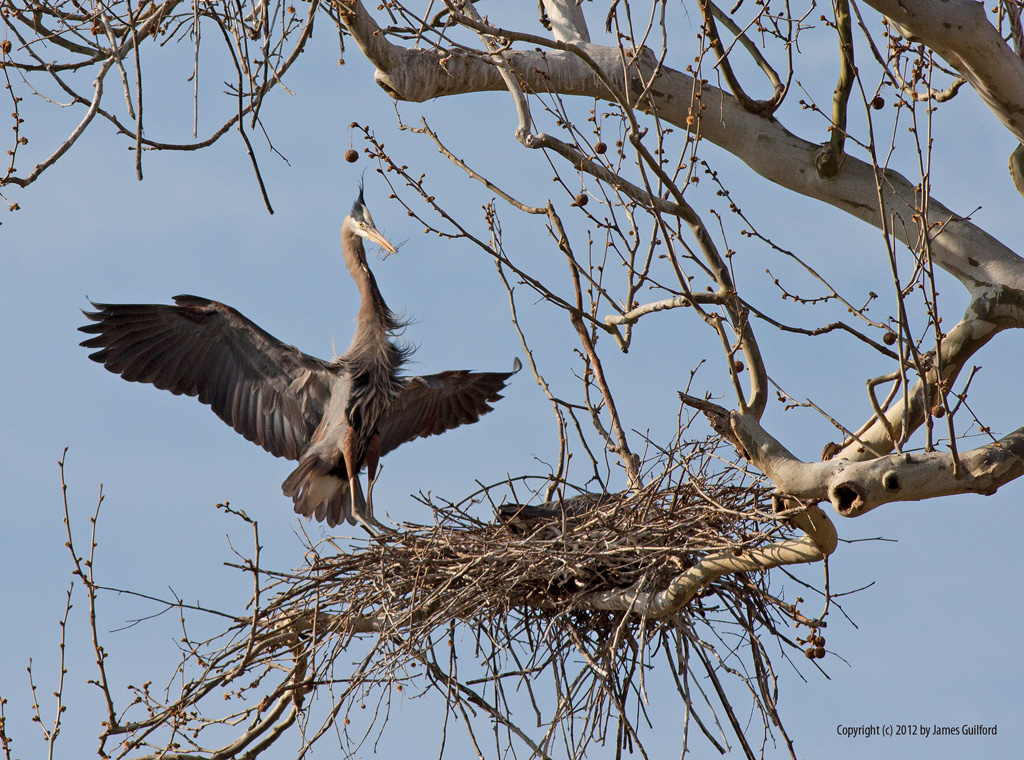
Alighting in the thin branches and on their nests, the collected twig is delivered to the waiting mate and appropriately placed to become part of the nest.
Lunging from the nest, the collector begins another cycle of careful selection and delivery of construction material. Soon chicks will appear in the nests and then, for mom and dad heron, the work really begins!
It was a fine morning of bird photography and I filled two memory cards with images. Once back, I deleted a few pictures but most were worth keeping and some were quite good; I’m happy to have shared a few here.
A clear evening sky gave me the opportunity tonight to see planet Venus floating right below the beautiful naked-eye star cluster, the Pleiades (M45). The combination was beautiful through my binoculars, just before 8:30 PM EDT. I decided to make a quick try at recording the scene with my camera and 400mm telephoto lens mounted on a tripod. The problem, of course, is that an exposure of any decent length will cause the stars to form curved lines as they appear to move through the sky. Even my brief five-second exposure was no different… it looked great in the camera’s built-in LCD preview panel but pretty sad on the big computer screen. So I used a bit of crude Photoshop work to round out the stars. The result won’t make the pages of Astronomy or Sky & Telescope magazines but it’s not too bad and saved the shot. This, and a very intriguing result from the nearby Orion Nebula (M42), makes me eager to get out on another clear night and spend some time with the camera mated to a tracking mount or piggybacked on a telescope!
The Photoshop work, by the way, was a duplicate layer used with “blending mode” set to “Darken” and then used as an offset filter. The offset filter is nudged around until the best combination of masking and brightness is found. I found the process described in a forum discussion on Cloudynights.com.