A Cooper’s Hawk perches on a tree branch, its eyes trained on nearby bird feeding stations. Heavy snow swirls around, as if in a snow globe. — Photo by James Guilford.
Early January and heavy snow was falling. Local birds were flocking to our bird feeders. Suddenly, the small birds disappeared. The local Cooper’s Hawk had showed up for lunch and our smaller feathered friends did not want to be lunch. Snow and blowing snow came and went as the raptor sat, observing from a tree branch. Sometimes the hawk could be seen clearly, sometimes snow completely hid it. The hawk watched for a while but, seeing no potential prey, flew off to hunt elsewhere.
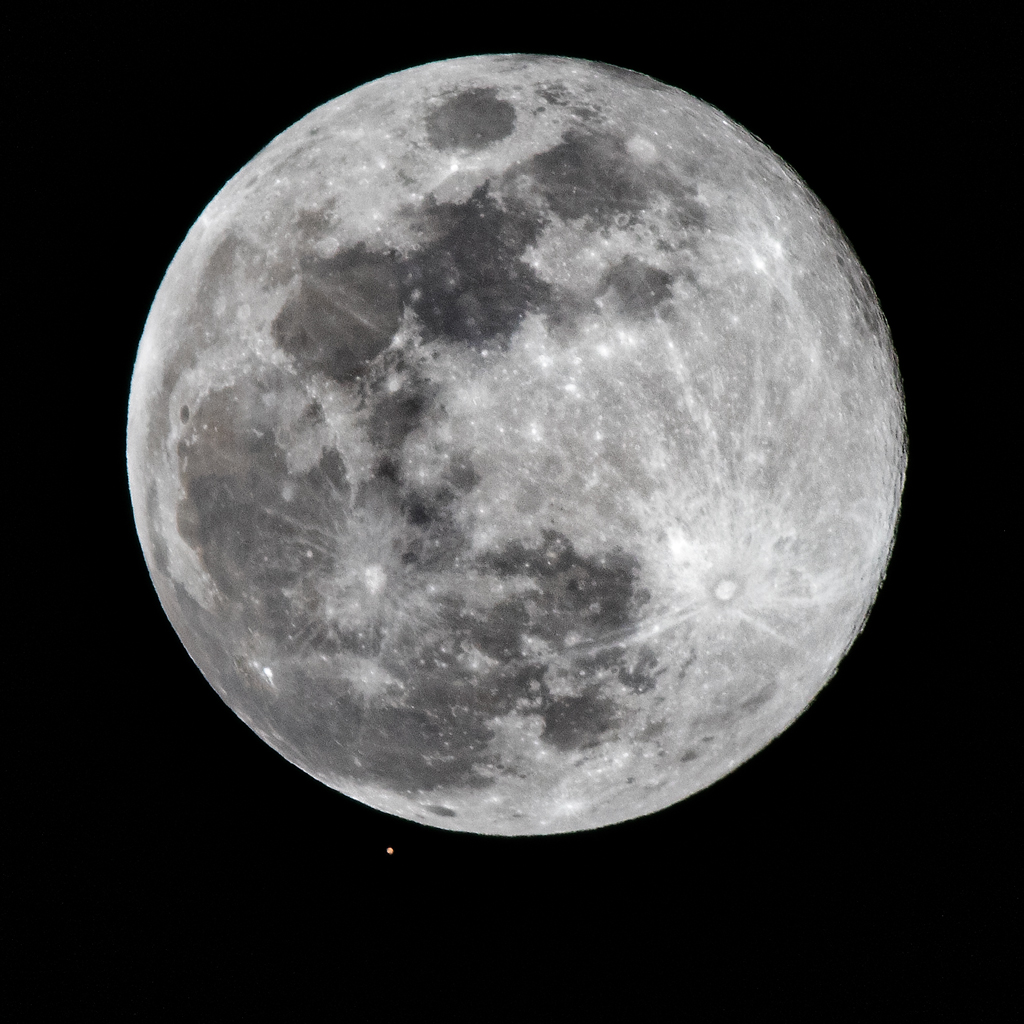
Only a few minutes from occultation, Mars is seen just off the lower edge of the lunar limb in this full-disk image recorded at 9:09 PM EST. The event only occurs with planet Mars about once every 14 years. Photo by James Guilford.
Passing clouds threatened to obscure the 2025 lunar occultation of Mars but thanks to gaps between those clouds, there was enough clearing for observation. Shortly after Mars vanished, so did those inter-cloud gaps. With Moon now cloud-covered, I did not return to the 13℉ night to watch for Mars to emerge.
A dull, ghostly lump is all that’s left as Mars disappears behind Earth’s Moon at 9:12 PM EST, January 13, 2025. Lunar basin Grimaldi is the dark oval just to the right of where Mars is seen here. Photo by James Guilford.
When wilt Thou save the people? O God of mercy, when? Not kings and lords, but nations, Not thrones and crowns, but men! Flowers of Thy heart, O God, are they; Let them not pass, like weeds, away; Their heritage a sunless day: O God, save the people!
Shall crime bring crime forever, Strength aiding still the strong? Is it Thy will, O Father, That man shall toil for wrong? "No," say Thy mountains; "No," Thy skies; Man’s clouded sun shall brightly rise, And songs ascend, instead of sighs: O God, save the people!
When wilt Thou save the people? O God of mercy, when? The people, Lord, the people, Not thrones and crowns, but men! God save the people; Thine they are, Thy children, as Thine angels fair: From vice, oppression, and despair, O God, save the people!
-- Ebenezer Elliott, 1850
I sang this song when I performed in "Godspell" now these many years ago. A musical by Stephen Schwartz, the show featured several songs with lyrics borrowed from old hymns. This one (ca. 1850) seems especially appropriate right now.
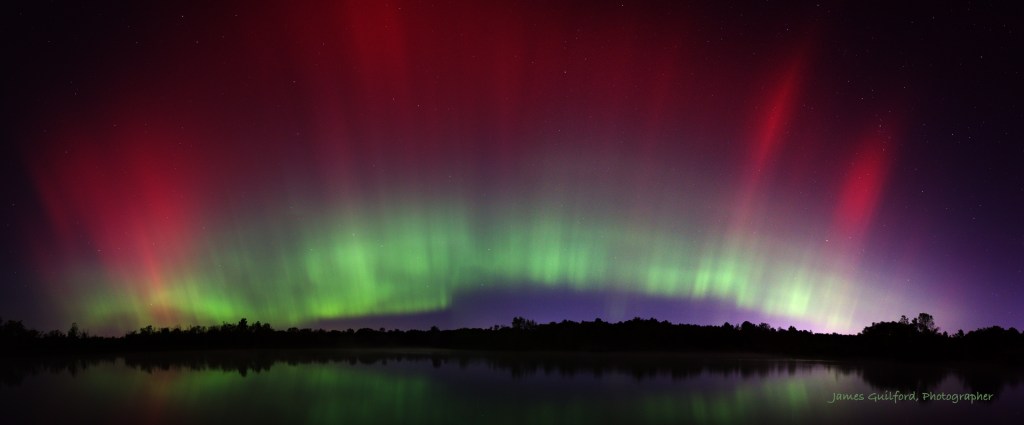
A panoramic view of the aurora borealis peak as viewed from rural Medina County, Ohio. The display is reflected in the still waters of a small lake.
It began on Tuesday, October 8, when a sunspot called AR3848 flared explosively over the course of several hours. The detonation hurled a large and powerful coronal mass ejection (CME) Earthward from Sun. On Thursday, October 10 the magnetically-charged solar plasma hit Earth’s geomagnetic field and fireworks erupted. According to SpaceWeather.com the aurora borealis was seen as far south as Puerto Rico!
I headed out to a remote county park location, where I have permission to be after dark, and was fortunate enough to be ready when a significant surge in activity occurred — around 10 PM EDT. That peak was amazing with colors, shapes, and movement visible across the entire northern horizon. It was particularly cool to see pillars appearing and disappearing in real time. Light from the aurora reflected upon the still waters of the park’s lake. Adding to the quiet, magical mood, were occasional calls in the darkness from perched birds, as if asking “who’s there?”. A wood duck, out on the lake, piped a note that echoed its solitude.
During peak activity, looking east, we see intense red crowning a curved green ring, the Northern Lights reflected from the surface of still lake water.
The auroral surge went on for probably a bit more than half an hour, challenging me to select a spot to photograph. First one area would glow, then one at the other end of the bow-shaped display, pillars of light would appear like searchlights, then fade away. A thrill to witness as light, movement, and delicate colors were visible to the unaided eye. The camera picked up more than my poor eyes could see but I say without reservation this was the grandest aurora I’ve witnessed.
The western end of the coronal arc appeared strongest, as viewed from Medina County, through most of the evening. Here, during the surge, we see the full range of auroral colors, curtain-like waves of shape, and pillars that look like they reach the ground or might be mistaken for searchlights projecting from the ground. Photo by James Guilford.
All evening there seemed to be more intense activity over the western end of the aurora; that was verified by relatives in northwest Ohio whose photos showed a sky full of color directly overhead.
Although some observers were concerned that moonlight might drown out the aurora, that was not a problem during the peak or as it began to subside. This image shows the waxing Moon, low to the western horizon, with colorful patches of glowing sky nearby.
While I was at the lake I heard others coming and going from the park, pretty much the entire time I was there. A young couple eventually ventured away from the parking lot and encountered me at my spot around 11:30, seeking what I had found — a dark spot near the water. Their arrival had been delayed by a camera gone bad, and they had gone home to pick up another. Things petered out not long after the peak and, checking NOAA resources, it looked like the auroral ring was retreating back north. The couple had missed the best of the night and I, with frozen fingers and toes, I headed home.
I submitted a couple of my photos to the local newspaper and the editor selected one for use on Page 1. Although color was subtle when the October 10 display was viewed by eye, cameras intensified the brightness and color. I boosted the color even more for use by the paper as, when printed, it loses a bit. This digital version of the page is even brighter than the others shown here.
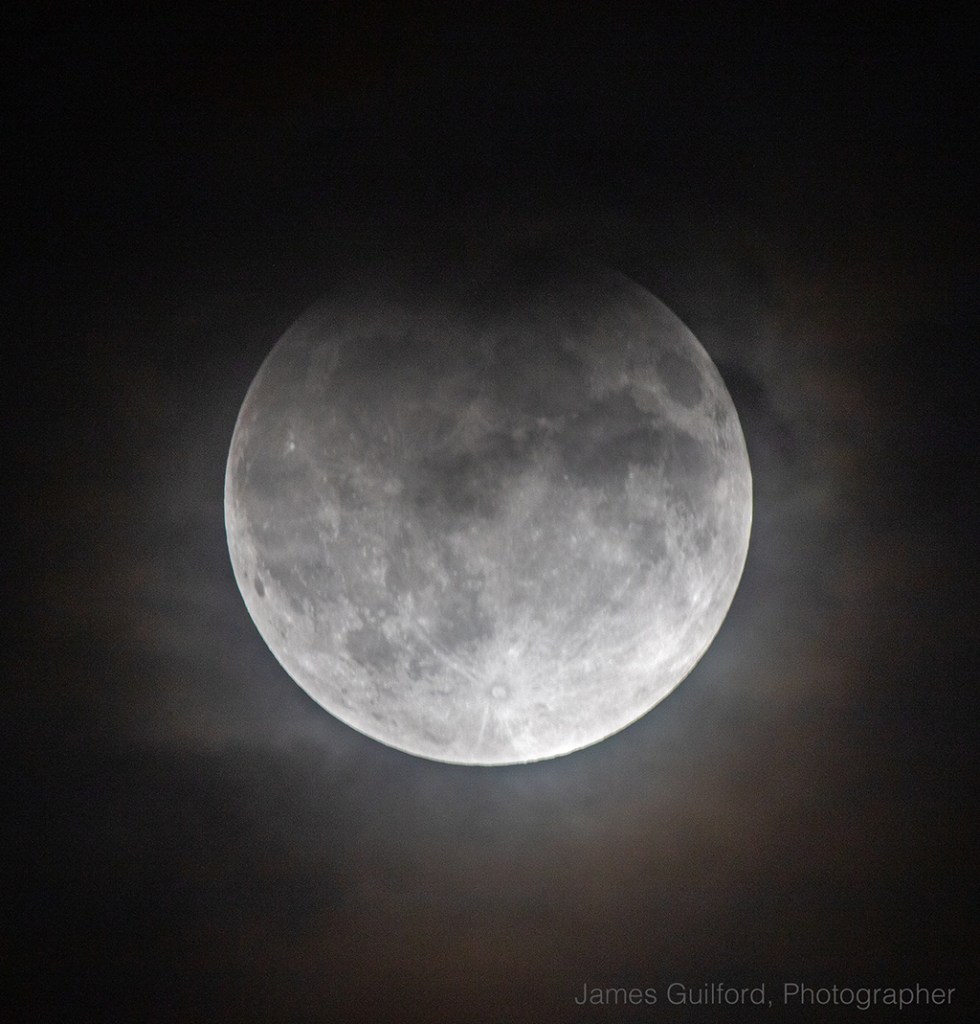
Clouds move across the face of the moon, two minutes ahead of maximum eclipse, lending color and mystery to the scene.
Tuesday, September 17 brought the opportunity to see a partial lunar eclipse without staying up all night. That’s the sort I call a prime-time event. The skies were partly to mostly cloudy through the evening but, as the time for maximum eclipse approached, breaks were appearing in the cloud cover. I set up my camera and tripod and, with about 15 minutes’ lead time, headed out to the patio. I made a few test shots using the Canon EOS 7D Mk. 2 camera, and then a few more to keep. One shot was made at 10:44 PM EDT simply to record maximum. My favorite images, and by-eye views for that matter, were of Moon as thin clouds passed across and near the glowing orb, lending color and mystery to the scene.
Partial lunar eclipse at maximum, September 17, 2024, at 10:44 PM Eastern Daylight Time, by James Guilford, Photographer.
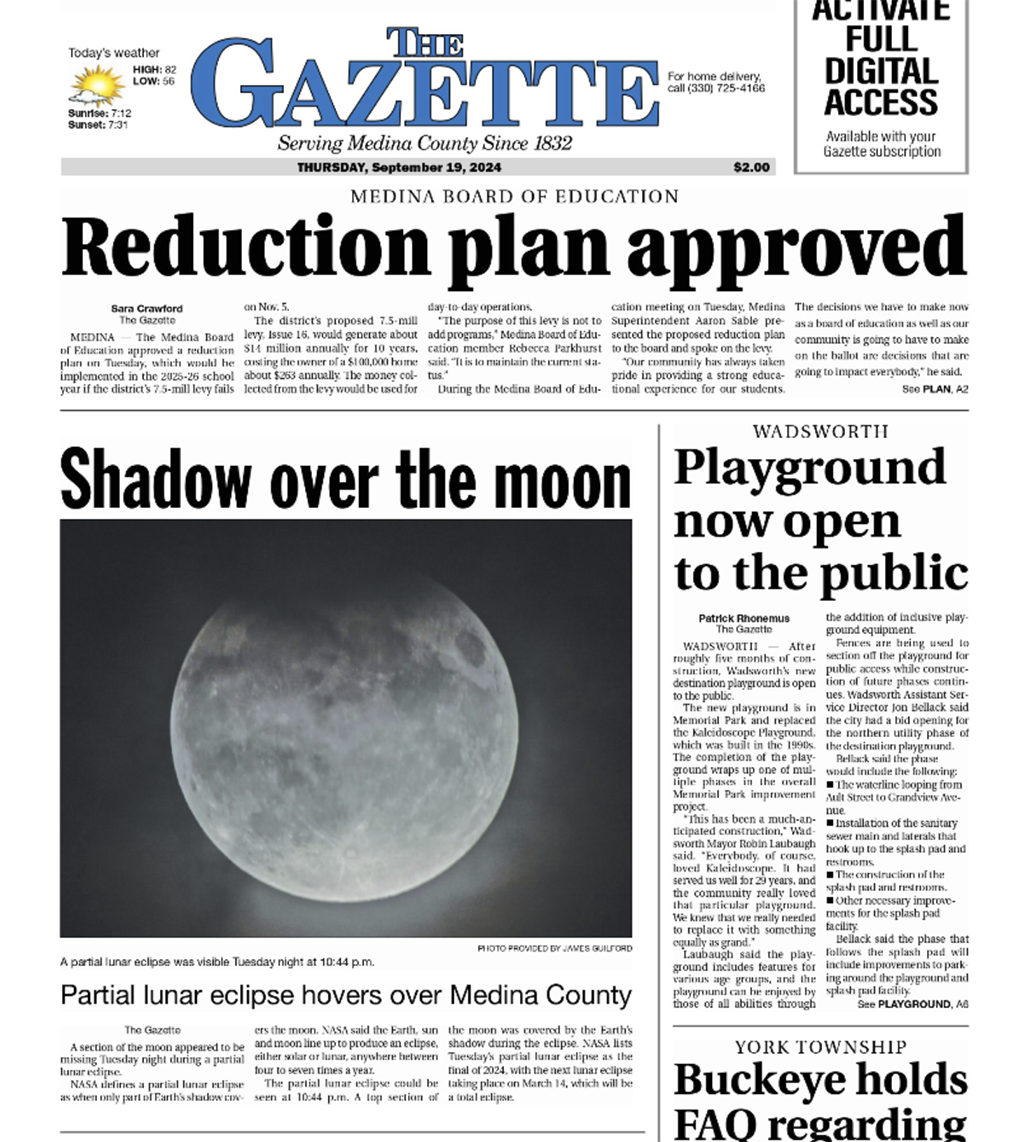
That same night I made a copy of my “maximum eclipse” digital image and sent it off to the local newspaper. Too late for the next day’s edition, my photo showed up today (Thursday), not only on Page 1 but at three columns, huge! The paper’s rendering of the image lost a bit in the translation but still represented what was seen.
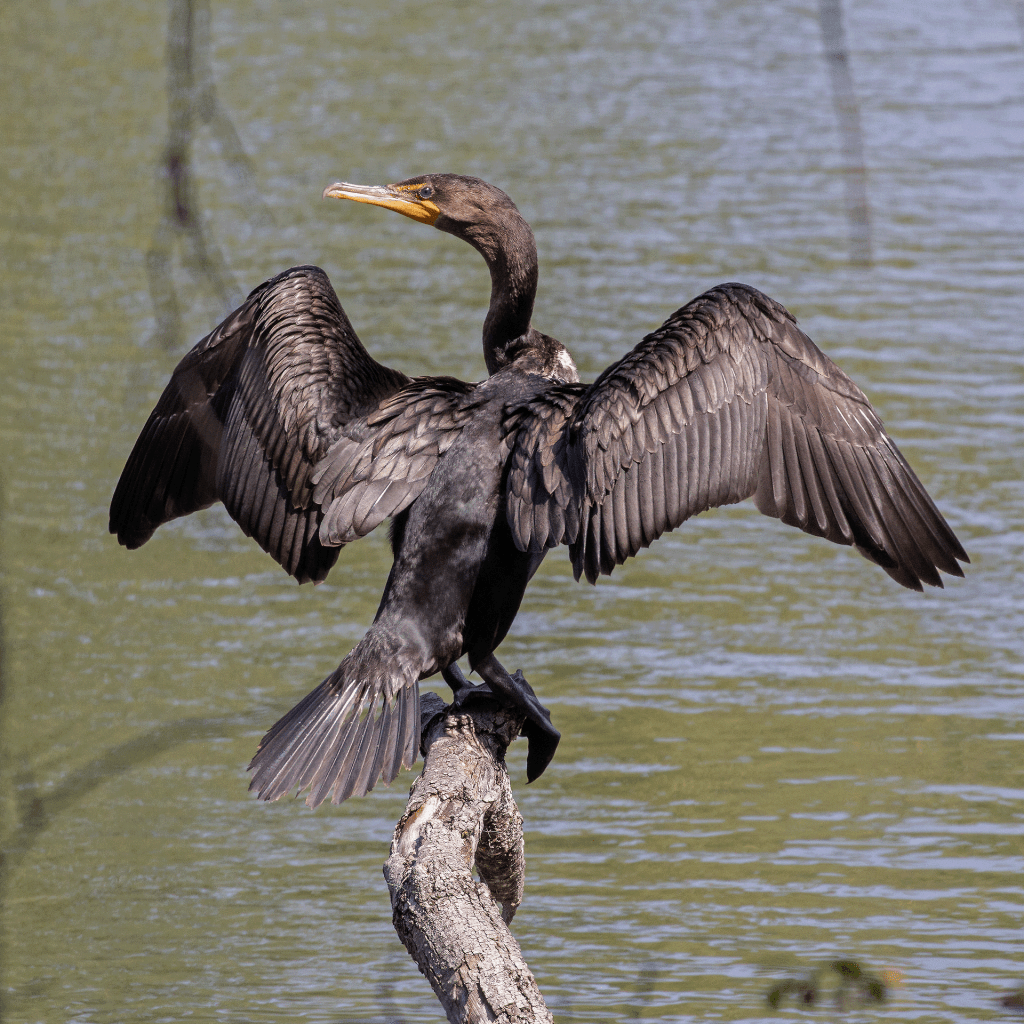
Recently I thought I’d caught glimpses of a cormorant flying over the far side of our pond but I couldn’t be quite sure. Yesterday, I noticed a large bird perched over the water on a fallen tree branch and there it was — a double crested cormorant! Not an uncommon bird but this is the first I’ve seen one here. The bird spent most of the day on that branch basking in the sun, looking around, occasionally swimming, mostly just hanging out. I haven’t seen it today.
A male Eastern Bluebird strikes an unusual pose atop the bend of a shepherd’s hook bird feeder hanger. Photo by James Guilford.
I glanced out the window this morning and spied this male Eastern Bluebird (Sialia sialis) looking all…. broken. The bird was perched atop the shepherd’s hook hanger for the bird feeder six feet off the ground, head cocked to one side, wings disheveled, and totally still. Sick? Injured? A little birdie weirdo? I don’t know! After what seemed a long time, he righted himself, shook himself back into shape, preened a bit, then briefly repeated the pose before flying off. Mrs. Bluebird paid a brief visit shortly after the mister left and she behaved normally. Thank goodness Mr. Bluebird stayed in place just long enough for me to capture a few frames through the window.
Sunspots AR3716, AR3713, and AR3712 are nearing the sun’s western limb or horizon to disappear for at least a couple of weeks or possibly forever. Vixen VC200L Cassegrain telescope with white light solar filter. Image Credit: James Guilford
Braving the already hot and humid morning today, I set up my telescope and made photos of three large sunspots. I’ve been checking on them daily since they made their appearance and wanted to bid them a fond farewell before they disappear to Sun’s far side. The close-up view is via my telescope while the full disk image is from my Canon 400mm telephoto lens; both images recorded using my Canon EOS 7D Mk. 2 DSLR camera body.
Full disk image of our nearest star via Canon EF 400mm 1:5.6 L lens with 2X extended and a white light solar filter used to prevent severe damage to the camera and to the photographer’s vision. Image Credit: James Guilford.
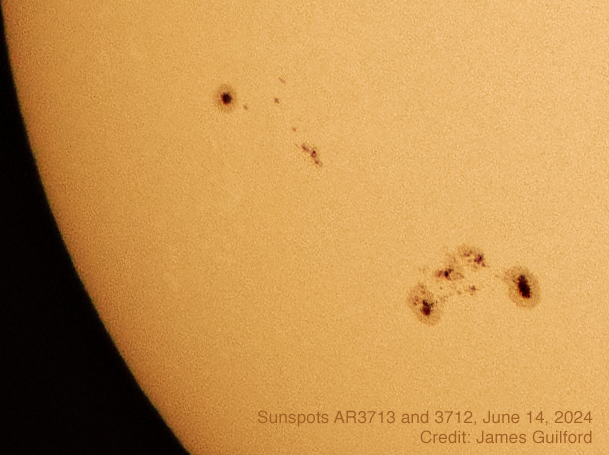
Detail copied from the whole-disk image of Sun, showing sunspots AR3713 and 3712 as they appeared June 14, 2024.
We have not been taking nature walks the way we used to so most photos of animals have been very close to home. I have been photographing the sun lately — maybe especially since the April total solar eclipse. I’ve been interested in Sun at one level or other since my youth. Though I hope to develop the ability to photograph old Sol in Ha or hydrogen-alpha (look it up) exposing chromospheric details in the plasma maelstrom of our nearest star, I remain fascinated with sunspots and the solar photosphere.
Today was another day featuring a cloudy morning and sunny afternoon. This time, however, we experienced excellent seeing for a while — just long enough to record today’s solar portrait. I’m so pleased with the “inset” image that we’re featuring it first — it’s cropped directly from the whole-disk picture. Obviously sunspots AR3713 and AR3712 are dominant features but there is a parade of features visible.
Annotated whole-disk image of the sun as it appeared the afternoon of June 14, 2024.
Doing this the “old-fashioned” way, this image was a single exposure manually selected as best of a larger group of shots. The chosen image is edited to produce the best available picture from the data gathered. Today’s excellent seeing made for an unusually good photo. I’m pretty pleased.
I saved a number of “also-good” exposures and may some day use them in the modern process of stacking sub-frames to create an even better view. Today, however, I’ll just sit back and enjoy what I got.
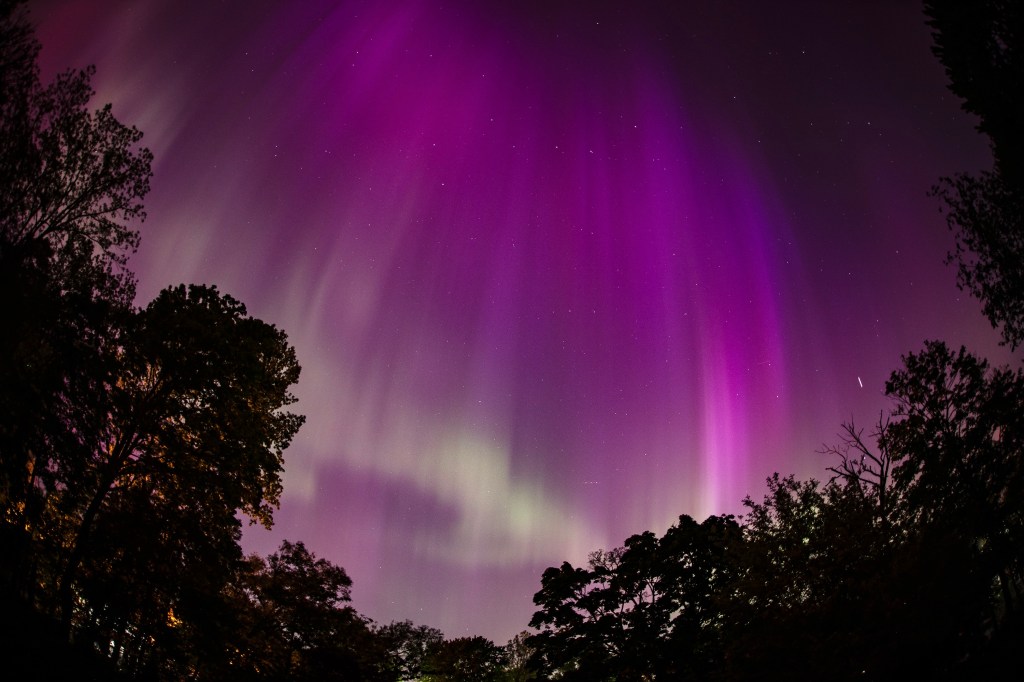
My first DSLR shot of the night turned out to be the most spectacular. This is a view looking northward from the city of Medina, Ohio.
It turned out to be a stronger impact than forecast, and the strongest thus far of this solar activity cycle; the geomagnetic storm of May 10 – 11, 2024 produced auroras (Northern and Southern Lights) visible at night from locations nearly pole to pole.
The forecast of possible aurora prompted me to step outside at about 10 PM (EDT), when twilight had faded, to check the skies. At first I saw what I thought might be clouds but knowing auroras can be feeble, I watched. Sure enough, there was movement in those “clouds”.
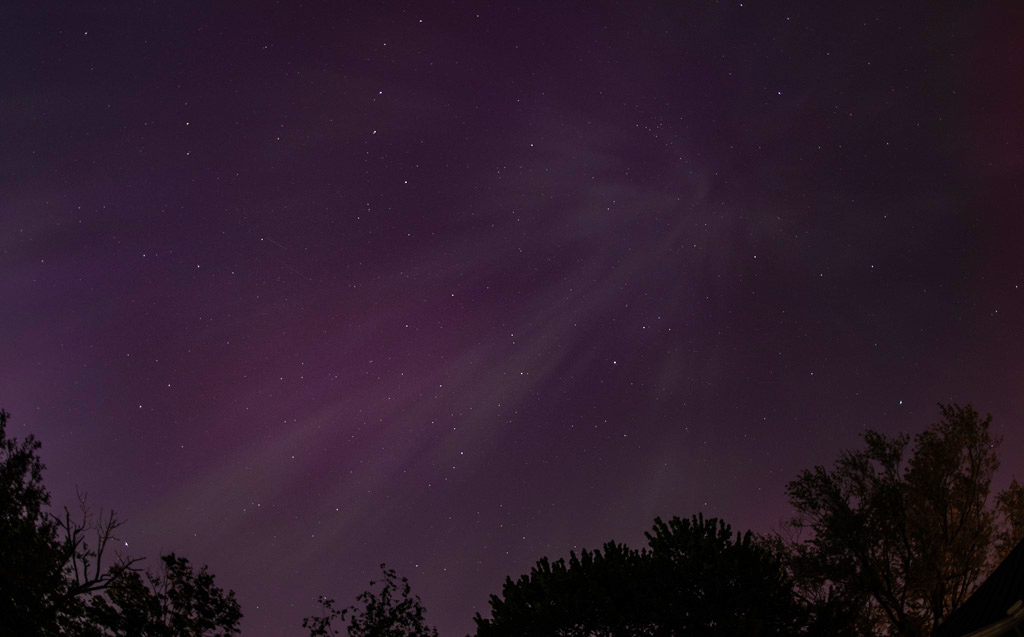
To the unaided eye, the great aurora of May 10 looked like this — streaks of “cloud” with a bit of color. Watching the streaks closely, however, the observer could see them changing in size and shape more rapidly than simple cirrus.
Glancing overhead I saw what I found hard believe — aurora ray features directly overhead … at 41º latitude, a rare sight, indeed! Rushing back indoors, I pulled together camera, fisheye lens, and tripod and headed back out.
My first image of the night was from my iPhone 13. So little effort to see and record such an amazing view! It was exciting to be able to share this with the world in real time via social media!
The aurora still presented itself as cloudy streaks with, perhaps, hints of color. Now also armed with my smartphone, I activated its camera and aimed it at the sky. There on the screen, light amplified by the phone’s electronics, glorious, eye-popping colors filled the sky! I’d never before experienced an aurora like it.
A rare sight indeed is an aurora borealis streaking down from directly overhead at 41 degrees latitude! I’ve never before witnessed such a display.
Only occasionally, during the time I was out, did the aurora’s color become visible to me; apparently being just below the limits of my, and others’ visual perception. Another local observer noted color was more visible shortly before I stepped outside to check on things — the actual peak of the display must have happened as twilight was ending and before 10 p.m.
Colorful curtains lit the northeastern sky as the aurora re-surged from a quieter moment.
I observed and photographed the aurora from shortly after 10:00 until about 11:30 EDT and in that hour or so, the intensity faded and then re-surged before fading away which was my signal to shut down.. I might have stayed out longer but had a commitment for the next day — sleep was needed — so, satisfied I’d seen the phenomenon at its best, I put away the camera gear.
Looking north, find the “Big Dipper” tipped over as if pouring watercolors down on the land. The single dot visible near the center of this picture is the North Star, Polaris. Note how one can find Polaris by looking where the two stars of the dipper’s bowl point.
Knowing it would be all over the news, I submitted my most spectacular shot of the night to the local newspaper — a daily that publishes on Saturday but not Sunday. It was too late for the Saturday edition but the editor gave my photo a three-column, Page 1 spot on Monday.
Our Sun is still in its peak activity period, by some accounts it won’t hit solar maximum until some time in 2025, so there may be more auroras in our near future but this was one for the history books!