I was messing around with my recent soft-focused “antique” image of Moon’s Crater Tyco when I discovered a Photoshop sharpening feature I’d never used. I reprocessed the image using that setting and got a “better” result: sharper appearance of the crater itself but with more grain. I think I like this new one better than the one I originally posted. Here they both are: Reprocessed Above / Original Below.
I’ve tried in the past to directly connect a modern DSLR camera to the ca. 1901 Warner and Swasey 9-inch telescope I operate for a small college. Because some original fittings have been lost over the decades and I use an eyepiece adapter a predecessor built, the telescope’s couldn’t be used for focal plane camera operation. Focal plane would have been like using the telescope as a 3,200mm telephoto lens. So I was limited to afocal use — holding the camera with one of its own lenses over the telescope eyepiece and trying to record that image. When it worked afocal photography produced very good, even excellent results for the Moon; dim objects could not be handled that way.
Recently it occurred to me that I hadn’t tried eyepiece projection: using a special adapter to hold an eyepiece, connect to the telescope and camera, and project the eyepiece image on to the camera’s image sensor. I scrounged around and found and eyepiece projection adapter in pieces, put it back together and, trying it last night, got interesting results. On this first try with the vintage scope the images all came out in soft focus with details at the center of the image somewhat better than those surrounding it. The overall effect is, I think, quite artistic.
I’ll keep trying with that old scope, with my own new telescope as well, to try and get sharp images but, for now, we have some lovely lunar art!
It surprised me. We were expecting rain and thunderstorms but the approaching weather looked disorganized and “wet” — that is, plenty of rain leading the way and blocking views of the storm clouds. Suddenly I got indications from observers to my west that something was cooking, so I fired up my radar access and saw a well-defined monster of a storm approaching. I grabbed a camera and headed out, knowing I couldn’t get far before meeting the storm.
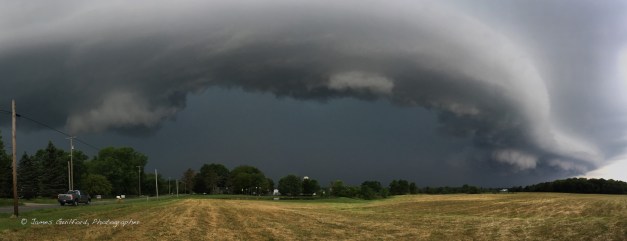
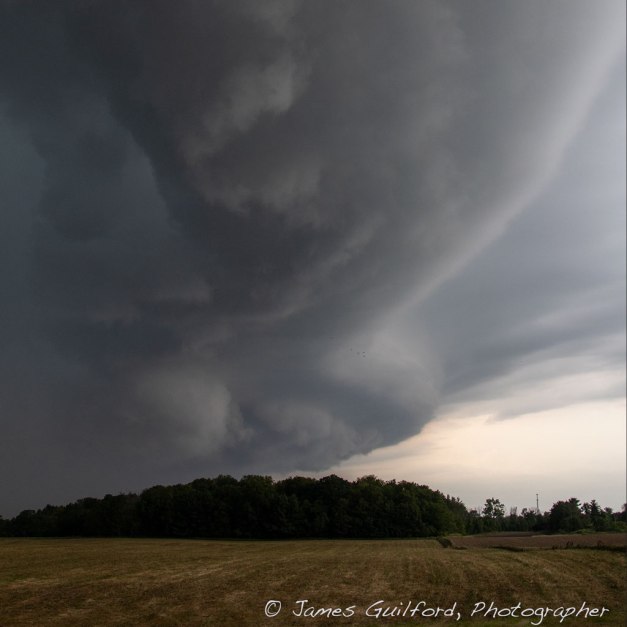
Finally getting through town and out into the countryside, I saw on the horizon hints of the approaching line. I quickly located a farmer’s field access path and pulled off. I got there just in time to watch the shelf cloud develop, roll toward me, and pass overhead.
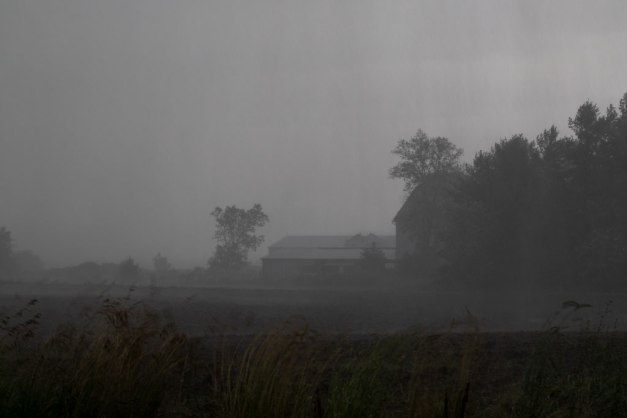
As the ominous clouds passed overhead, I knew to what to watch for: torrential rain! I strolled to my car as the wind began to rise, got in, and enjoyed the arrival of the downpour from dry, air conditioned comfort!
This was possibly the most impressive shelf cloud I’ve seen; bear in mind I don’t chase in the Great Plains. I nearly missed this one and, as it turns out, I grabbed the wrong camera — could have done with the wide-angle lens left behind!
Thanks to the unnamed property owner who drove over to see what I was doing and generously allowed me to stay put on her drive!

Shelf cloud photographed July 2, 2019 in central Medina County, Ohio. Note the area of heavy rain to the left, the “clear” area bearing strong winds to the right.
I love shooting shelf clouds — clouds that form a line or arc along the leading edge of a gust front in a thunderstorm. They are awe-inspiring, scary, to me they’re just beautiful in their power rugged symmetry. I’ve looked at clouds from both sides now (apologies to Joni Mitchell) and discovered something at least as impressive; clouds of chaotic shards and pieces, tumultuously flowing together as a mass. I saw this configuration with a severe thunderstorm that dropped a tornado a few weeks ago, and I saw it again today in another severe thunderstorm — after the shelf cloud passed. I still love photographing shelf clouds (called “shelfies”, a twist on self-portrait “selfies”) but…

StormLight — Storm clouds close in giving last light to a farmer’s field before rain began. Canon 6D MK-2 Image.
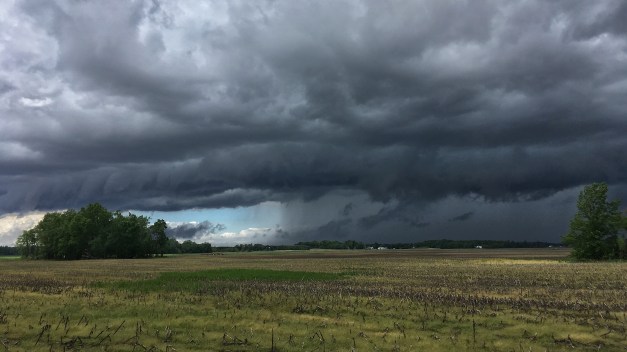
May and June bring stormy weather and stormy weather often means dramatic skies. The evening of June 1 saw strong storms moving across Northeastern Ohio and when I saw an outflow boundary showing up strong and clear on radar, I headed out to see what was happening. I had not driven very far when I reconsidered my original observing destination and headed for the nearest open area I could find. Sweeping toward me over the treeline was a very impressive line of cloud; the line was so long I quickly shot several images using my trusty iPhone SE with the idea in mind of creating a multi-panel panorama later.
Once the outflow boundary rolled over me, I continued my trip seeking the cleanest storm edge I could find; several appeared to be headed my way but the line of storms seemed to be changing direction. After a good bit of moving around, I decided to head to the Wellington area in Lorain County as my best chance at a storm intercept. I discovered a farmer’s field access drive off a rural road and waited, surrounded by open fields, for the weather to come my way. And I waited. And waited. While I waited I photographed the changing cloudscape and wound up with my favorite view of the day — the last light illuminating a field as stormy clouds closed in. A complex and brilliant bolt of persistent Cloud to ground lightning convinced me my time in the open was done. Not set up for lightning photography, I watched from inside the car for a bit and headed into rain and home.

A gust front rolls over open farm land ushering in a cold air mass and heavy rain.
On a visit to Northwest Ohio yesterday (May 30) I stepped outdoors, looked to the west and spied a beautiful sight… the ragged edge of a line of clouds in the distance.
I strolled out, beyond a treeline to get a better look and saw an impressive gust front running ahead of cold air rolling over the area! I quickly shot a series of photos of the scene using my iPhone but realized my big Canon DSLR camera was in the car. I quickly retrieved the Canon and returned to my vantage point.
Seeing how quickly the line was moving, I race-walked seeking a different view and shot a few more photos before rain drops warned me I’d better get to shelter.
Normally I drive miles to intercept phenomena such as this gust front but this time it came to me — a surprise but a convenience — saving me the trip!

A gust front rushes closer ushering in a cold air mass and heavy rain.
Photographed and Written: September 16, 2018. Published February 25, 2019.
The weather has been so often uninviting this summer that it was a pleasure to have a nice day Sunday. It was hot but too pretty to stay indoors, so we drove to the Sheldon Marsh Nature Preserve in Huron, on Lake Erie.
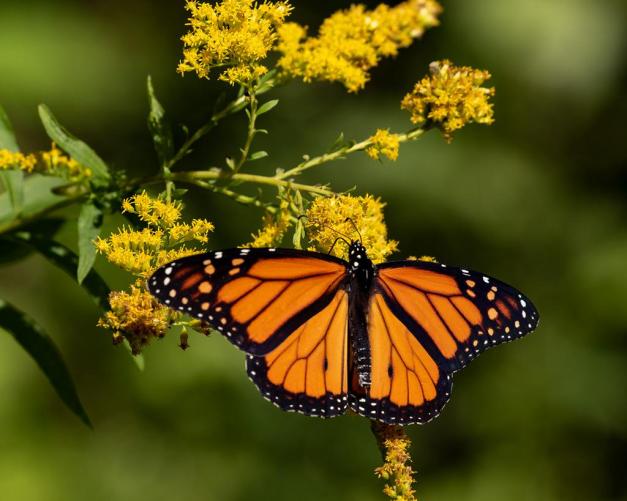
It’s migration season for birds but we rarely think of Monarch butterflies … they migrate too! It’s hard to imagine such delicate creatures as butterflies flying hundreds of miles but we have seen seeing them lately heading south. One of the first beautiful things we saw at the preserve was a Monarch picking up nectar from bright yellow flowers along the path.
We were also delighted to see an American Bald Eagle swooping down over the shallow waters of the marsh trying to catch a fish! As far as I could tell, the eagle missed the fish it was after when I spotted it. Some other visitors told us that they saw the eagle catch a fish but that it got away; it turned out to be a young bird so perhaps it needs to work on its technique! We didn’t even know there was an eagle’s nest at the nature preserve, so this was a real treat. At one point the eagle flew right overhead and that’s when I got my best pictures of it.
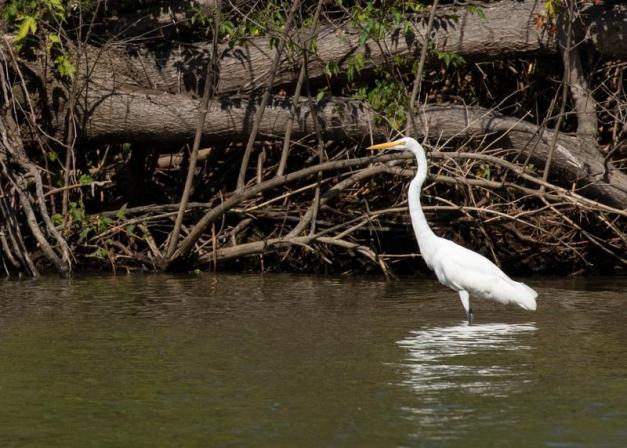
We watched a Great Egret, though we couldn’t get very close to it. The egrets are brilliant white with dark legs and only a little color: their orange beaks and a tiny greenish patch next to their eyes. They are so bright in sunlight that they are hard to photograph without special camera adjustments. The Great Egrets are sometimes harder to find than Great Blue Herons but are also wonderful to watch and I’ve gotten a few nice pictures of them over the years.
The main walking path at Sheldon Marsh is not very long but because of wooded areas, the wetland area, and the Lake Erie shoreline, offers plenty of wildlife spotting.
Speaking of spotting, I saw a feather stuck in the bark of a tree along the path! The feather was black with white spots. I don’t know how or why the feather was in that place but I suspect someone found it and put it on the tree. No matter, really, there it was! It turns out the be a wing feather from a Downy Woodpecker – beautiful, small black and white birds that often come to home feeders. I’ve found a Downy feather before but on the ground, not on a tree trunk.
The earliest fall colors are beginning to show up. Among them were some brilliant red leaves from a vine growing on a tree. The afternoon sun was shining through the woods, lighting up the leaves: perhaps my favorite way to look at them!
Among the other things we saw was a pretty Garter Snake – though it was too quick for me to get a picture – and a beautiful little Wood Duck that was quietly paddling around the marsh, just off the trail.
It was a beautiful day but as I said, it was also hot. We were walking slowly and mostly in the shade but we were dripping sweat so we headed home. It was a lovely Sunday afternoon.
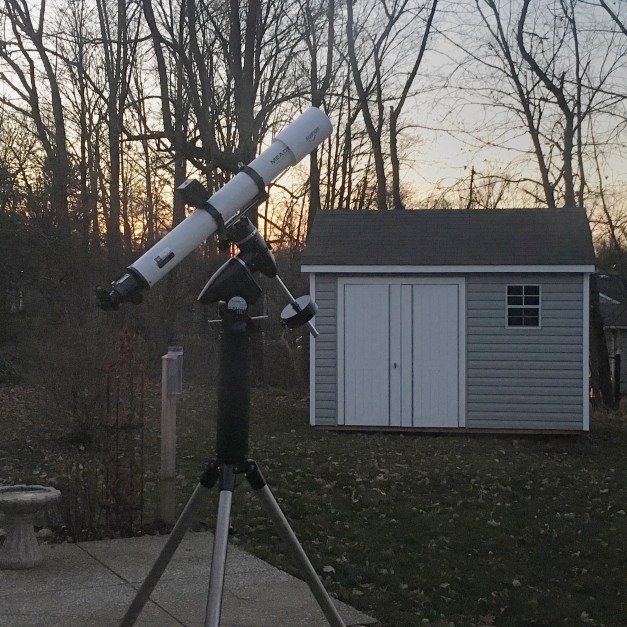
I’d been reading articles about Comet 46P/Wirtanen and how it was making one of the 10 closest comet flybys of Earth in 70 years “…the brightest comet of 2018.” It certainly wasn’t a spectacular, or even very prominent comet: bright, with a long glowing tail. Others’ images showed a small, pretty, green glowing ball. Still, a comet’s a comet and most of us don’t get to see that many in a lifetime, so I thought I’d give it a try. The trouble was the weather. We, in Northeastern Ohio, have been experiencing an unusually long stretch of cloudy and overcast days and nights and the night of Wirtanen’s close approach (Dec. 16/17) was no exception. The night of December 28, however, was to be clear but (there’s always a but) the Moon would be bright and not far from the comet’s position in the sky. You’ve gotta go with what you’ve got so I set up my ancient but solid Orion telescope mount managing very good polar alignment.
Piggybacking a big DSLR camera atop a telescope, I waited til 10 PM so that Wirtanen would be high overhead where the atmosphere is thinnest. The night was cold –about 24ºF– but quiet. As feared, that Old Devil Moon had lit up the sky making dim celestial objects invisible. And waiting til my target was near the zenith may have made sense technically, aiming the camera straight up was literally a pain in the neck. Thank goodness the camera has an articulated LCD panel so I could examine results without having to twist my neck or move the camera.
Starting out, I adjusted the camera settings so as to not overexpose due to lunar and terrestrial light pollution. It turns out those first two exposures were very useful. Then I blindly aimed the setup and shot about 10 exposures at wide angle. I re-aimed and shot 10 again. (For best results, astrophotographers often shoot more than 10 times that many exposures of the deep sky.) Then I tried zooming in, hoping greater magnification might isolate my quarry. I peeked at the camera’s LCD panel for a preview. Oh. It looked like we had jumped to light-speed! The zoom lens, pointing straight up, had slowly slipped from around 85mm to 24mm during the multi-second exposure. It’s a really good lens, a Canon L-Series, but I normally don’t point it up like that. Gotta get myself an 85mm prime (non-zoom) lens. The lens did hold at 105mm so I shot a few exposures at that focal length.
Feeling I’d done what I could to record a comet invisible to my eyes, I aimed the camera at constellation Orion’s belt and sword region now just above the trees, made a few exposures, and with cold fingers packed it in.

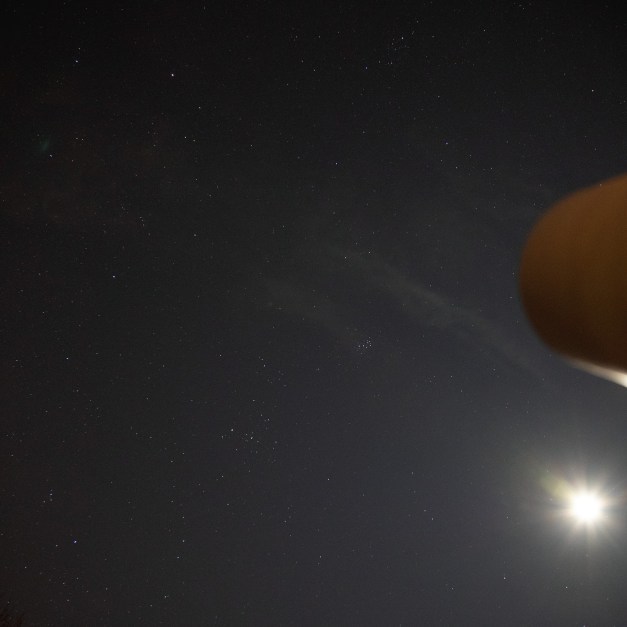
Riding the Telescope, the Camera’s View of the Sky. Think that’s a Comet in the Upper-Left?
As it turns out, I think I did image the comet but with all of the challenges and some inexperience at shooting “faint fuzzies,” the results were less than impressive: a hint of a glowing ball is all I got of dear, departing Comet 46P. The camera recorded far more stars than I could see in the far-less-than-perfect sky.

The Lens Flare looks Better than the Comet
I did get a pretty nice shot of Orion, which helped make the effort worthwhile.
Otherwise, not much to show for it but it was fun trying!
Working on my annual photo calendar for family and friends, I realized I missed posting here a few shots I love from 2018. This shy male Wood Duck (Aix sponsa) we spotted in the wooded shallows near the path in the Sheldon Marsh State Nature Preserve, Huron, Ohio. The bird soon paddled deeper in the wetland wood disappearing completely from sight. September 2018.