Vacation Day #5? Not really. I spent Friday doing things other than photography. The photo above was from my visit to the Cuyahoga Valley National Park’s Ira Road Trailhead/Beaver Marsh area. I watched as a pair of Tree Swallows (Tachycineta bicolor) made frequent commuter flights between nearby ground and areas of the surrounding wetland. I couldn’t be certain whether they were feeding young or working on their nest within the trunk of a dead tree. This was one occasion, however, when I wished I’d carried a tripod — the birds are fast and I’d have liked to catch them arriving at the nest hole or together but the narrow view of the telephoto allowed little lead time. Still, I’m very happy with this picture: the female diving from the nest hole beginning yet another flight.
CVNP
All posts tagged CVNP
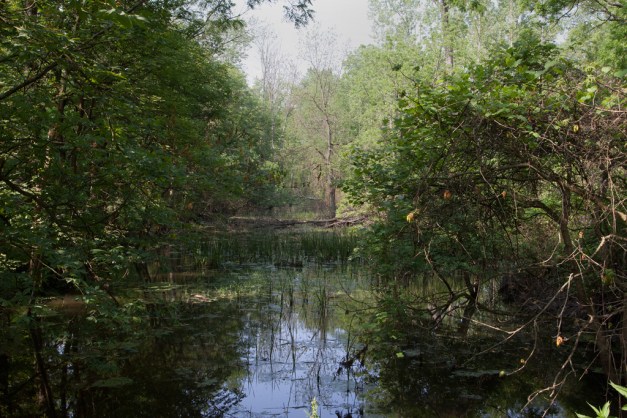
The Cuyahoga Valley National Park was developed around the Ohio & Erie Canal which shadows the Cuyahoga River within its great valley. There remain relics of the great canal project of the first half of the 1800s. The one relic still in daily use is the towpath — where mules provided the “horsepower” tugging canal boats loaded with cargo and passengers north and south between the Ohio River and Lake Erie. Today the towpath is a popular trail used by runners, hikers, and cyclists for recreation. The canal, for the most part, has become a series of longitudinal ponds or slow-moving creeks dug by men but claimed now by nature.
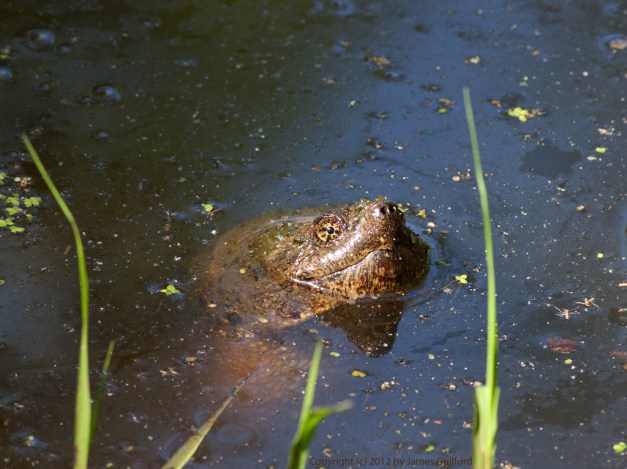
When I first arrived at the Ira Road Trailhead and walked the short path from parking lot to towpath, I looked to the side and at the still water in the canal. Near the bank was something… a submerged stick? a frog’s head? a turtle’s head? No. Oh, but yes! That thick stump was the head of a snapping turtle, doubtless waiting for some careless animal to stray within reach! I shot a couple of photos before the monster >>blup<< pulled its head beneath the surface and dove for the bottom.
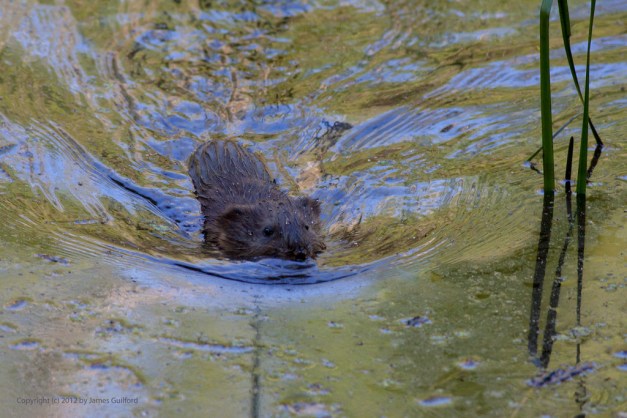
A little farther on I heard a rustling in the reeds, looked and spotted a young (by size) muskrat energetically swimming around in the canal finding and nibbling on, well, something or other. The rodent seemed unafraid of my presence though I don’t think it had learned to look up much. It swam this way and that, stopping for a nibble, then out and around again, and, like the turtle, <<blup<< underwater.
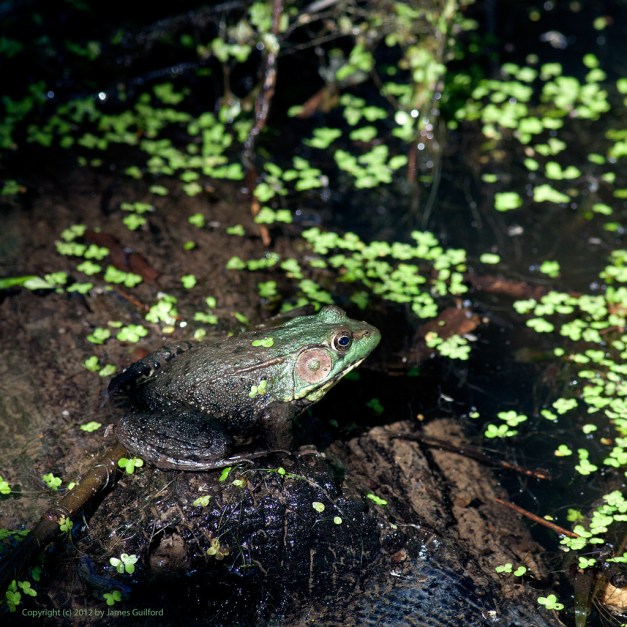
Of course, no naturalized pond would be complete without frogs and turtles and there were plenty to be seen and heard… one could hear the frogs, anyway.
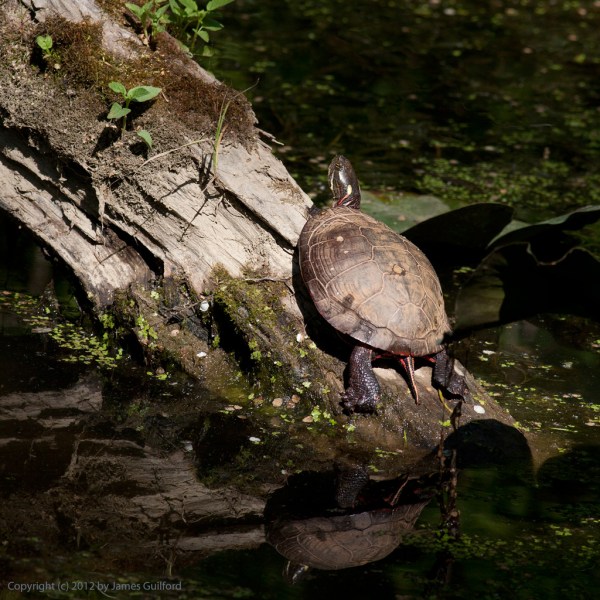
North from the trailhead is the Beaver Marsh area. The canalway apparently either skirted or opened into that wet area. The expanse is now densely packed with aquatic plants and tall reeds and home to all manner of life. The reeds teem with Redwinged Blackbirds, Great Blue Herons (if they brave attacks from the Redwings) come there to fish, and swallows fill the air apparently scooping multitudes of insects to feed themselves and their young families.
Long ago “canal life” probably best referred to the lives and livelihoods affected by the big canal system project. That transportation system carried freight traffic from 1827 to 1861 when the railroads made it obsolete. Now, more than 150 years later, canal life means something more like life supported by the canal — the plants and animals that depend upon that construction for their lives. I can’t think of a better end for such a thing.
This, the morning of my first day of my vacation week was spent enjoying nature in the Cuyahoga Valley National Park. Doing what? Following the progress of the Great Blue Heron families at their rookery, of course! I arrived a little after 9:00 AM and it seemed the birds were only beginning to stir. There was a constant background noise –chattering amongst the birds– but not much activity in the air. As time passed birds began to take flight, seeking food for their burgeoning babies, and I watched with undiminished awe as they flew overhead.
The young birds, when they can be seen, appear to have adult feathers and markings and are hard to tell from their parents in the nests. It’s been close to a month since I was last at the rookery (blame weather and work) and at that time I’d seen no chicks at all. Today there were birds everywhere. Adults were making regular food runs to nearby wetlands, ponds, and streams. The parents could also be seen, on occasion, carrying nesting materials, most likely for making repairs.
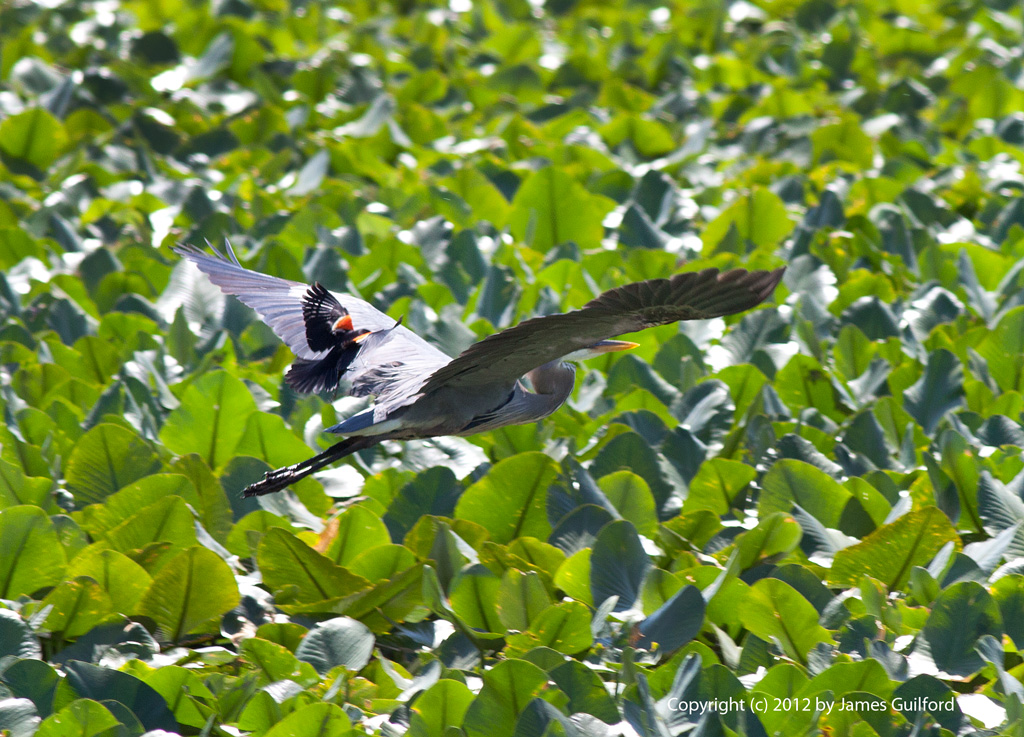
At the nearby “Beaver Marsh” area of the national park area, I watched for herons fishing. I’d seen one earlier and had hiked to a spot I thought might provide a better view. Just as I spotted the bird, it took off but possibly not because of me. In hot pursuit was a relatively tiny Redwinged Blackbird! The redwings inhabit the marsh in great numbers and are constantly squabbling over territory there. It seems, however, that NO interloper is to be tolerated: the tiny black bird chased the big adult heron, even physically strafing it before turning back towards home.
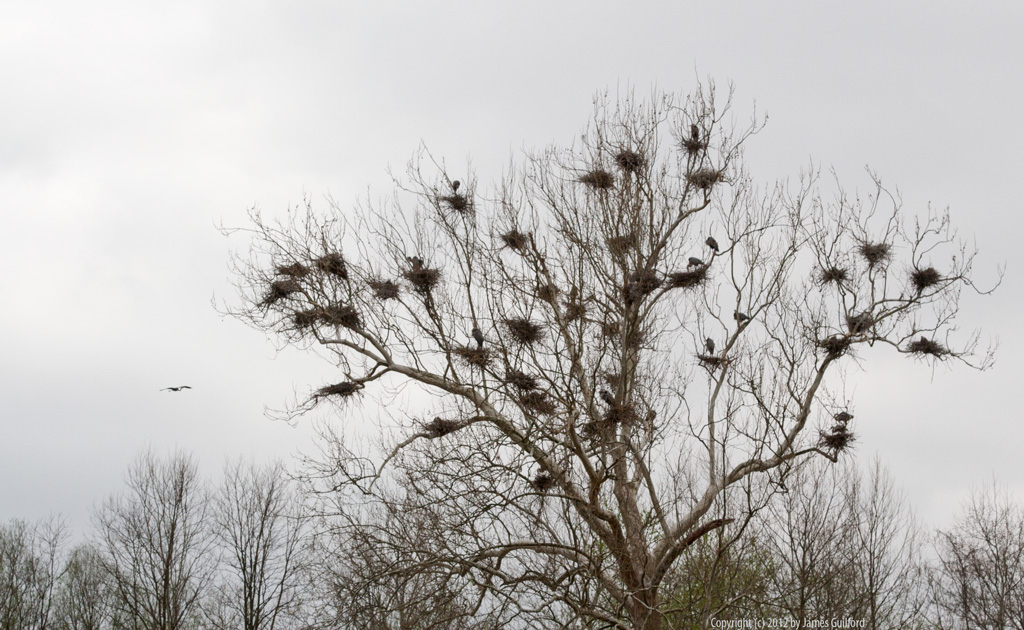
It was a damp, dark, chilly morning this Sunday. After breakfast and lounging around the house we could stand it no more and decided to take our changes… we’d head to the heron rookery! We arrived just as a large hole in the thick overcast delivered blue sky and warming sunlight. The scene along Bath Road was much quieter today. Nest building appeared to be done and the Great Blue Herons were mostly sitting on or perched near their nests. We presume, at this point, the birds are sitting on clutches of eggs. The homey scene was marred, however, by a sad sight. Somehow one of the adult birds had died, its lifeless body dangling from branches near a nest. Occasionally another, presumably its mate, would alight nearby and remain nearby perhaps wondering why there was no greeting, no reaction from its partner. I recorded a few cheerier scenes of birds flying or occupying their nests. All too soon the sky closed up again, drizzle returned, and we sought the warm shelter of our car.
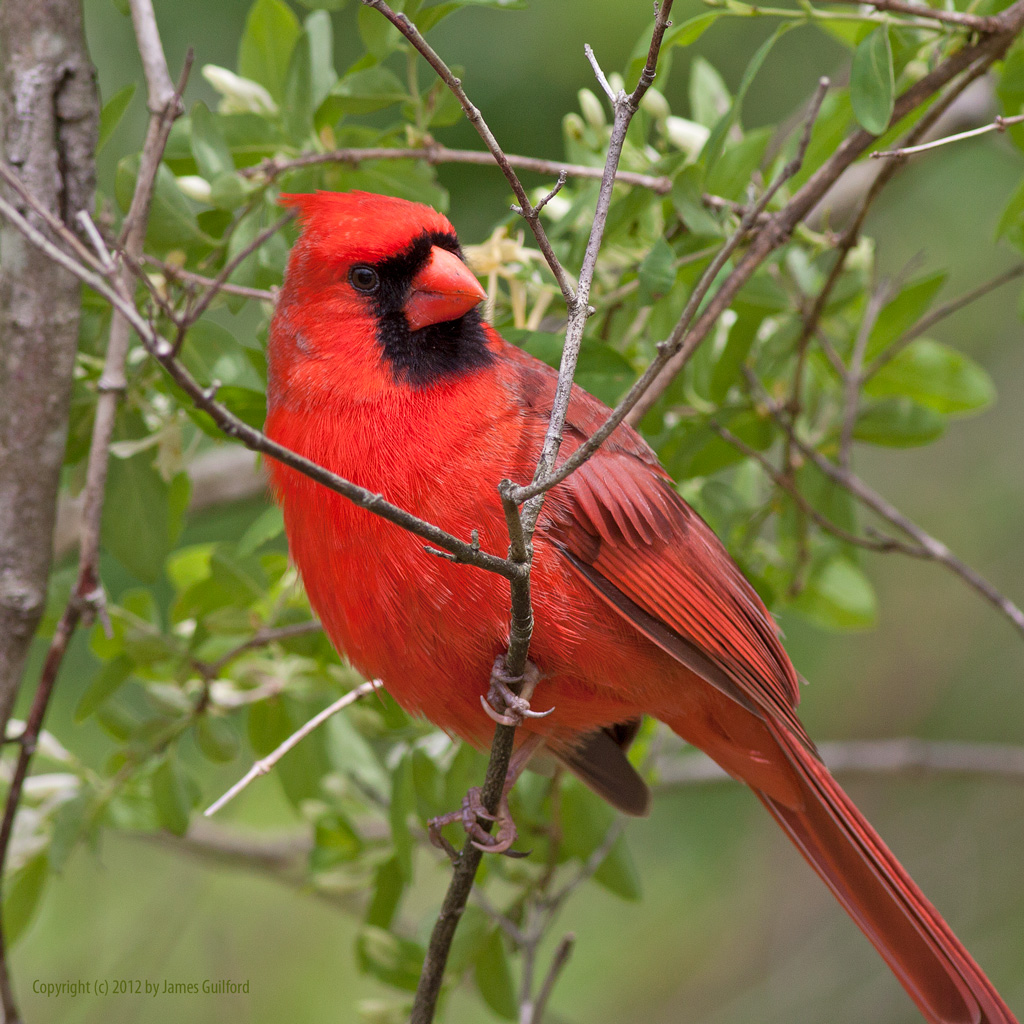
We’d set out today with the intent of also exploring the Ira Road Trailhead, an access point to a long boardwalk crossing a wetland area only a short distance north from the rookery. By the time we reached the parking lot, the drizzle had nearly ended and we set out for the boardwalk. We were greeted with lovely, dark scenes of lily pads, ducks and geese plying the water, Redwing Blackbirds, a turtle on a log, a Great Blue Heron slowly fishing along a neighboring shoreline. I got many more images to my liking from the Ira Road area than from the rookery today. My favorite was a Cardinal. I stalked the cardinal as I walked along the edge of the parking lot. First he was high in the trees, red feathers ruffled by the cold wind. Then the bird dropped into lower trees and shrubs. Finally he disappeared into the leafing brush. Fingers stiff and aching from exposure (we both shot big batches of photos), we made our way home happy that we had spent time with nature on a fine miserable day.
Appropriate wishes to all for a happy Earth Day every day!
We were trying to make our way from Point A to Point B this afternoon when, somehow, I missed a turn. We wound up traveling south instead of north — pretty easy to do on unfamiliar roads and under overcast skies — and traveled quite a distance from where we wanted to be. We also didn’t spring for the navigation package for the Honda Insight; I don’t regret that, however. Since we had no schedule there was no pressure so, as we realized the mistake, we simply turned and headed north, carefree. As we drove we began to recognize some names of crossroads and knew that some would take us into the Cuyahoga Valley National Park and toward Peninsula. As we progressed along Bath Road we saw a group of people gathered along the side of the road, several of them crossing the road to stand along a fence; they were all looking at the trees. Oh yes! It’s the Heron rookery! Of course we stopped. I happened to have my little old Canon Digital Rebel XT with me so I shot photos as we watched the Great Blue Herons gliding down to the fields and lofting back up to the trees with twigs and branches. A birder I spoke with said the herons were nesting early this year because of the warmer weather. We were very lucky to happen across the scene and stood and enjoyed the activity for some time before continuing our trip. Sometimes a wrong turn is the best.
It’s been a challenging spring. There’s been a lot of stress and work dealing with the needs of our aging mothers, lousy weather, big projects running less than smooth, astronomy prevented by thick clouds and heavy rains. Once in a while we get a break. One such respite was a visit to the Cuyahoga Valley National Park’s Ledges Area near Peninsula, Ohio. The soft light and mossy rocks were quite restful and, while we really didn’t hike, we did explore for a few minutes. It was literally a breath of fresh air!