“Oh no,” I said, “here comes another storm!” It showed up as “small” on radar and I didn’t think much of it. What arrived, however, was one of nature’s natural fireworks shows, and in time to close out the July 4th holiday; the small thunderstorm came through dry and full of lightning. Most of the lightning was cloud-to-cloud and there were plenty of what I call “crawlers” — discharges that appear to move in branches across the bottoms of the clouds. I was caught by surprise! I love shooting photos of lightning, or, at the very least, trying to capture those images. This was the perfect opportunity — no rain to get in the way or ruin my lenses — but all my gear was stowed! I quickly gathered camera and tripod and headed to my sheltered observing post. It was a great show though, with a storm this active, I didn’t know where to aim for the best shots. Out of maybe 150 exposures, I got a good number with at least some streaks of lightning; out of those, I’d managed to get a couple of good images. Displayed here is the best of tonight’s bunch.
nature
All posts tagged nature
Thinking to avoid the hot sun of midday but wanting to get out, we decided to take a nice, leisurely walk in shady woods somewhere. We paid a visit to the Carlisle Reservation of the Lorain County Metro Parks. The woodland trail turned out to be a good choice for avoiding excessive sun in the 90-degree heat and moderate humidity but woods are very good at blocking breezes; we wound up pretty sweaty by the end of our little hike. Of course I carried a camera –in this case my trusty old Canon Digital Rebel XT– always on the lookout for picture possibilities. I checked each of the several ponds we encountered for the usual subjects: birds, snakes, frogs, and dragonflies: No (wading) birds at all! No snakes seen. Lots of quick little frogs. And a nice selection of dragonflies! I’d decided to carry a “walking-around” zoom lens with modest telephoto abilities and it was both fun and frustrating to use that lens’s limits and capabilities to best effect. My favorite results are shown here. We left Carlisle ready for cool beverages but happy for the quiet walk.
Birds gotta eat, I know. Still, it seemed unfair. A female Red-winged Blackbird had captured a meal. I photographed her perched on a swaying tree branch at the Columbia Reservation of Lorain County Metroparks. I could see, clutched in her beak, the shining gossamer wings of a dragonfly. I’m a fan of dragonflies and of Red-winged Blackbirds too, for that matter, so had a little remorse over the fate of the dragon. Birds gotta eat, I know. Preparing this photograph for posting today, however, brought out unexpected details in the picture. The tangle of dragonfly in the bird’s beak contained two dragonfly abdomens and, yes, two heads, and too many wings — the blackbird had captured two dragonflies. How could that happen? I can only think of one way. The insects were mating in flight, as they do, when caught. It seemed somehow unfair that they should die in that last embrace.
I decided to take some time to see if I could capture a better portrait of the skittish Green Heron I watched the other day. So I revisited Medina County’s Alderfer-Oenslager Wildlife Sanctuary. Today I arrived armed with my wonderful 400mm telephoto lens and began stalking heron. I looked along the boardwalk, no heron. I checked the banks of the wetland and in the trees… nope. Red-winged Blackbirds aplenty but no heron. I looked around the smaller pond above the wetlands and still found no little heron. Oddly, this day very few dragonflies were visible either. Disappointed and about to give up hope, I spotted “Little Green” on the banks of a very small and shallow pool near the large wetlands. The heron was scuttling along the edge of the water, apparently looking for prey from upon the muddy banks. He hiked up and across a fallen tree branch that formed an arch, then back to the mud. I managed to squeeze off a few shots but then my quarry took off. No, I hadn’t spooked it… another Green Heron was flying over and mine gave chase. I stuck around for quite a while after that but the birds did not return. So I took off, myself.
Though obvious in these pictures, quite a few animals can become invisible by matching their environment to their color. A bullfrog, waiting for prey to come a bit too close or for his own protection against predators, may sit quietly in duckweed. If the frog holds still enough, perhaps he will be overlooked and gain a meal or avoid becoming one. The green dragonfly, also a predator, has the same advantages if it alights among green plant leaves. The dragonfly, by the way, was much harder to spot than the frog! These animals were spotted at the Columbia Reservation of the Lorain County Metroparks hiding in plain sight.
American bullfrog (Rana catesbeiana) — Eastern Pondhawk Dragonfly (Erythemis simplicicollis) female.

Could it be? This yellow dragonfly appears to be a female “Little Blue Dragonlet”, counterpart to the male I recently photographed in an obelisking pose!
It was a much warmer day than I expected with the high temperature reaching about 87 degrees (F). Still, I decided to pay a visit to the Columbia Reservation of the Lorain County Metroparks System for a good, long walk and to shoot some dragonflies — shoot pictures, that is! The walk on the park’s gravel trails was plenty warm but it felt good to be out in the woods and by the wetlands. The only nuisance came from a few deer flies — no mosquitoes approached me, even amongst all the wetlands. The ever-present Red-Winged Blackbirds scolded from their tree-top perches. I spotted a Great Blue Heron and a Green Heron as they flew from one site to the next. Dragonflies buzzed all around! There was, however, one particular type of dragonfly I was really after: a yellow one! I’d spied one about a year ago and tried photographing it. I thought then I’d captured its image but, lo, the image was dramatically over-exposed –blown out, as they say– and unrecoverable. Since then I’ve refined some of my skills and believed I was up to the challenge. What should I see in the first 1,000 feet of my hike but a pretty yellow dragonfly! It was perched on the seed head of dried grass, just the same as the “lost” dragon, and in nearly the same spot as before. Of course, today’s was a different seed head and a different dragonfly. The grass swayed occasionally in the breeze but the insect held tight and posed so well. I shot photo after photo and, when I was through, I was certain I’d made a nice portrait of an interesting insect. It turns out the yellow dragonfly is the female Little Blue Dragonlet — Erythrodiplax minuscula — counterpart to the “obelisking” male I photographed recently at another location! I captured nearly 200 images this afternoon and will likely post a few more from today’s shoot. The pick of the day, however, was a year in the making!
Dragonflies are creatures of two worlds. Both phases were on display at the Alderfer-Oenslager Wildlife Sanctuary in the Medina County Park System today. Dragonflies hatch from eggs and live the first portion of their lives as nymphs –aquatic creatures– six legs of predator seeking prey underwater. When, in the fullness of time, they reach maturity, dragonflies haul their alien-like bodies out into the air and grab hold of a leaf or twig. Then the nymph body is split open from the inside and the next phase of life begins … life as a creature of flight. In the air dragonflies seek prey and mates. The females dip their abdomens into still waters of ponds and marshes, lay their fertilized eggs there, and the cycle continues. No, that dry husk isn’t a dead insect … it has simply moved on.
It was a fine early summer day! A weather front came through the region last night and pushed away 90+ degree heat and high humidity. Sunshine, fresh breezes, puffy clouds, and comfortable warmth ruled! With the day off I decided to pay a visit to the Medina County Parks’ Wolf Creek Environmental Center and go hunting for dragonflies. I bagged something more than expected.
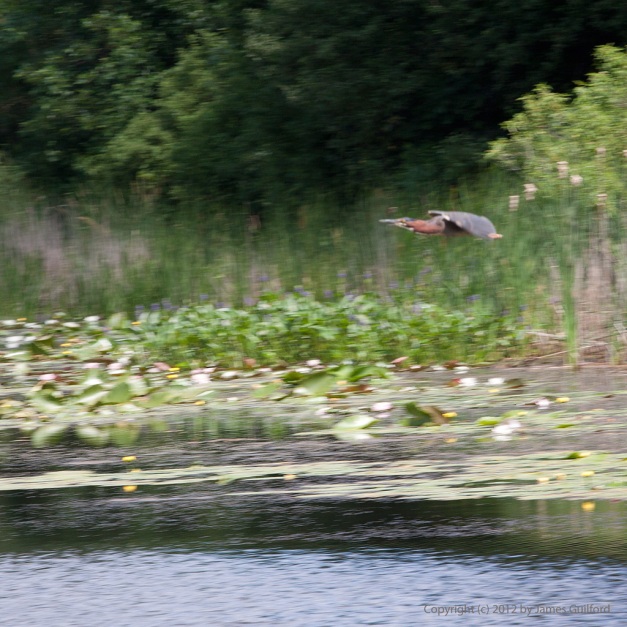
As I wandered the grounds I enjoyed viewing the small ponds dotted with blooms of water lilies and buzzing with dragonflies. Red-Winged Blackbirds scolded each other and me from their treetop perches. I made my way towards the extensive boardwalk that extends into the area’s largest pond when a bird shot into the sky and made its way into more distant trees. At first I thought it was an unfamiliar type of duck but no, its beak was long and sharp. Once it perched, I studied it as best I could through my camera’s 200mm telephoto lens and wished I’d have brought the 400mm! Is that a duck? A Kingfisher? No… A Green Heron?! The bird let out a shrill cry and took off into the woods. I thought I’d seen the last of it. More enjoyable dragonfly hunting followed with lily flower photography thrown in for good measure. I wandered back to a smaller pond but heard that odd call in the trees ahead — the mystery bird had returned! So as I continued my stroll I paid attention to the infrequent screeches and when I saw that same feathered friend dart down towards the board walk, I knew that I, too, would go there again.
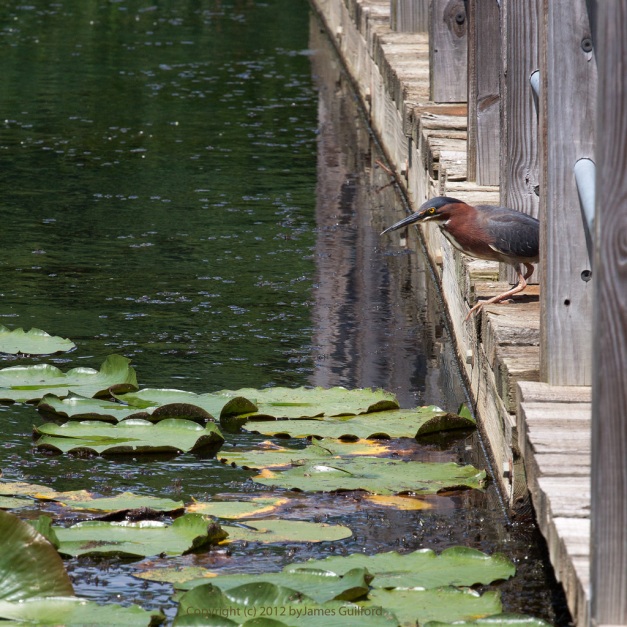
I crept down the path and on to the wooden walkway, all the while watching the shallows for my quarry. Seeing nothing I continued until I spotted it and froze where I was. The bird, smaller than I’d expected, was also strolling along on the boardwalk ahead of me and around the bend! Suddenly it struck into the water just off the deck and, thrashing, bounded back up with a sunfish in its beak. That bird was using the boardwalk to extend its fishing range!
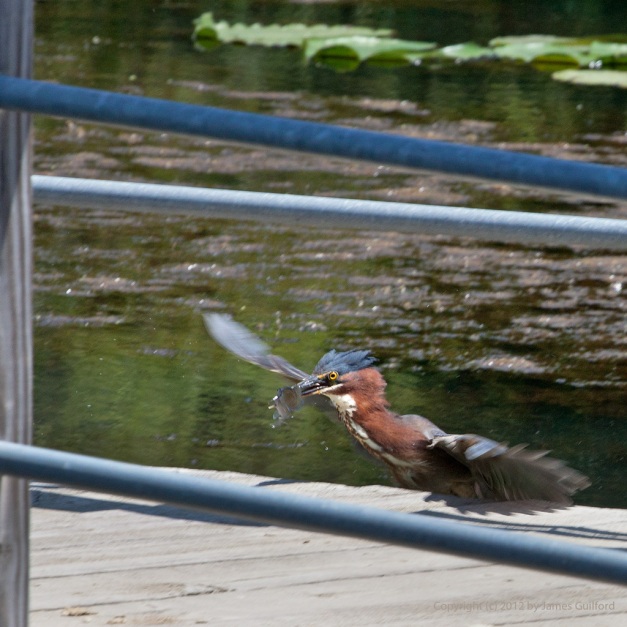
I followed the little guy for a while, being very quiet and slow in my movements. By now I knew it was, in fact, a Green Heron — smallest of the herons and renowned for its intelligence. I squeezed the shutter release regularly and the bird seemed to grow accustomed to my presence. I’d never photographed a Green Heron before and I wanted to get the best images I could. The skittish little smarty would, however, only allow me to get just so close. When I was satisfied I’d gotten the best shots I could from where I was, I tried moving even closer — the heron walked farther away. Rather than spook the bird and spoil its hunt, I turned heel and headed off the boardwalk.
Sometimes I spy something special during my long commute to work. A morning fog was veiling the West Branch of the Columbia River so, after crossing the bridge, I swung my car into a pull-off. As I headed on foot back to the bridge to try and capture the image I’d seen in my mind’s eye, I noticed something else. Just off the path was the remnant of a fallen tree, well on its way to returning to the soil that once nourished it. The deep colors of the rotting wood were marvelous and, as it turned out, my river pictures were not.


