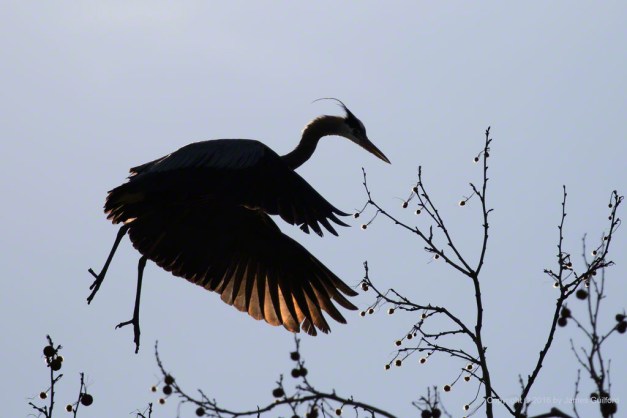
For wildlife, springtime is usually when family life begins. The hard winter is nearly gone, spring’s warmth is moving in, and the hope of a summer plentiful with food is ahead; so it is with the Great Blue Herons. Large numbers of herons annually nest together at their rookery in Cuyahoga Falls, at the edge of the Cuyahoga Valley National Park. The big wading birds build nests of twigs and some surprisingly large branches, pair off, and raise their young. On Sunday, the herons were mostly quiet, little mating, nest building, or flying, and no vocalization at all. The sky was milky white with cirrus — not the best conditions for bird photography. Still, a silhouette can tell a story of the ancient rite of spring,
nature
All posts tagged nature
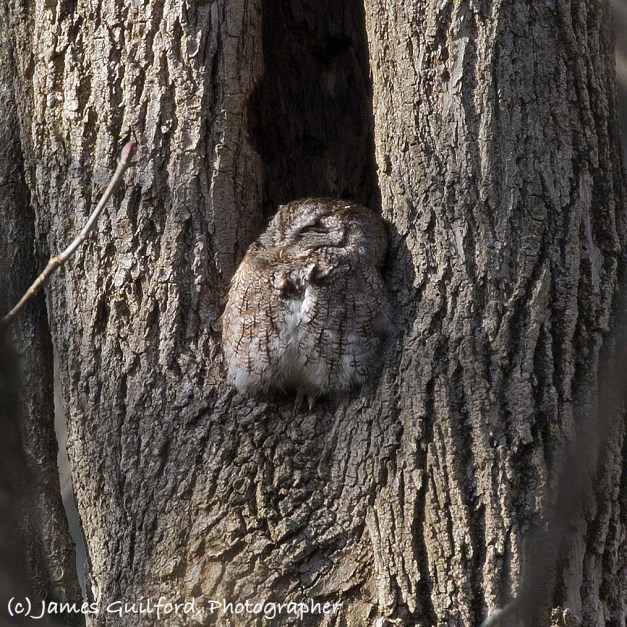
I had been told there was a Screech Owl resident within sight of the Cuyahoga Valley National Park’s (CVNP) Towpath Trail. I’ve heard about the bird for at least a couple of years. I had even been told where to look for the owl on previous hikes but never saw it or its hidey-hole. Though I wasn’t seeking the bird Sunday, I was on a little hike to see if anything was happening in the CVNP’s Beaver Marsh area north of the Ira Road Trailhead. As I began my walk, a returning couple said, “The owl is out today!” So now I had something to look forward to! Farther along, I could see a group of people stopped on the path, looking westward and off-trail … right about where I knew the owl was said to live. “Yes,” they told me when I reached the group, “there he is!” They pointed. They described how the owl could be seen: “see that snag? Now look for two trees behind it, and it’s about three trees over that way.” Directions like that didn’t help me much; it’s a heavily-wooded area! Finally, however, a patient woman let me stand behind her as she described the location and pointed… and there, at last, was the owl! The little bird was sitting at the bottom of an elongated opening to the hollow in a tree. From the trail, the owl’s plumage made it look very much like a part of the tree. Excellent camouflage. Far away. Darned near invisible! I was carrying my camera with a 400mm telephoto lens attached (~600mm with sensor cropping) and shot a few images. The owl never moved that I could see but the light changed as time passed. I could get only one clear view of the bird — fairly thick woods — but that was enough. So I captured my first images of an owl in the wild as it enjoyed the afternoon’s weak sun. Making the hike was a wise choice.
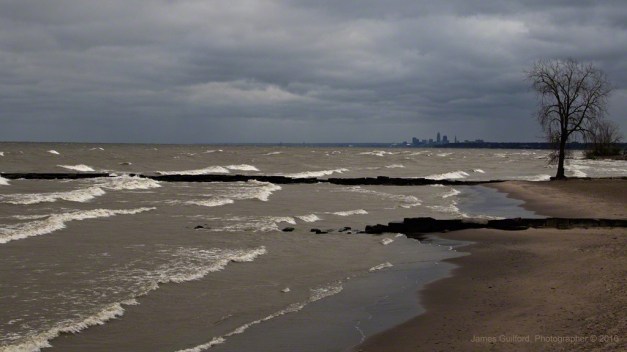
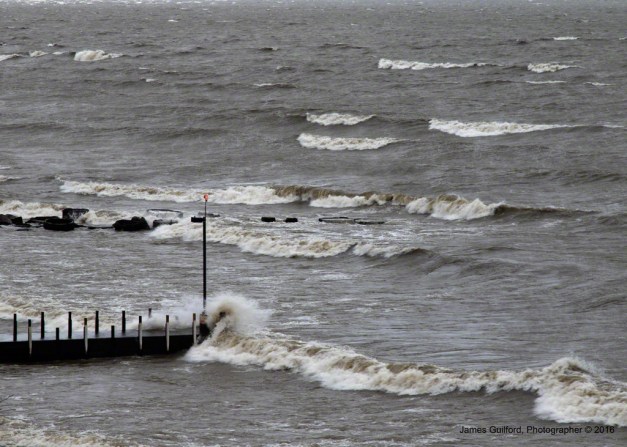
November ushers in the change of seasons. Autumn is ending. Winter is beginning. We transitioned from warm and sunny conditions one day, to cold and snowing the next. Overnight we received about three inches of wet snow in Medina, Ohio. Wanting to get out, we ventured north to the shores of Lake Erie. Call me crazy but I find exhilarating the wild weather often experienced at the edge of our Great Lake. Today, with steady northwest winds of about 20 miles-per-hour, the lake offered plenty of action — and it was mighty cold! The air temperature of about 34 degrees (F) equated to something in the 20s, and as I explored camera in hand, those hands and my ears quickly began to ache. Now that I live farther inland, my visits to Lake Erie’s coast are less convenient and less frequent; they are no less exciting.
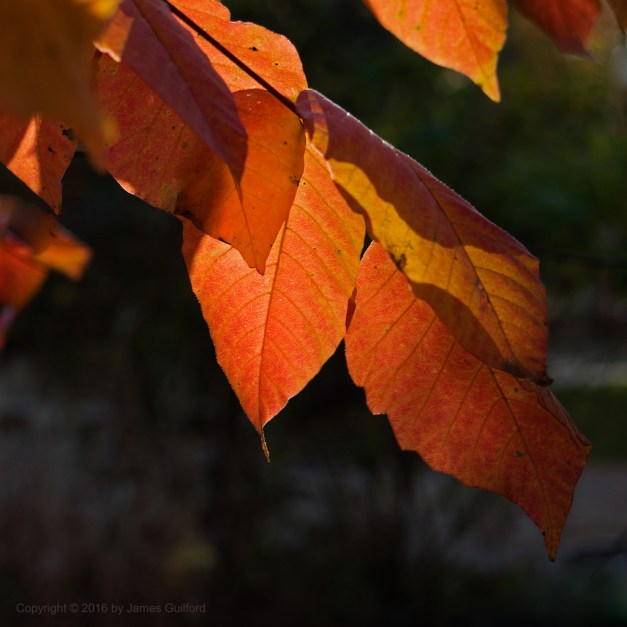
We took a short walk to get out on an amazing autumn day. The warm afternoon air gently stirred leaves primarily of yellow and brown. Many tree branches look barren. The last brilliance of autumn is here.
UPDATE: A small giclée canvas print of this image was contributed to the annual “In the Pink” show and raffle hosted by Hudson Fine Art & Framing Company in Hudson, Ohio. Proceeds from the sale benefit The Gathering Place, a local organization; their mission is to support, educate, and empower individuals and families touched by cancers through programs and services provided free of charge. I am pleased to have been a part of the show and fundraising effort! For more information on The Gathering Place please visit www.TouchedByCancer.org.
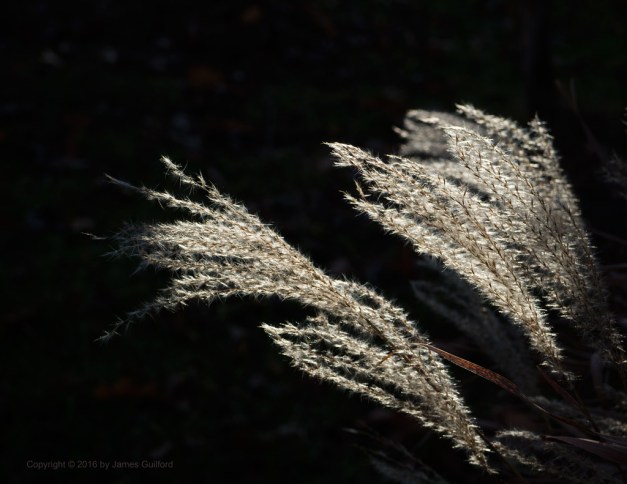
This started out to be an excellent year for photography. In addition to my still work, I was preparing to make my first nature film. Then we decided to buy a house and move. I look back at this blog now and fully realize how fully I dropped my artistic efforts. Finding, buying, and preparing a poorly-maintained house took the balance of summer and, now, the best of autumn. I hope it will be worth it. I do want to share here a photo I have come to love: it is both realistic and dreamlike; it is my remembrance of the seasons passed.
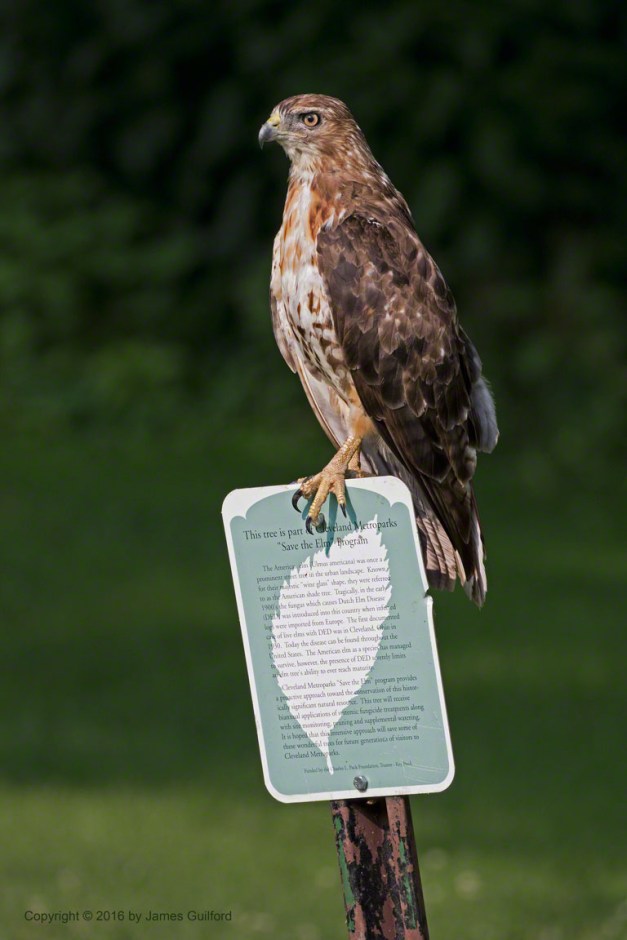
Walking in the Hinckley Reservation of Cleveland Metroparks today, the first day of summer, I spotted a group of visitors looking at something along the path ahead. As I drew closer I discovered they were watching and photographing a hawk! The bird was perched upon a signpost and did not appear to be bothered by the attention of nearby humans. Carrying my DSLR fitted with a 400mm telephoto lens, I was able to capture especially close-up images of the beautiful raptor at it watched for people and potential prey.
At one point a cicada flew within a couple of feet of the hawk and the bird turned to watch. Fortunately for the insect, it was just a bit out of reach for the hawk and, for its part, the bird seemed to think pursuit wasn’t worth the bother.
I left after several minutes of photography, moving around and a bit closer to my subject. Not wishing to spook it into flight, I left the hawk still on its perch from which it could see and be seen.
UPDATE: The original version of this post mis-identified the location of the Tree Swallow photograph. While there was much activity at Sandy Ridge Reservation, the nest box bird portrait was actually made at the Old Woman Creek National Estuarine Research Reserve, Huron, Ohio.
On Monday we ventured to Lorain Metro Parks’ Sandy Ridge Reservation for a walk and to see how wildlife activity was going. In short, the protected wetland is becoming busier all the time. We saw Canada Geese sitting on their mounded nests, some just a step off the trail, and we spotted the first goslings of the season … all ready! A flock of Coots floated in one area, and four widely-separated Great Egrets waded, looking for prey. Tree swallows zoomed over the waters, between hollows in trees. We even spied a water snake catching some rays, that unusually warm afternoon!
We also visited the Old Woman Creek National Estuarine Research Reserve in Huron, Ohio. Tree Swallow activity was very high there, and finding a bird that would stay perched for more than a minute was pretty rare. One swallow, however, stayed put — perched on a nest box — for several minutes, providing a great photo op! Among the numerous shots I made of the little bird was the one shown here: my best ever of a Tree Swallow, showing off its beautiful iridescent head and back. Although I have other good shots, the one of a little bird looking into the sky is my pick of the day!
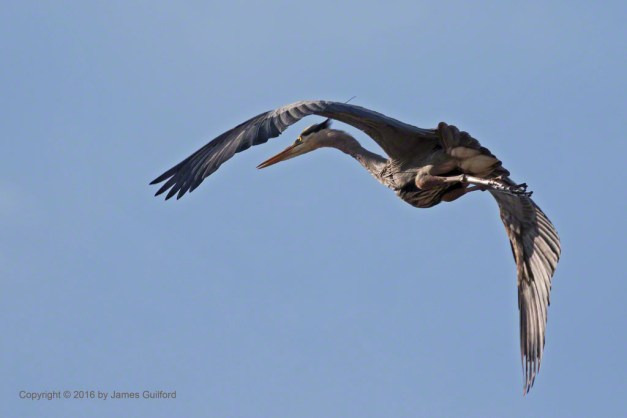
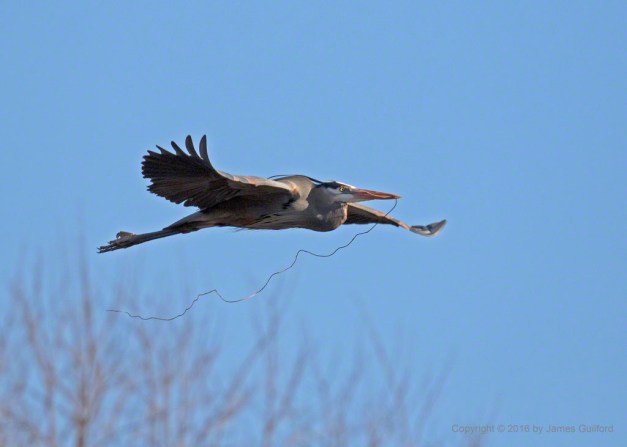
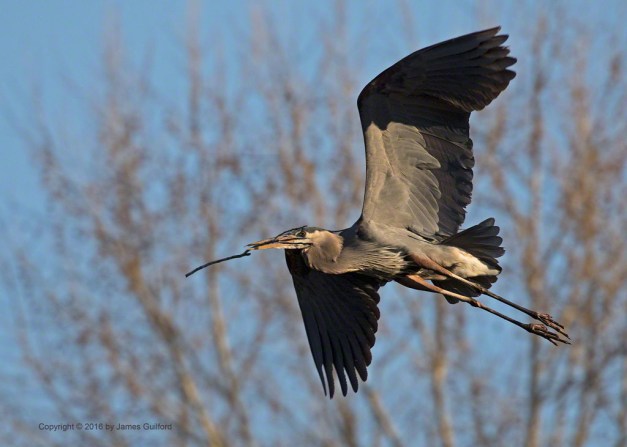
March 29 was a beautiful day and inspired me to pay a visit to a very active heron rookery in the Summit Metro Parks system, immediately adjacent to the Cuyahoga Valley National Park (CVNP) at the north end of Akron. I was pleased to discover that the resident Great Blue Herons were still working on their nests, providing me with plenty of “photo ops” for catching them in flight.
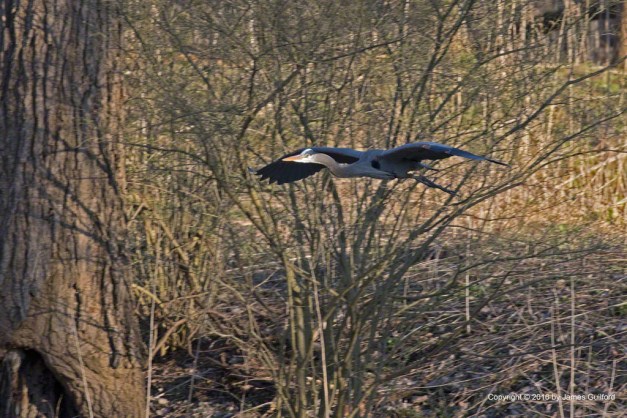
The trees that support the heron nests are part of an open wooded area, affording the birds access to fallen twigs and other materials with which to build and maintain their nests. Every so often a bird launched from a treetop, glide away, and circle down to the ground. Strolling around for a while, the heron would find just the right stick needed and, grasping it in its stiletto-like beak, lift from the brush. High into the air, the bird would soar, circling around for the right approach, and ever so gently alight near its nest. Mates, if on the nest, exchange greetings and the stick may be handed off.
Because the woods are full of herons, smaller birds and animals, raptors are also present. I had been told about hawks and eagles being around and occasionally spooking the Great Blues but I hadn’t seen them. This evening, however, was different. First one motorist, then another visitor flagged me and described where a Bald Eagle was perched. The first site was distant, in the shade, with strong backlighting — none-too-photogenic. The second site, however, put the eagle in a fairly decent position for photography: well-lit with the sky behind.
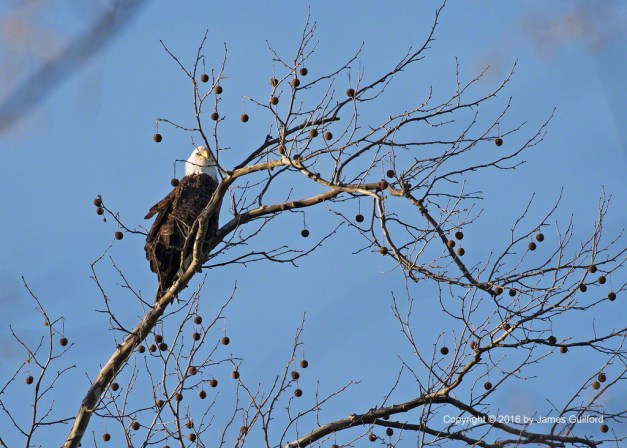
Up til now, the only Bald Eagles I had seen in the wild were either perched far away or flying away from me but not this bird! Apparently a young adult (four to five years old), the eagle watched the rookery from across a road! The eagle’s tree-top spot allowed it to see the main rookery, a secondary nesting area, and an open field; an excellent location for passive hunting. I got some decent shots, even if partly obscured by tree branches!
Sunset was approaching and I wanted to check out a nearby portion of the CVNP called Beaver Marsh, so I packed up and headed down the road. The wetland offered open waters and open sky to the west and the possibility of some nice evening views. A few visitors were on the boardwalk watching native beavers go about their business. Robins and other birds were singing their evening songs. And Canada Geese were noisily settling in for the night.
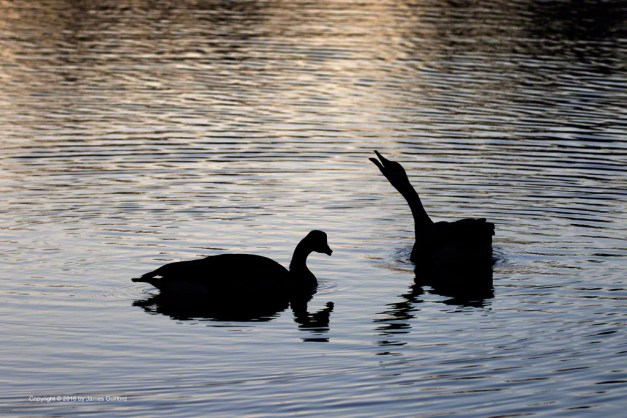
As I watched, a small group of geese began to fly over the spot where a pair had set up for the night. One of the floating birds looked up and squawked loudly as if to say, “Go! This is ours!” The birds overhead kept flying, leaving those below swimming on rippled waters lit by setting sun.
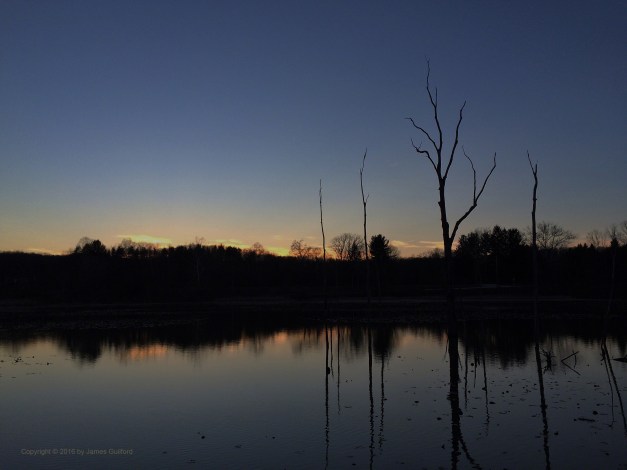
I really didn’t want to leave — the sky, the water, and the sounds were so beautiful — but it was getting cold, and I was expected home. I do plan, hopefully one day soon, to return “after hours” to enjoy evening’s wings.
A favorite place of ours and of many actual birders is Sheldon Marsh, a spit of land that extends from the south shore of Lake Erie in Huron, Ohio. A paved pathway runs from the parking lot nearly to the beach – a protected natural area. The preserved environment serves as a place for migrating birds to rest and refuel, and as permanent residence for others. With little breeze Sunday, the open water areas were mirror-smooth. It was pleasant to once again hear the sounds of birds from the still-bare trees. Canada Geese occasionally had raucous disagreements and small flights of Mallard Ducks could be heard “squeaking” overhead. Heard from surrounding brush were Red Winged Blackbirds with their raspy and warbling calls. Downy and Red-Bellied Woodpeckers could also be seen and heard. Now the wetlands just south of the lake are relatively still, though the population and activity will steadily rise as spring and its birds return.
Taking advantage of a pleasant morning following a very rainy day and preceding more clouds, we paid a visit to the heron rookery of the Summit County Metro Parks. The rookery, where the big birds make their nests, is situated along the Cuyahoga River at the north end of Akron, Ohio. Every year flocks of Great Blue Herons (and bird watchers) descent upon the site. Parking areas along the busy road bordering the nature preserve allow easy access, though utility poles and wires along the road often interfere with watching and photography.
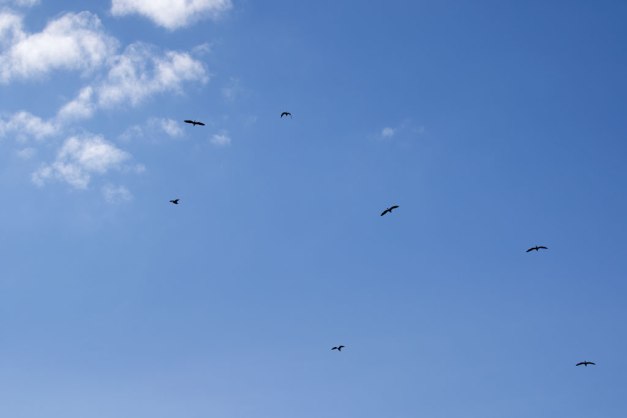
This year, for the first time, we saw the entire population of herons abruptly rise into the air and circle high above their nests. Apparently, the birds were spooked by the appearance of a Bald Eagle and/or hawk near their nests. The huge herons probably stand a better chance against raptors as a group and in the air than when standing on their nests.
The weather this week is expected to be cloudy with rain chances every day but we hope to return soon for further developments during this year’s nesting.