A Cooper’s Hawk perches on a tree branch, its eyes trained on nearby bird feeding stations. Heavy snow swirls around, as if in a snow globe. — Photo by James Guilford.
Early January and heavy snow was falling. Local birds were flocking to our bird feeders. Suddenly, the small birds disappeared. The local Cooper’s Hawk had showed up for lunch and our smaller feathered friends did not want to be lunch. Snow and blowing snow came and went as the raptor sat, observing from a tree branch. Sometimes the hawk could be seen clearly, sometimes snow completely hid it. The hawk watched for a while but, seeing no potential prey, flew off to hunt elsewhere.
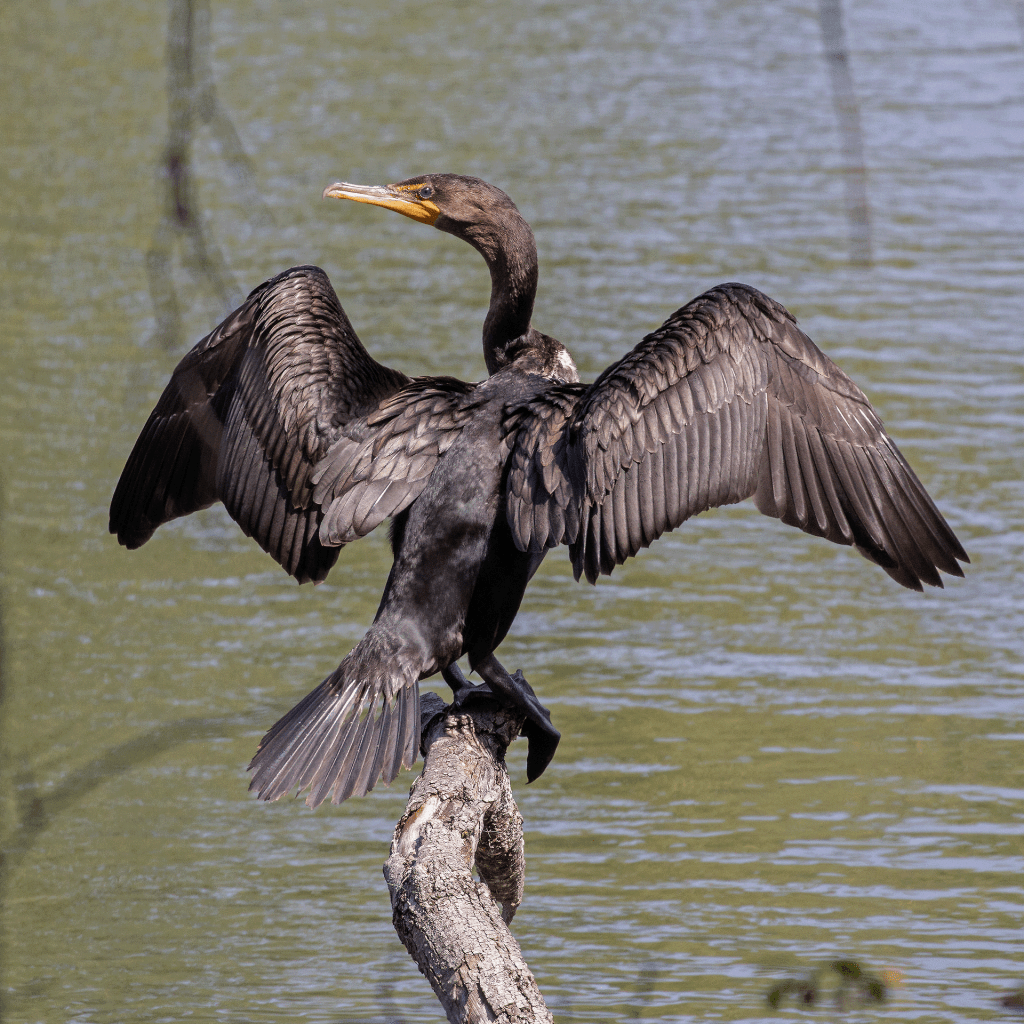
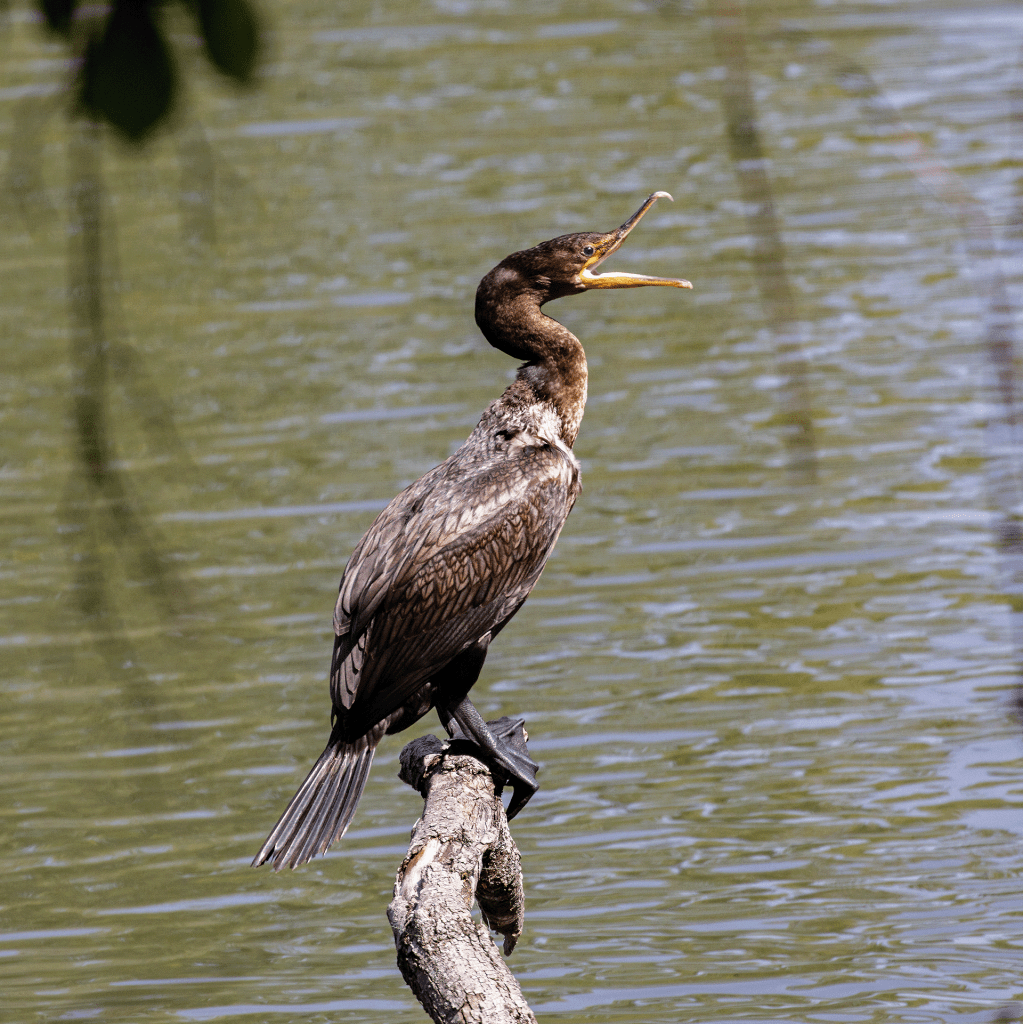
Recently I thought I’d caught glimpses of a cormorant flying over the far side of our pond but I couldn’t be quite sure. Yesterday, I noticed a large bird perched over the water on a fallen tree branch and there it was — a double crested cormorant! Not an uncommon bird but this is the first I’ve seen one here. The bird spent most of the day on that branch basking in the sun, looking around, occasionally swimming, mostly just hanging out. I haven’t seen it today.
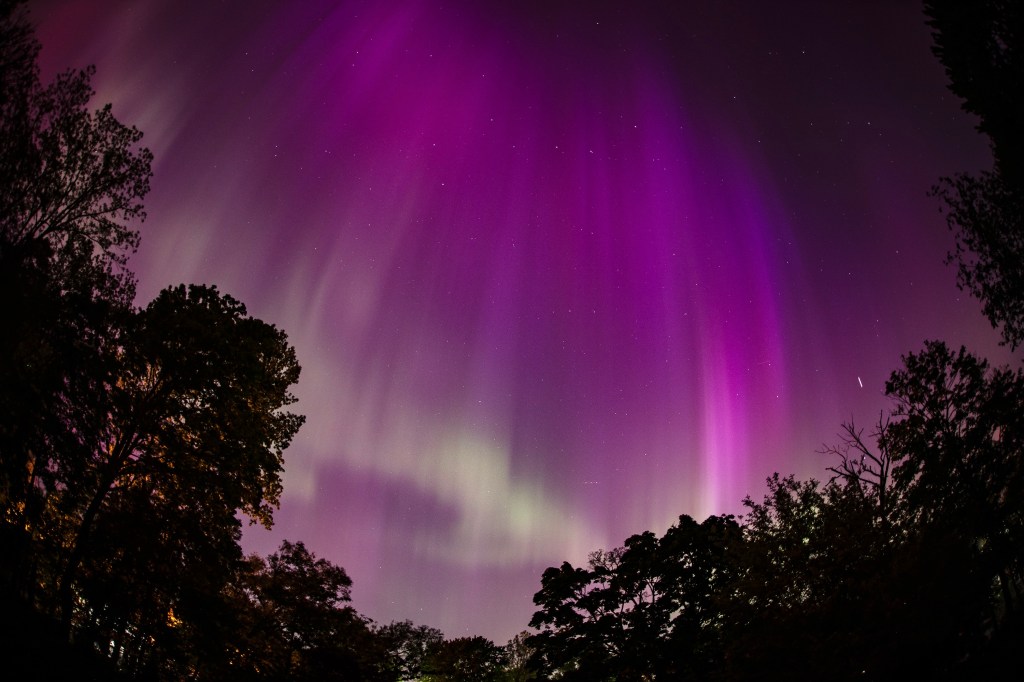
My first DSLR shot of the night turned out to be the most spectacular. This is a view looking northward from the city of Medina, Ohio.
It turned out to be a stronger impact than forecast, and the strongest thus far of this solar activity cycle; the geomagnetic storm of May 10 – 11, 2024 produced auroras (Northern and Southern Lights) visible at night from locations nearly pole to pole.
The forecast of possible aurora prompted me to step outside at about 10 PM (EDT), when twilight had faded, to check the skies. At first I saw what I thought might be clouds but knowing auroras can be feeble, I watched. Sure enough, there was movement in those “clouds”.
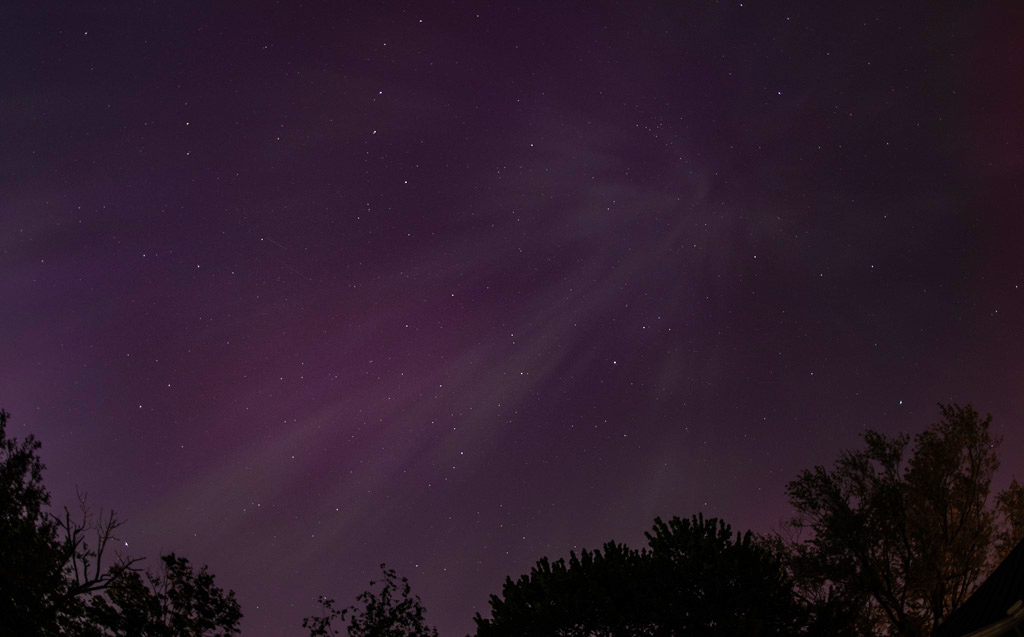
To the unaided eye, the great aurora of May 10 looked like this — streaks of “cloud” with a bit of color. Watching the streaks closely, however, the observer could see them changing in size and shape more rapidly than simple cirrus.
Glancing overhead I saw what I found hard believe — aurora ray features directly overhead … at 41º latitude, a rare sight, indeed! Rushing back indoors, I pulled together camera, fisheye lens, and tripod and headed back out.
My first image of the night was from my iPhone 13. So little effort to see and record such an amazing view! It was exciting to be able to share this with the world in real time via social media!
The aurora still presented itself as cloudy streaks with, perhaps, hints of color. Now also armed with my smartphone, I activated its camera and aimed it at the sky. There on the screen, light amplified by the phone’s electronics, glorious, eye-popping colors filled the sky! I’d never before experienced an aurora like it.
A rare sight indeed is an aurora borealis streaking down from directly overhead at 41 degrees latitude! I’ve never before witnessed such a display.
Only occasionally, during the time I was out, did the aurora’s color become visible to me; apparently being just below the limits of my, and others’ visual perception. Another local observer noted color was more visible shortly before I stepped outside to check on things — the actual peak of the display must have happened as twilight was ending and before 10 p.m.
Colorful curtains lit the northeastern sky as the aurora re-surged from a quieter moment.
I observed and photographed the aurora from shortly after 10:00 until about 11:30 EDT and in that hour or so, the intensity faded and then re-surged before fading away which was my signal to shut down.. I might have stayed out longer but had a commitment for the next day — sleep was needed — so, satisfied I’d seen the phenomenon at its best, I put away the camera gear.
Looking north, find the “Big Dipper” tipped over as if pouring watercolors down on the land. The single dot visible near the center of this picture is the North Star, Polaris. Note how one can find Polaris by looking where the two stars of the dipper’s bowl point.
Knowing it would be all over the news, I submitted my most spectacular shot of the night to the local newspaper — a daily that publishes on Saturday but not Sunday. It was too late for the Saturday edition but the editor gave my photo a three-column, Page 1 spot on Monday.
Our Sun is still in its peak activity period, by some accounts it won’t hit solar maximum until some time in 2025, so there may be more auroras in our near future but this was one for the history books!
Portrait of Cleveland radio personality “Count” John Manolesco, made in the 1970s. Photo by James Guilford
“Cleveland radio has had more than its share of characters. Take “Count” John Manolesco, for example, who hosted a show on news/talk WERE. Manolesco, who claimed to be a physic from Romania, went so far as to perform a live, on-air exorcism.” — Kabir Bhatia, Ideastream.org
I was assigned by a local magazine to shoot photos of Manolesco for a feature article on the Cleveland talk radio personality. I did make the usual photos of him but shot one or two using a low-angle flash — a proven technique to introduce a spooky mood to an image. This is my favorite shot from the job.
John Manolesco was born December 3, 1918 in Timisoaka, Romania, and died January 10, 1983 in Cleveland, Ohio at 65 years of age.
After a long absence, we returned to Sandy Ridge Reservation, a notable area for birders in the Lorain Metro Parks System, and were richly rewarded. We spotted and watched a Sand Hill Crane family as they explored the waters’ edge for food: the impressive adults escorted their colt (that’s what the young are called) watching humans watching them from the nearby path. The colt was allowed to explore a bit on its own but the mated pair were never far away. It was thrilling to see the family and a first for me; a wonderful surprise.
As we watched the Sandhill Cranes, Great Egrets, and dragonflies, an American Bald Eagle soared overhead. We could not see the eagle’s nest but behavior told us it was on hunting flights, probably feeding its young in the hidden nest.
A Sandhill Crane colt combs the wetlands for food with one of its parents.A Common Green Darner (Anax junius) in flightBig Foot: This Great Egret was wading the shallow waters of the wetland searching for food, the vivid green patch marking at the base of its beak was particularly striking. Caught mid-stride in this photo, the span of the bird’s toes on its raised foot is impressive!
A male Halloween Pennant (I believe) perches on the broken tip of a twig along the edge of a small pond, the sun glimmering in the cells of his gossamer wings. July 7, 2022. Photo by James Guilford.
I haven’t been “dragon hunting” in some time so today’s mission was to shoot a few. One I bagged today — a male Halloween Pennant (?) — at the Medina County Park District’s Letha House Park West. I saw and photographed several varieties and missed a couple. It looks like it will be a fine Dragonfly Summer.
Sunset June 30. Clouds parted enough that evening to allow a colorful end to the day. I used my recently-purchased quadcopter drone to rise above the treetops in order to see, enjoy, and photograph the night’s fine sunset. This is a two-panel panorama, created post-flight. I continue to be impressed by the DJI Air 2s camera system; its dynamic range is excellent, lens is reasonably sharp, and the drone is a surprisingly stable platform. It’s also a hoot flying this little aircraft! Bringing the drone in for a manual landing before dark, I was tickled by how it automatically switched on its landing light. The flying camera adds another dimension to my photography and, as I said, it’s a hoot!
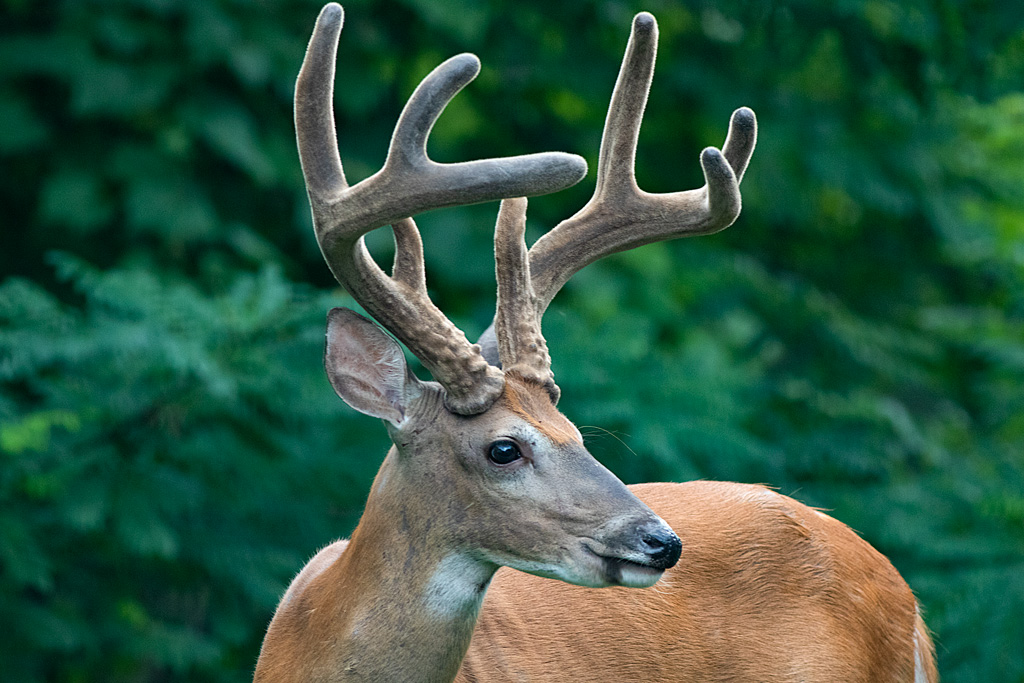
We had a Very Impressive Visitor in our backyard July 23! This buck White Tail Deer looked happy to be here. He stayed in the backyard for a while, sniffing the ground occasionally, watching us from a distance. He eventually strolled off, down a hill into a nearby gully.
Goodness! I didn’t realize I hadn’t posted here since February!! I’ve mostly been making short-form posts to Twitter and Instagram and neglecting this blog. So here we are in July and I’ll make a couple/few quick image posts with captions. These photos are from July 23 and 24 when local wildlife, here in the neighborhood of a small city, paid us extra-close visits.
Another backyard visitor! Mid-afternoon on July 24, a very cooperative Shadow Darner dragonfly alighted on our deck railing allowing me to get up close and personal with my macro lens-equipped DSLR. This is a fairly large insect, ours being 2 3/4 inches long with a wingspan of 4 inches. A guidebook says they’re fairly common in Ohio and fly from about July 4 to November 6.
Comet C/2020 F3 (NEOWISE) floats in a clear summer’s night sky, reflected in lake waters.
Comet madness continued Friday night, July 17, as the region was finally blessed with clear skies. I ventured to a county park which extends after-hours access to my astronomy club, set up my gear, and waited for darkness and the emergence of Comet C/2020 F3 (NEOWISE). Twilight seemed to take forever to fade but finally I spotted the comet, and at a decent elevation above the horizon.
I shot many images, experimenting with stacking, using my 400mm telephoto, etc. but the shot I was hoping for and that I finally got was the comet above a glowing horizon, reflecting in the still waters of the park’s lake. Attempts at depicting the expansive and complex tails of the comet gave largely unsatisfying results; in part because our clear night sky wasn’t quite clear, or dark, enough to allow best imaging of the delicate details.
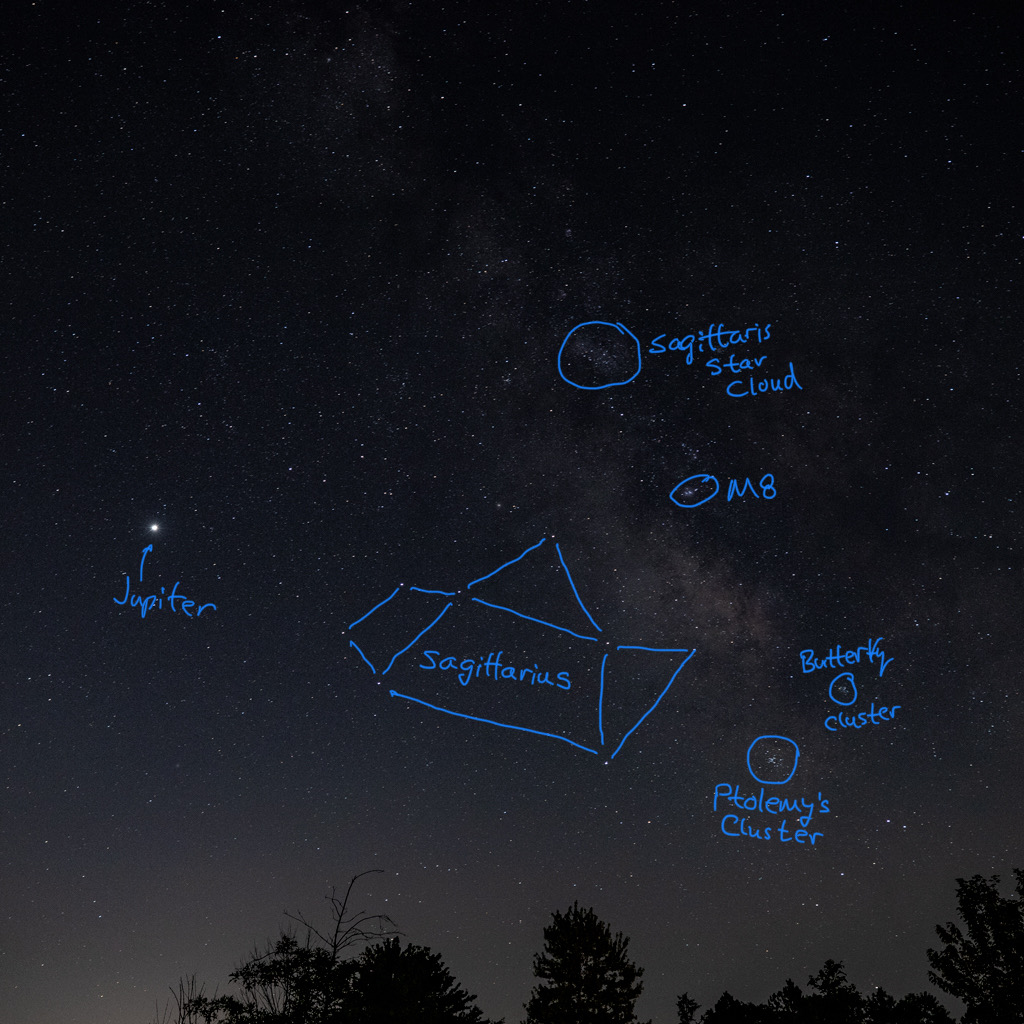
A portion of the Milky Way, above constellation Sagittarius. The bright “star” to the left is planet Jupiter.
When the comet finally faded in the west, I made a number of shots of the beautiful night sky itself. We rarely see the Milky Way these days. I grew up in a small town and, at that time, I could step out into the back yard, look up, and see the beautiful star trails of our home galaxy. It was a pleasure to see the Milky Way and get a half-way decent photo of it. I’ve included a labeled copy of the image below, in case you’re interested.
Annotated Milky Way image labeling some major features.
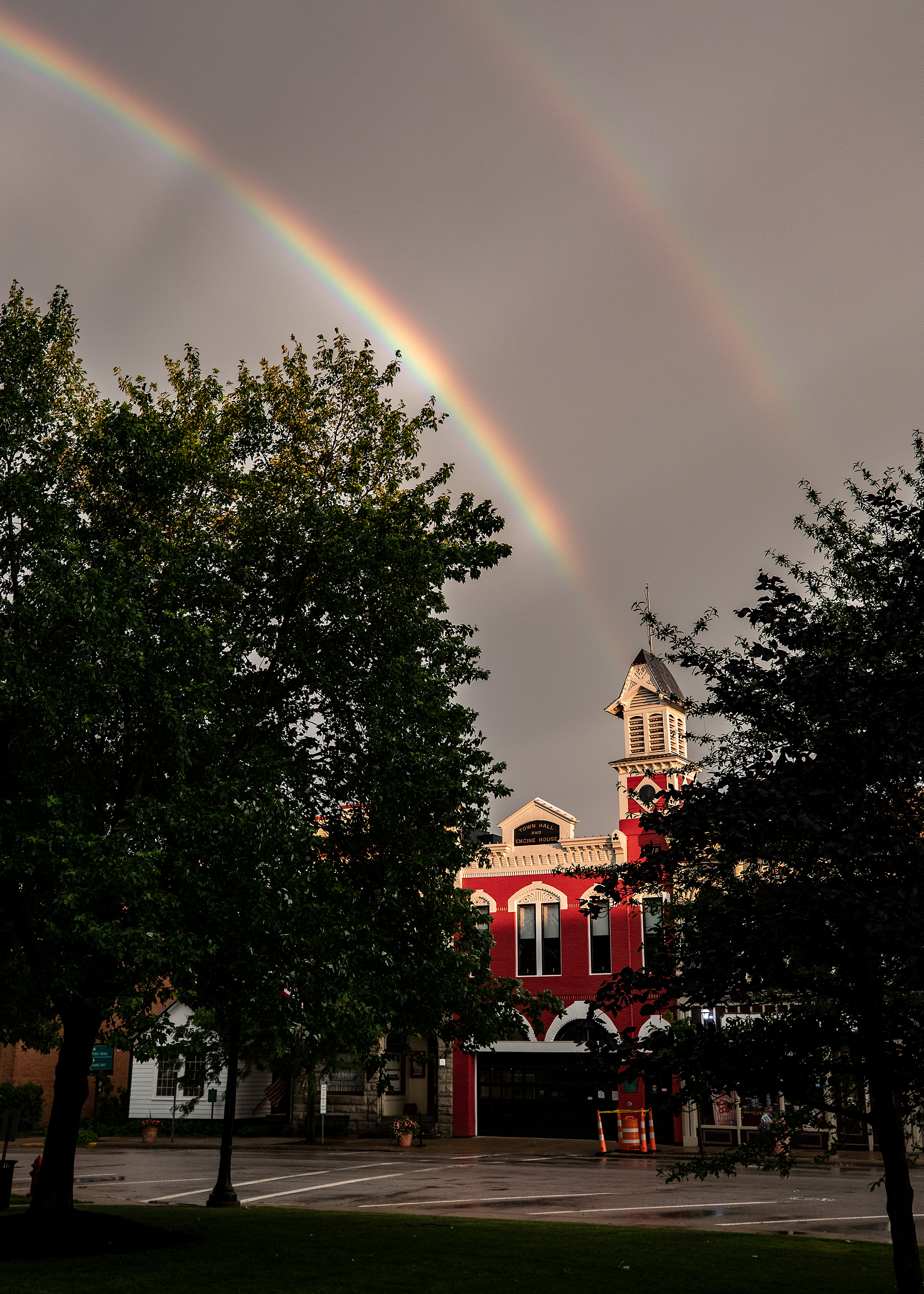
As a storm rolls away and sun breaks through, a double rainbow appears over Medina, Ohio’s old Town Hall and Engine House on Public Square. Dark streaks, anticrepuscular rays, cross the bright rainbow arc.
Returning from a storm interception last night (June 10) and watching the sky from a red traffic signal, I saw a brilliant rainbow glowing against the dark background of clouds. The receding severe thunderstorm was rolling off to the east and the late evening sun was shining through clearing skies in the west. I hoped I could reach Medina’s Public Square before the rainbow faded, since there was the possibility of shooting landmark buildings with a rainbow above. I parked and trotted with my camera across the Square’s green and in light rain, with occasional cloud-crawling lightning overhead, I found my spot. That late sunshine was lighting the bright red top of the city’s old Town Hall and Engine House, dark sky in the background, and — yes! — that brilliant rainbow with a companion arc making the picture. I stood there for a while, shooting the rapidly changing lighting and rainbow intensity and when the sun went away, so did I. I’m very pleased with the resulting picture, which The Medina Gazette published today (at unfortunately low resolution), and I hope it brought a smile to many people who saw it.









 PhotonStopper