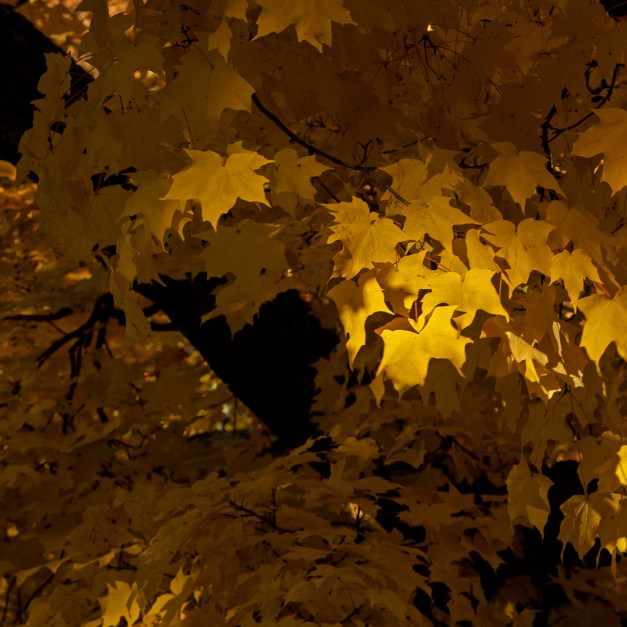
A beautiful autumn day, a rarity this year, presented an excellent opportunity for a little walk. Exploring the area in the late afternoon was a pleasure and offered a few opportunities to record what I saw. My favorite sight and photo of the day was the porch of an ochre-colored house. Antiques and rustic items lined the outside walls, a patriotic fan bunting glowed in the natural spotlight of sun through trees.
northeastern ohio
All posts tagged northeastern ohio

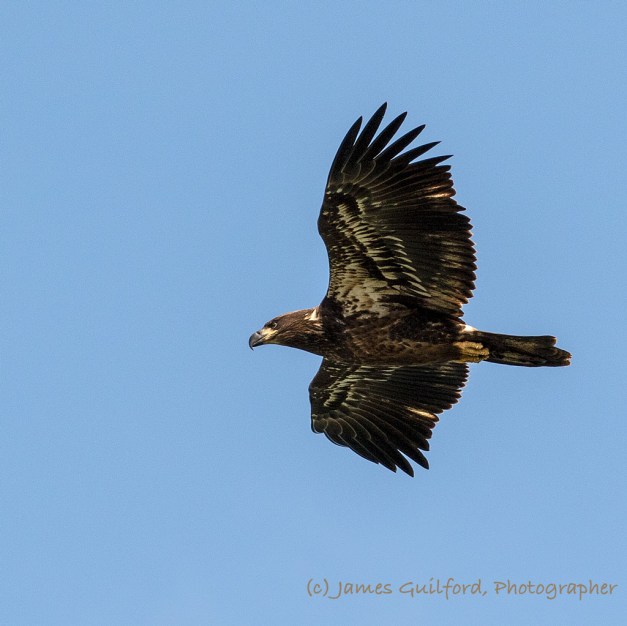
A juvenile American Bald Eagle (One of two seen Wednesday!) glides on the updrafts along the shoreline at Lake Metroparks Lake Erie Bluffs park.
Sighting an American Bald Eagle in Northern Ohio was once, not that long ago, seeing a rare bird. Fortunately the eagle population is growing and sightings are more common, though still thrilling.
A juvenile American Bald Eagle glided on the updrafts along the shoreline at the Lake Metroparks Lake Erie Bluffs park. While we eventually saw two eagles of the same apparent age, I was only able to photograph (above) this one; I believe it to be in its first year. The distinctive white head and tail feathers take about five years to fully develop.
On an earlier September visit to Sheldon Marsh State Park, Huron, Ohio a mature American Bald Eagle soared majestically over exciting visitors as it fished the shallow waters on a Sunday afternoon. We saw the bird swoop in low over open waters, apparently missing the fish it had spotted, then climbing high to continue its patrol of the wetlands. Other visitors saw the bird catch a fish, only to have it escape. Even a fierce predator misses most of the time.
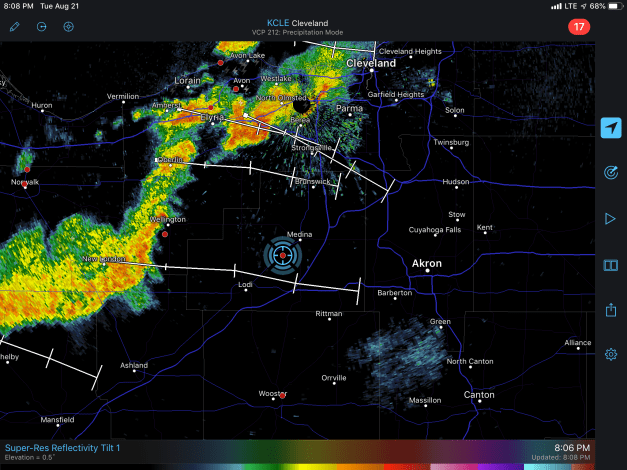
A well-defined line of storms was headed our way and looked like a good possibility for shelf cloud photos, so I headed out in the early evening to intercept the storm.
Things don’t always work out the way one expects and that may be especially true with weather. The rule proved true but I wasn’t terribly disappointed because of the way things worked out.

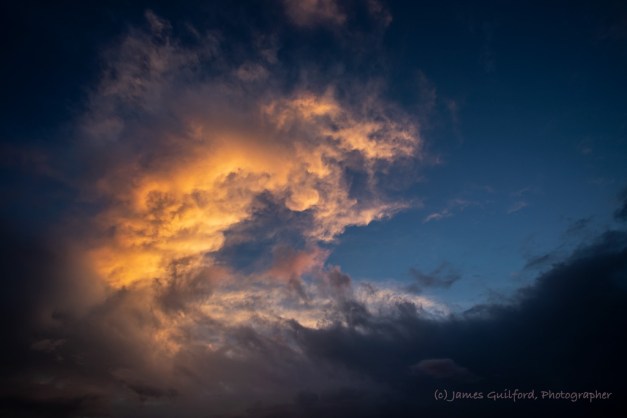
Evening Flight. Sunset colors illuminate the clouds. A tiny dot in the upper right-hand area of this image is an airliner on an evening flight.
I could hear rumbles of thunder to the north and caught a glimpse of two lightning bolts: one from cloud to ground, the other within a gap in the clouds. But as the line of storms came nearer, the sun was sinking lower reducing the energy driving the weather. While the prospects of strong storm images dimmed, the developing sunset lit the roiling clouds in beautiful and unexpected ways.
Storm clouds moved and swirled as they passed across the western sky and rolled overhead, changing from minute to minute. No shelf cloud to be had but the show was wonderful.
All but ended, clouds closed in ending the evening’s show, the conclusion of a glorious sunset storm.
I love photographing scenes that include dramatic weather and clouds and that often involves “storm chasing” or, as I prefer to refer to my activity, storm interception. I try and anticipate where interesting scenes will develop and be there when it happens. I’ve had some success.
Springtime brings its share of weather drama, even in Northeastern Ohio. Thunderstorms can be powerful, even dangerous, and produce impressive sights as they balance heat, cold, and moisture.
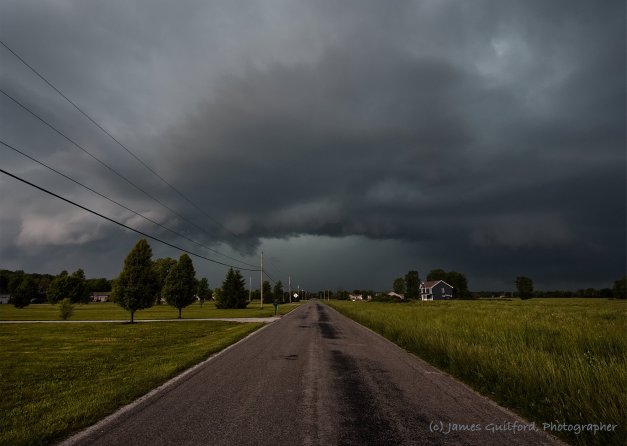
On May 26, watching radar for coming opportunities, I spied an area of interest in the area between Wellington and Oberlin, Ohio, and so headed in that direction. As I approached Wellington, I could see I needed to head a bit north to meet the approaching storm head-on but it came on faster than I expected. In the LaGrange area I realized I needed to stop and set up right away! I wound up on a county road, facing west, as the storm developed outflow clouds, a shelf cloud formation, as I watched.

Overtaken. As the storm overtook my position, I turned my car around and ran with the storm. At one point I stopped and looked up.
Thunder rumbled in another storm to the north of me, in the Oberlin area, I saw but one flash — no lighting photography for me this day — the drama of the storm overhead was satisfying. The outflow quickly overtook me and I scurried back to my car, got inside as sprinkles fell, and then came torrential rain. It was a fine intercept.
A couple of “catch-up” images follow:

Daytime Strike. My first successful attempt at capturing lightning during the day (May 6) using a device known as Lightning Bug™️ leaves me hungry to find a storm where I can safely shoot scenes including lightning. The device senses a lightning flash before the human eye can register it and automatically triggers the camera shutter.
And while we’re at it, here’s yet another storm seen this month, a real beauty!
Taking advantage of a recently-rare pretty day, we paid a visit to the Lorain County Metro Parks’ Sandy Ridge Reservation – a haven for nature lovers and, especially, birders. A long trail through swampy woods connects the reservation parking lot with a large, open wetland area. While most speedily hike the trail in an effort to get to the open area (or away from resident mosquitoes) there is much to be seen in those woods. The excitement began as we heard an unusual (to our ears) bird call — a Plieated Woodpecker noisily announcing itself as it dropped to the forest floor in search of insects in and among the decaying logs there. This particular bird seemed especially large even for a Pileated Woodpecker. We watched and photographed for a couple of minutes as it powerfully plunged its beak into soft wood, hopped from spot to spot, and then took off deeper into the woods. A Most Impressive Bird!

A very cooperative or naive Great Blue Heron (Ardea herodias) ignores the nearby photographer whilst hunting for a meal.
Along the shores of the shallow open waters of the wetland, we spied a Great Blue Heron. Expecting it to take flight at any moment, we were surprised when the heron tolerated our close approach; it was fully focused on hunting for fish. The bird, either fearless or (more likely) naive, slowly paced along the shore, wading in very shallow water, stopping when it sensed prey nearby.
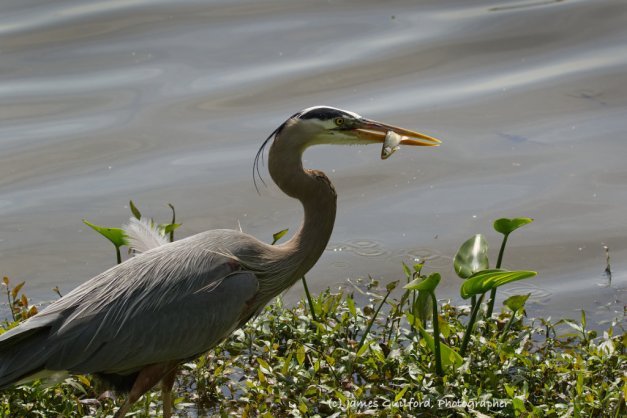
This particular heron enjoyed three successes while we watched, snagging small fish and then swallowing them whole. Someone commented that the woodpecker was a beautiful dinosaur and, while that may be true, Great Blue Herons make me think of Pterodactyls every time!
The Sandy Ridge Reservation is a haven for Great Egrets; I see more of the big white birds there than anywhere else we roam. The egrets hunt, squawk at each other, fly from spot to spot, providing lovely contrast to the largely darker, more subdued wetland scene.

A female Red-Winged Blackbird (Agelaius phoeniceus) perches on a mature cattail reed to take a look around.
The wetlands of Northern Ohio with their crops of cattail reeds are ideal homes for Red-Winged Blackbirds. We enjoyed the blackbirds’ songs and raspy calls, and the shiny black plumage of the males with their colorful shoulder patches. More subtle, less visible, but wholly beautiful are the female Red-Winged Blackbirds with their streaked bodies and warmly-colored heads; they are a delight to discover.
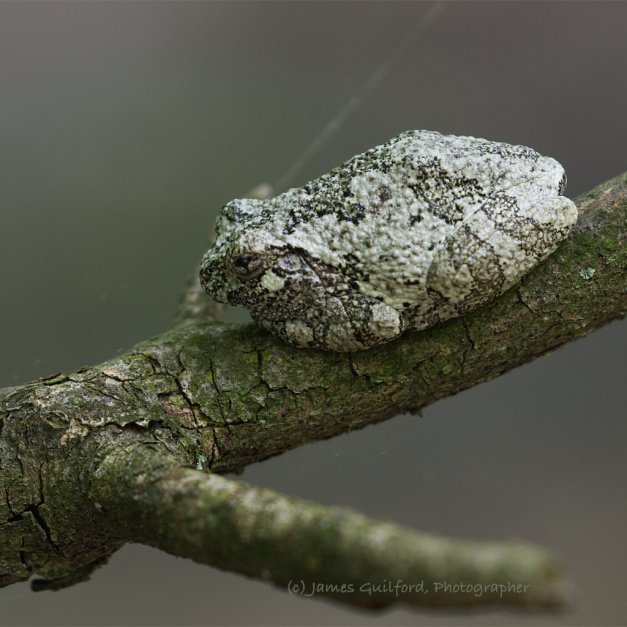
We saw yellow warblers, water snakes, many Great Egrets, Red-Winged Blackbirds, Great Blue Herons, a nesting Bald Eagle, dragonflies, squirrels, Tree Swallows, chipmunks, turtles, and during our wood-lined exit, a little Gray Treefrog, all on our walk in the woods. It was a day full of wonder.
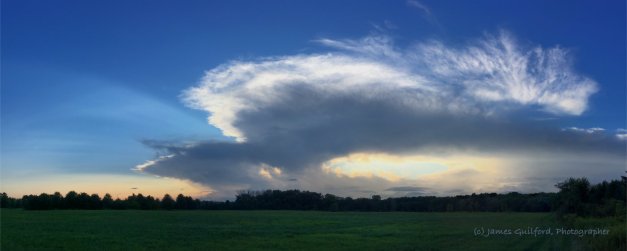
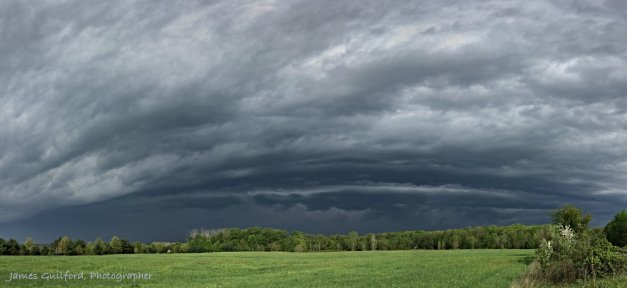
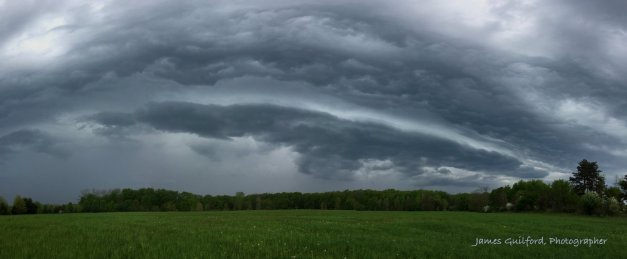
Outflow 79-82 — A panoramic view of cloud structures shaped by the outflow from an approaching thunderstorm. Assembled from multiple iPhone images.
Due to poor timing I missed shooting a spectacular shelf cloud that passed over our area yesterday; it was an epic view, maybe not once in a lifetime but certainly an uncommon sight in this region. I felt terrible, having seen the shelf cloud in all its glory but missing the opportunity to photograph it. Today’s weather, though not as amazing, gave me another chance at impressive cloud structure and I’m feeling much better for it!

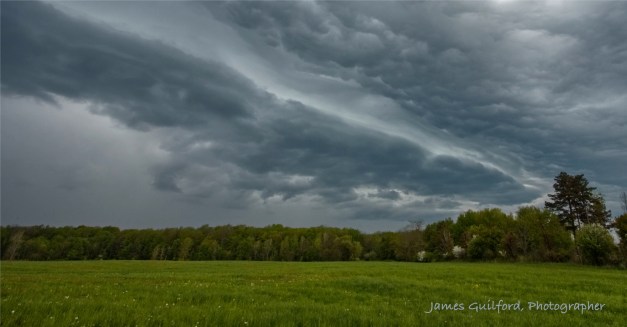
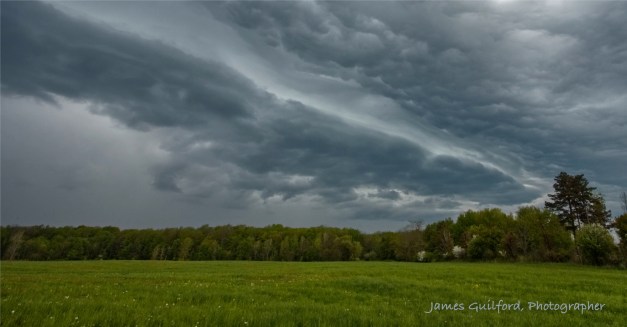
As the outflow boundary approached, a segment built up its form, intensifying into a formidable shape. Panorama assembled from multiple iPhone images.

Gathering Storm: The outflow boundary arrives, nearly overhead now, in all its bluster and drama. Rain arrived next. A single image made with a Canon 6D.
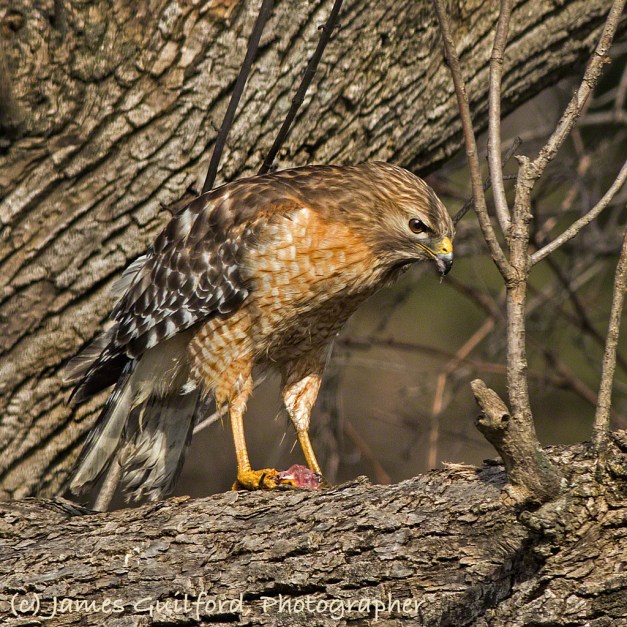
Not long ago, She Who Must Be Obeyed called me to the window. “There’s a hawk up there,” she said, “and he’s eating something!” I took a look and, sure enough, perched on a low branch was a big bird pulling at something it had caught. I grabbed my camera, put on the big lens, and returned to the window. There, in graphic detail, I could see a Red-Shouldered Hawk (Buteo lineatus) pulling, dismembering, and eating a bullfrog it had captured by our pond! I shot a number of photos: the hawk standing, the hawk with bits of meat in its sharp beak, the hawk pulling at guts. I normally don’t publish such graphic photos here because, well, it somehow doesn’t seem right. I know, hawks are birds of prey, beautiful, though natural-born killers, and what they do is how they live. I may add a photo later showing a bit more of the action though, over the past week, I’ve reconsidered several times. For now, I’ll post the photo shown above — the beautiful hunter with just a bit of the carnage — and leave the rest to your imagination.
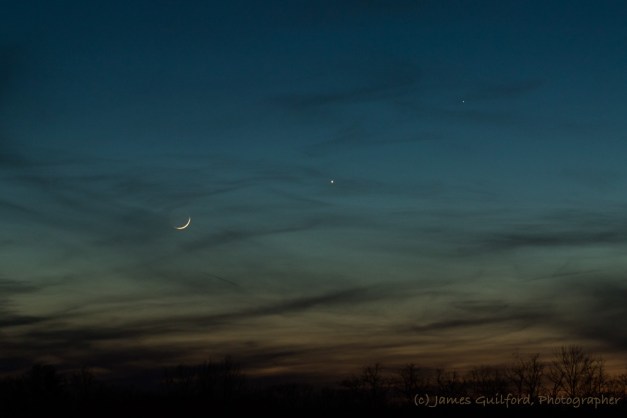
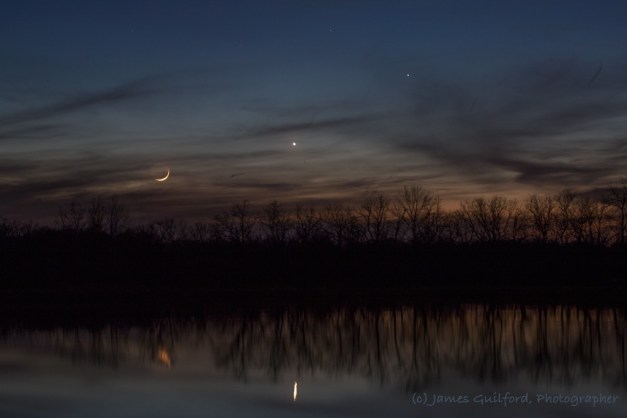
Sunday night, March 18, was to bring a lovely sight to our western sky: a conjunction of a very thin crescent Moon, with planets Venus and Mercury. I arrived at the Medina County Park System’s Letha House Park, where I have after-dark privileges, about half an hour before sunset. I was a bit disheartened when I saw the entire western sky covered with a mixed pattern of cirrus clouds. I thought, “Oh, well, even if I can’t see the Moon and planets, it should be a spectacular sunset!” I need not have worried.
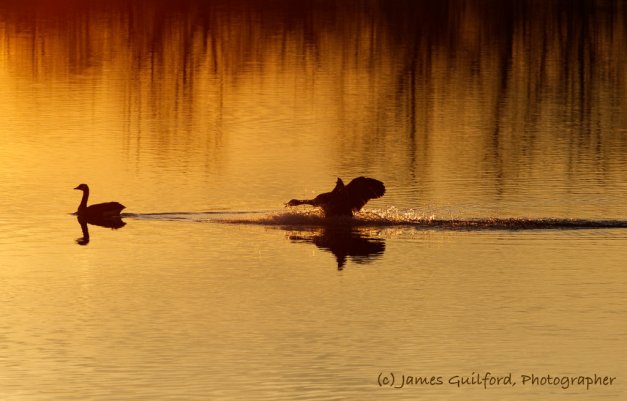
While I waited I was delighted by the evening songs of hidden birds. That sense of peace was shaken by Canada Geese, jostling for nighttime position, squawking and chasing each other in the air and on the waters. The geese provided me with entertainment and some lovely scenes of sunset-lit ripples and splashes.

Blue Conjunction. The setting Moon and planets float in skies that changed in color before finally fading to night.
As the Sun sank below the horizon, the clouds thinned considerably leaving some streaks floating in the light, reflecting in lake waters. The sunset, while beautiful, wasn’t as spectacular as I might have expected but suddenly the Moon became visible, then Venus, and finally tiny Mercury — and brighter than expected.

Colors of Twilight. Left to right: Moon, Venus, and Mercury, in conjunction, sink in the tree-edged western sky.
So, I shot many photos, changing exposure and composition, and captured a few images I rather like. I was a bit surprised and disappointed with the captures from the Canon 7D Mark 2 camera (a “crop sensor” camera) — they came out “grainy,” even though I stayed with ISO 400 for the whole shoot; that’s the camera I typically use for wildlife shots, not scenics, and I normally don’t see the grain. The full-frame Canon 6D performed very well (its images are typically “smooth”) though I wish I would have increased my exposures — too many were too dark and not recoverable — I’ll blame that on trusting the camera’s built-in LCD panel whilst judging exposures. The LCD, of course, looks brighter in the dark tricking my eye!

Parting Shot. The Moon, and Company, sink into clouds and trees to disappear for the night, their light reflected in dark lake waters.
Still, in all, a beautiful night for a gathering of Moon, planets, and sky.
Wow! I haven’t posted anything since October?! Things have been happening, not all of them happy, but I did get out today on a little solo hike in the snow and fresh air. I also brought home a nice collection of new photographs and here are a few of them…
I spied a little bird’s nest in the branches of a small tree, the branches bare and the nest full of snow. I wrote this to accompany the photo:
A bird’s tiny nest,
Carefully woven in springtime,
Young fledged and gone away,
Nest now filled with snow.
Memories of times past,
Hope for the future.
The day was breezy and cold — 20° F– and as I was paused, photographing something at trailside, a gentleman passed, trudging through the fresh snow. “It’s refreshing today!” I answered, “That’s a word.” Perhaps not a witty exchange, but it was accurate.
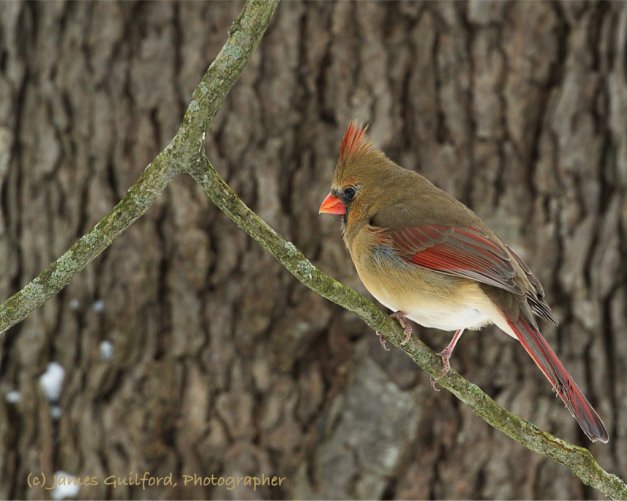
Though it won’t officially be winter for another several days, the weather, woods, and wildlife tell a different tale. Birds, especially, were scarce and mostly silent. In fact, during the first portion of my hike near the frozen wetland of Buckeye Woods Park, Medina, I saw no birds at all. Finally, in a small area along a branch trail, could be heard chirps of feathered ones. In the distance, Cardinals, Blue Jays, and a woodpecker flitted from tree to tree. A Chickadee eyed me warily, half in fear, half in hope of my bringing lunch. Only a lone female Northern Cardinal (Cardinalis cardinalis) lingered long enough and close enough for me to grab an image. The bird glowed in muted colors, lit from beneath by white snow. She soon joined her kind in trees far from me.
I ended my foray by venturing to the end of the trailhead parking lot. Across the road and a field was a derelict barn surrounded by bare trees, white snow below, white sky above. I think it might make a nice holiday card.
I must get out more often.
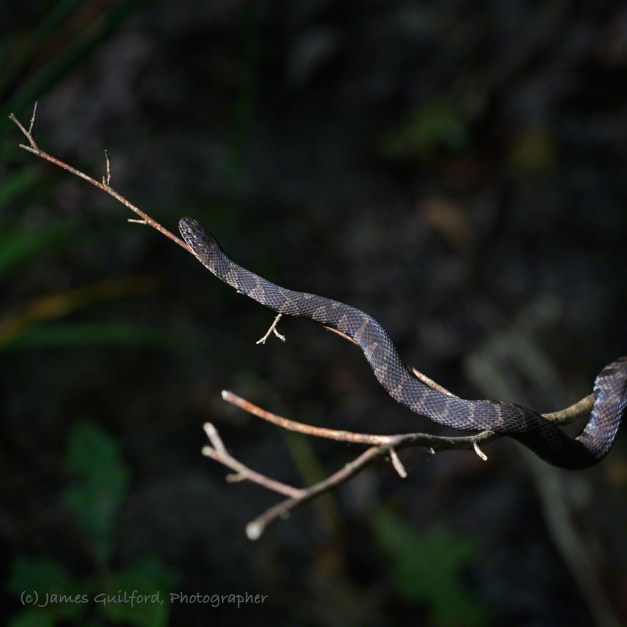
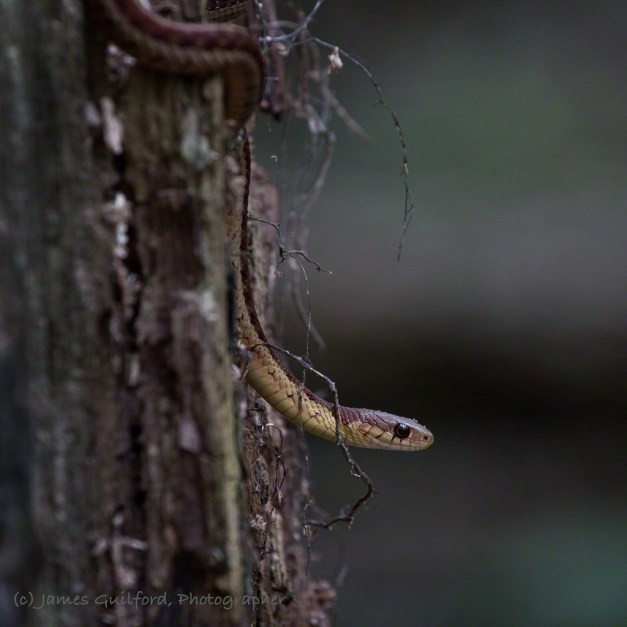
Photo hikes in nature can present one with surprises. We visited the Lorain County MetroParks’ Sandy Ridge Reservation hoping and expecting to see an assortment of birds native to that wetland. What we did not expect to see along the way is, well, what you see here: a couple of small snakes literally hanging from and on trees! The first was a Northern Water Snake (Nerodia sipedon) stretched out along the skimpy branch of a tree along the trail. When we first saw the dark-colored reptile, a spot of sun was shining on it from between the trees; perhaps it was catching some rays to warm its cold blood. The snake allowed fairly close approach and did not move at all during the “photo session.” On the way back from enjoying the birds — there’s a long hike through a heavily-wooded area between parking lot and wetland — we spied another little snake. Snake number two had hung itself vertically on the trunk of a tree, head curved out parallel to the ground. The tree-hanging Butler’s Garter Snake (Thamnophis butleri), like the water snake, held perfectly still during our entire time watching and photographing it. Snakes alive, what a surprise!