An Autumn Meadowhawk dragonfly perches upon a dead leaf and watches its world.
One of many Autumn Meadowhawk dragonflies we spotted this afternoon at theMedina County Park District’s Alderfer-Chatfield Wildlife Sanctuary. These red beauties are usually the last dragonfly seen each year with a flight season that begins in July and which can extend to mid-November if there aren’t heavy frosts, according to the Wisconsin Wetlands Association.
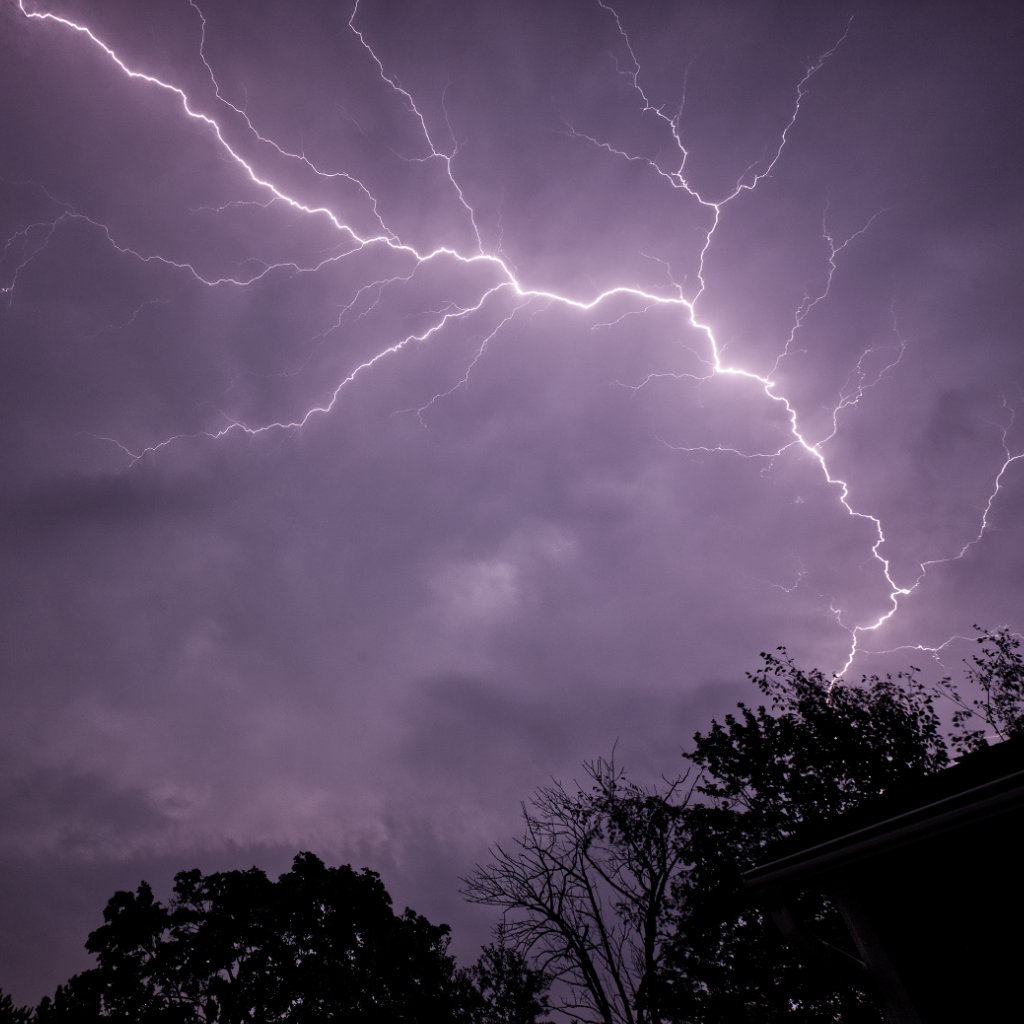
Shot of the night was of this magnificent anvil crawler that lit the clouds overhead as it sprawled across the sky. In the lower left-hand corner of this image is an interesting cloud feature — something invisible without the flash of the lightning discharge.
A line of thunderstorms was bearing down on our area the night of July 24 and it looked like it might be interesting — it has been a while since I’ve made any lightning pictures. The storm progressed slowly from Southeastern Michigan and Northwest Ohio and across Lake Erie finally beginning its arrival here around midnight. As the storm overran the area, I watched it for lightning potential. Ducking outside and looking up at one point, I was treated to a beautiful “anvil crawler” display nearly overhead!
I rushed to my office and quickly assembled my gear: Canon EOS 6D Mk. 2, wide-angle lens, and tripod. First to the northern side of the house. After some waiting and a couple of “teasers” the storm let loose a magnificent crawler — brilliant lightning crossing the cloud bottoms, branching off to the sides. Turns out, that was the shot of the night though I didn’t know it at the time since I was unable to preview my images. Light rain began to fall and with not enough shelter, I moved to the south side of the house.
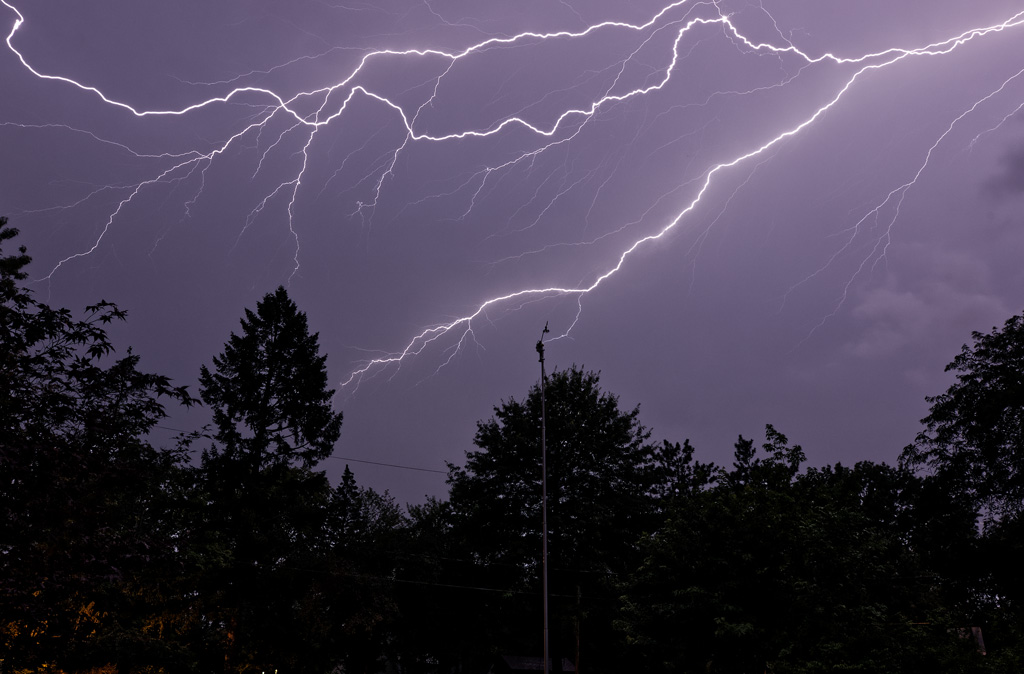
Long streaks of lightning branch across the southern sky over Medina during a relatively quiet thunderstorm the night of July 24.
It took a while for the storm to progress southward enough for me to see the dwindling cloud-to-cloud lightning flashes but they eventually came. I spent maybe 90 minutes watching the storm, aiming the camera, waiting for the automatic trigger to capture the ephemeral brilliance. Thunder, this night, rolled across the dark countryside for many seconds after each flash before fading away — something I’ve not experienced in quite some time. It was lovely. My sheltered spot on the south side kept camera, lens, and photographer dry throughout, which isn’t always the case. Rain prevented me from aiming the camera as high as I’d have liked. Just a few drops on the camera lens, combined with a bright lightning flash, produces an unusable image.
Not a pretty picture, at 1:08 a.m. this powerful cloud-to-ground bolt hit only a mile or so away! Perhaps surprisingly, I head no sirens and have read no accounts of storm damage.
The storm petered out so, sometime around 1:45 a.m. I went back indoors, and reviewed the images via the camera’s display. Yes! Beautiful stuff! Editing the photos after sleeping for a few hours was the highlight of my Sunday morning.
In future I really need to find a sheltered place, or at least a place where I can park and shoot from my car at night, a spot that has an open view of the countryside and/or town. In the mean time, results from the Saturday night storm were worth the sleep deprivation.
The Shot of the Night was this magnificent anvil crawler that lit the clouds as it sprawled across the sky. The Medina County Gazette ran my photo on Page 2, crediting “resident photographer James Guilford”. I like my new title.
It has been a fairly quiet (visually) storm season for me this year but there has been some drama. Here are several shots, from two storms, that took place in July.
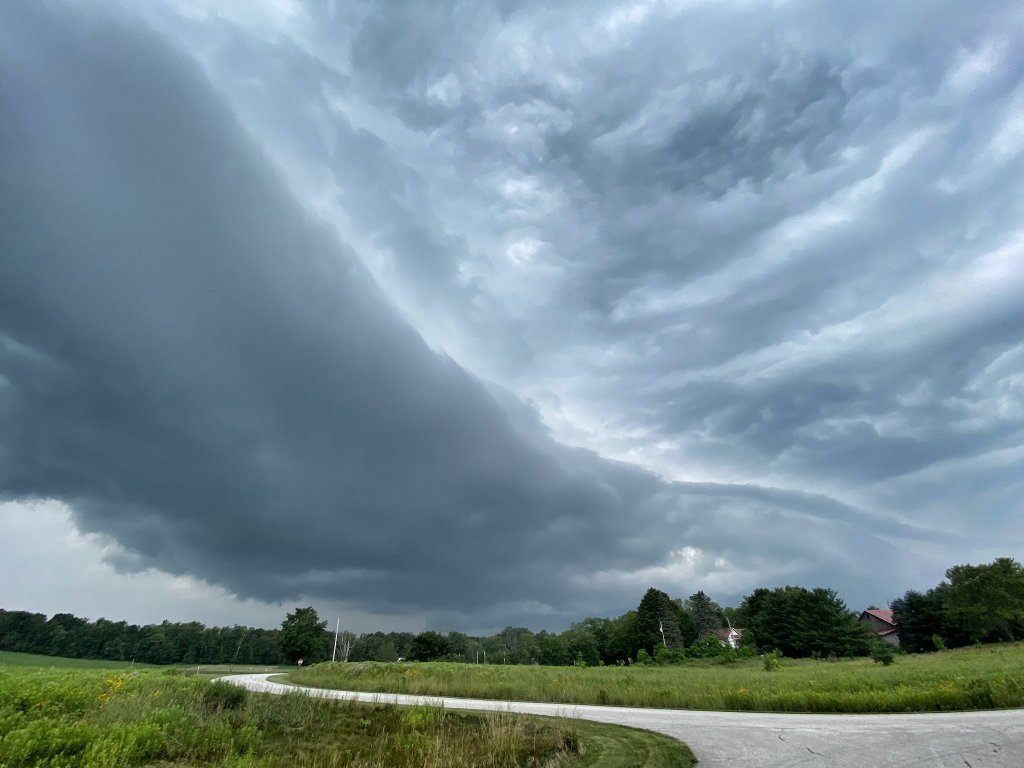
Views of the July 7th’s approaching storm: the most active portion was behind me producing low rumbles of distant thunder. Except for light, cooling gusts of wind and these beautiful clouds, nothing remarkable happened where I stood. Not even a drop of rain.
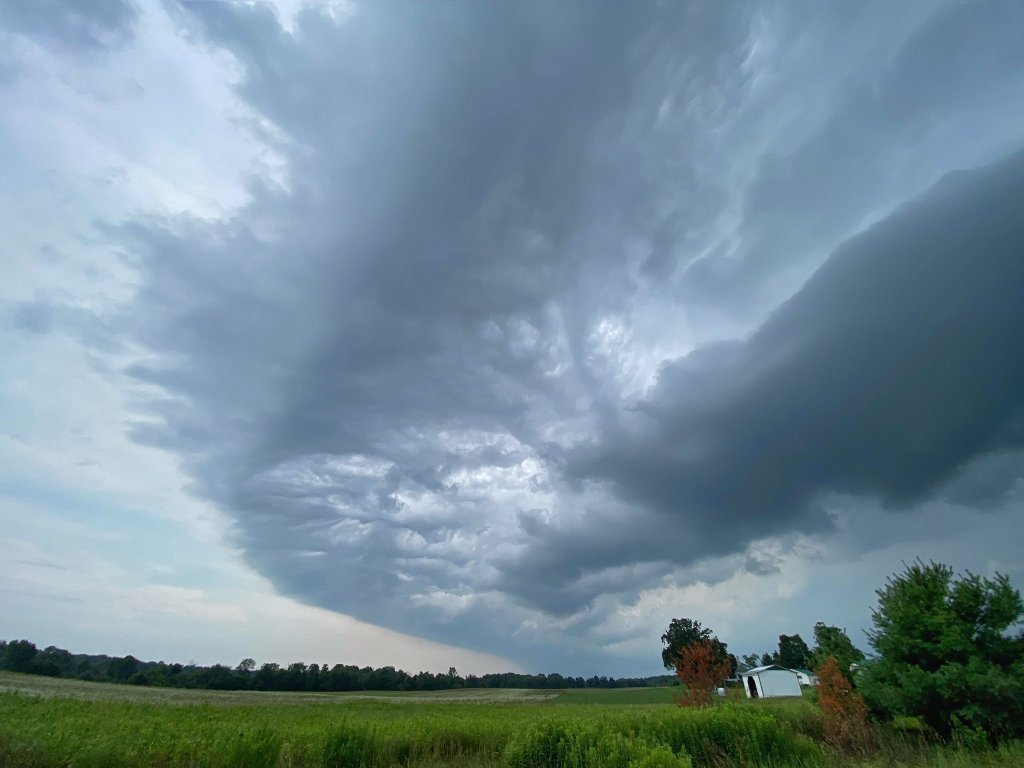
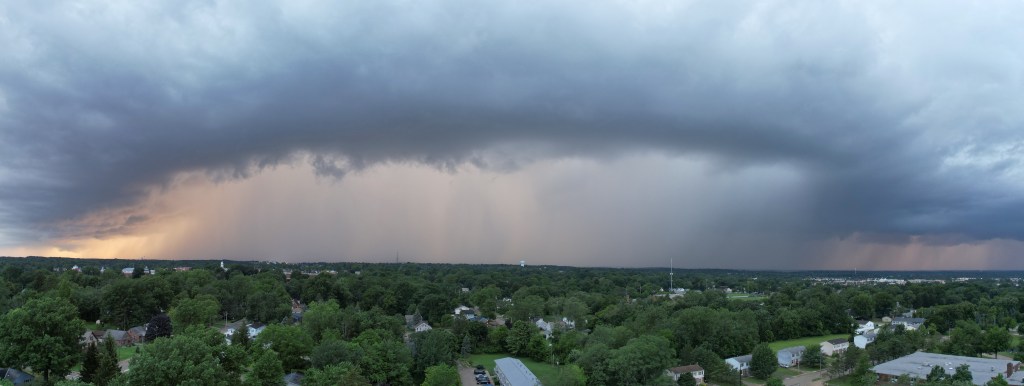
I love the sweep, the grand curves of these cloud formations! Shelf clouds and the like thrill and fascinate me and I’m so lucky to be able to seek them out.July 7 shelf cloud, seen from the ground, near Chippewa Lake, Ohio.July 7 shelf cloud viewed from the air via DJI Air 2S quadcopter drone.July 13 shelf cloud dropping rain, viewed from the air via DJI Air 2S quadcopter drone in Medina, Ohio.
Sunset June 30. Clouds parted enough that evening to allow a colorful end to the day. I used my recently-purchased quadcopter drone to rise above the treetops in order to see, enjoy, and photograph the night’s fine sunset. This is a two-panel panorama, created post-flight. I continue to be impressed by the DJI Air 2s camera system; its dynamic range is excellent, lens is reasonably sharp, and the drone is a surprisingly stable platform. It’s also a hoot flying this little aircraft! Bringing the drone in for a manual landing before dark, I was tickled by how it automatically switched on its landing light. The flying camera adds another dimension to my photography and, as I said, it’s a hoot!
Though high in July 19th’s sky, our waxing Gibbous Moon was decidedly orange. Smoke, high in the atmosphere from North American wildfires, tinted what should have been a bright white Moon in the colors of moonset. Ruddy or not, I love that we can see mountain peaks and crater edges peeking up from the darkness just left of the sunlight terminator line. A friend commented on the sunrise-illuminated mountain peaks, “Mons Pico at 8,000 feet and Mons Piton at 7,500 feet are two solitary mountain peaks sticking up out of the lava plain in the northeast corner of Mare Imbrium.“
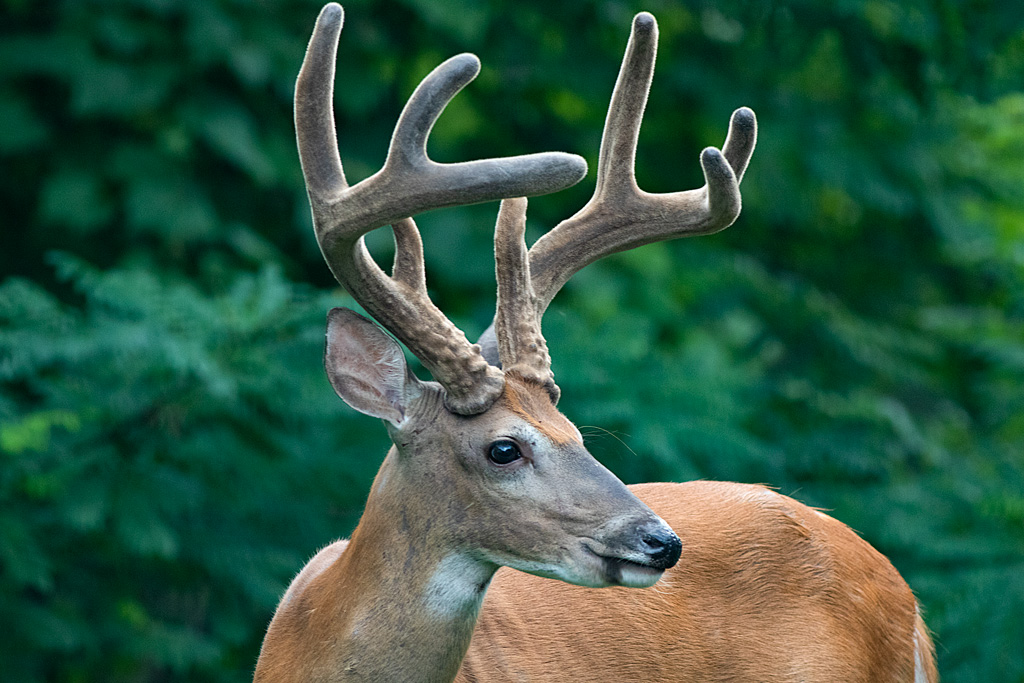
We had a Very Impressive Visitor in our backyard July 23! This buck White Tail Deer looked happy to be here. He stayed in the backyard for a while, sniffing the ground occasionally, watching us from a distance. He eventually strolled off, down a hill into a nearby gully.
Goodness! I didn’t realize I hadn’t posted here since February!! I’ve mostly been making short-form posts to Twitter and Instagram and neglecting this blog. So here we are in July and I’ll make a couple/few quick image posts with captions. These photos are from July 23 and 24 when local wildlife, here in the neighborhood of a small city, paid us extra-close visits.
Another backyard visitor! Mid-afternoon on July 24, a very cooperative Shadow Darner dragonfly alighted on our deck railing allowing me to get up close and personal with my macro lens-equipped DSLR. This is a fairly large insect, ours being 2 3/4 inches long with a wingspan of 4 inches. A guidebook says they’re fairly common in Ohio and fly from about July 4 to November 6.
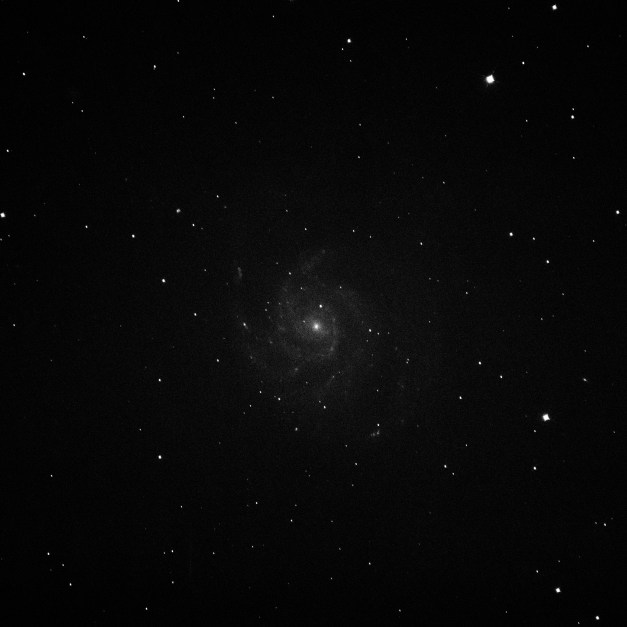
Messier 101 — The Pinwheel Galaxy — in Ursa Major. The spiral and star clouds just emerging from the background. DSLR camera at prime focus of 1,800mm FL Cassegrain telescope. A first attempt that shows great promise.
All right, I know this is a weak and maybe ugly image of a beautiful gem of the night sky but to me it represents great promise. This was a target-of-opportunity imaging attempt I made after shooting comet photos. I keyed in M101 (for object no. 101 in the famous Messier Catalog) on the telescope’s control pad and with loud whirring the telescope swung up and to the north. Peering through the eyepiece at stars in a light-polluted sky, I manually moved the telescope … was that a little cloud in space, or a floater in my eye? Back again, yeah! That’s what a galaxy looks like through a small telescope: a little, dimly-glowing cloud. I shot a test image and sure enough, there’s something there. I shot a series of images, a series of “darks” — covering the telescope and recording the electronic noise of the camera’s image sensor — and called it quits for the night. So, after processing I got what you see above. I know I need to boost the camera’s ISO (sensitivity) and maybe the exposure time for each image. The image shown here is, however, the best photo I’ve ever made of an object outside of the Milky Way — the spiral arms show, star clouds and all. I know now I can do this and I hope the next attempt will actually be beautiful for others to see!
The Pinwheel Galaxy is a face-on spiral galaxy 21 million light-years away from Earth in the constellation Ursa Major. It was discovered by Pierre Méchain on March 27, 1781. https://en.wikipedia.org/wiki/Pinwheel_Galaxy
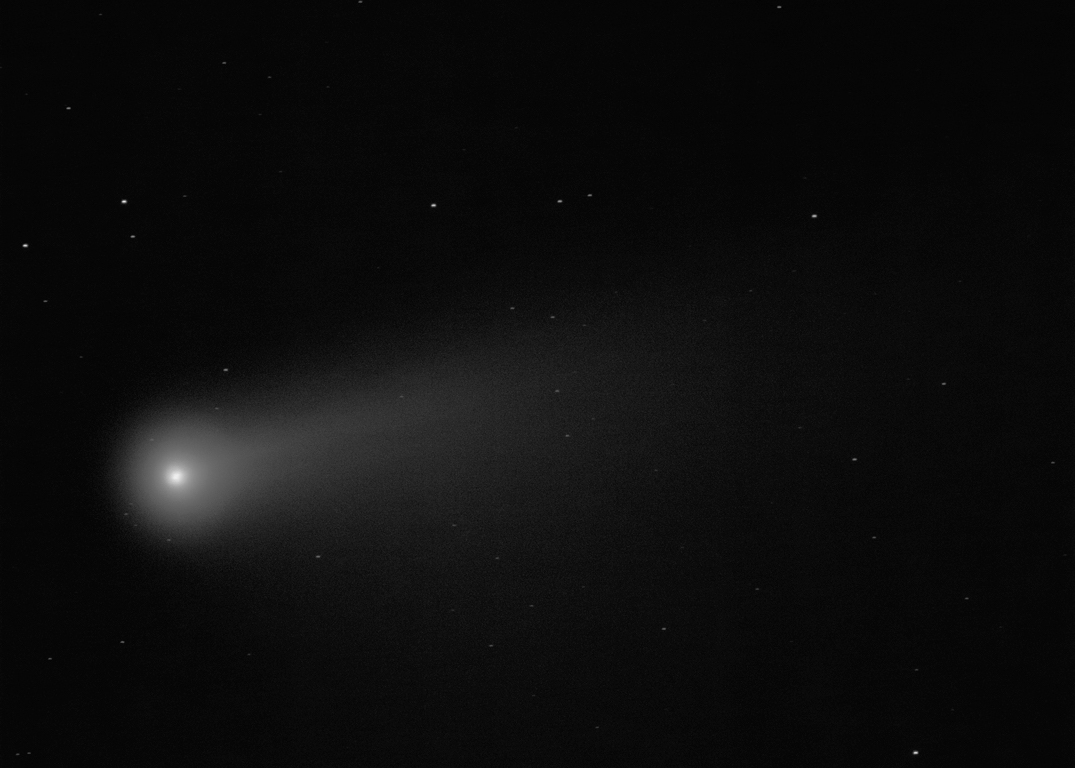
Comet C/2020 F3 (NEOWISE) glows green in close-up imagery. DSLR camera at prime focus of 1,800mm FL Cassegrain telescope.
Friday night, July 24, 2020, offered possibly the last best chance for me to see and photograph Comet C/2020 F3 (NEOWISE). The comet was nearing its closest approach to Earth but was speeding away from our Sun as it headed toward the outer Solar System — it was closer to us but dimming!
I met up with other astro-folk and photographers at a Medina County park. This time, having made photos capturing the scenic beauty of the comet in the night sky, I traveled with telescope and computerized mount. I wanted to see what “close-up” detail I might capture in the comet’s nucleus and tail.
The old Meade-branded mount fired up and, to my surprise, I quickly achieved good alignment using a compass and “eyeballing”. The recently-discovered comet wasn’t in the computer-controller’s database so I selected a spot as near the comet as I could and manually moved the telescope for aim. Through binoculars I was readily able to spy the comet, though it was noticeably dimmer than a week earlier. A companion and I both were sure we caught a naked-eye glimpse of the object through averted vision. It certainly did not reflect in the park’s lake waters.
So I shot a number of image series, experimented with various ISO settings, and shot a few images in “portrait” orientation in case I might record long cometary tails. That’s not what I got.
The camera recorded/rendered C/2020 F3 with a vivid green nucleus with a diffuse, reddish tail. Through the telescope I could see the greenish tint so I knew that was real and to be expected in the images. These close-up images are not what I expected but, I think, not bad; they serve as a farewell to a comet that brought a good deal of excitement to the amateur astronomical community in general and to me in particular.
Comet C/2020 F3 (NEOWISE) monochrome conversion. DSLR camera at prime focus of 1,800mm FL Cassegrain telescope.








 PhotonStopper