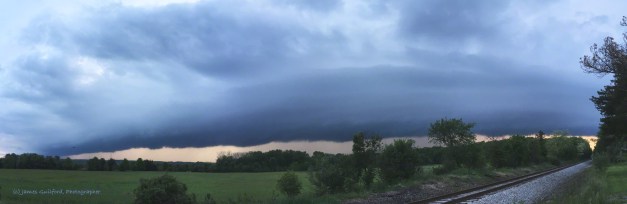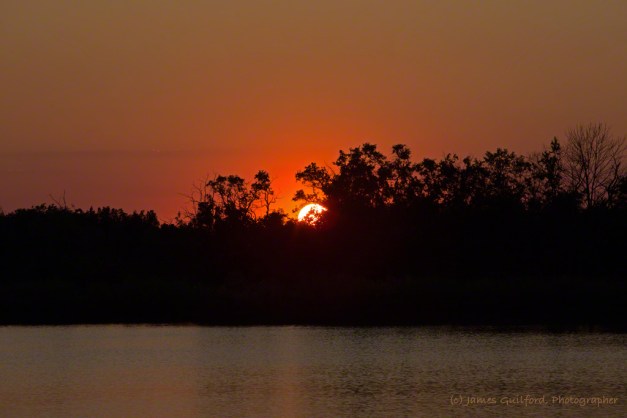
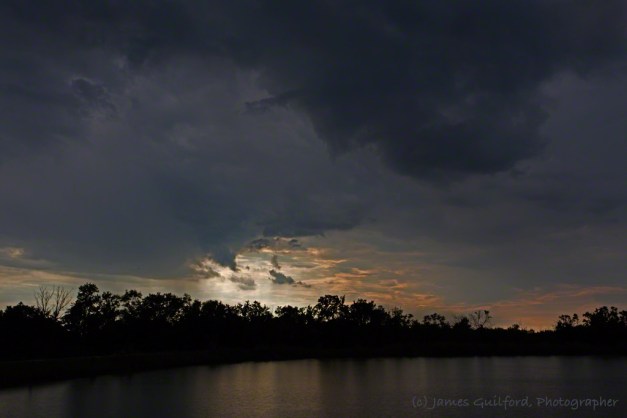
Storm clouds flowed overhead at the edge of a storm seen from rural Medina County (Ohio) but light could be seen on the horizon. “Even in the midst of the storm the sun is still shining.” ― Dayna Lovely
photograph
All posts tagged photograph
On Saturday night, July 29, I headed out to the Medina County Park System’s Letha House Park for a little stargazing and photography. The Cuyahoga Astronomical Association was hosting a public star party and it seemed a good occasion to try some Milky Way photography from their “dark sky” site.
Following a beautiful orange sunset, I shot photos of the assembling sky watchers. I had not planned to shoot photos of the Moon but the waxing crescent dominated the sky with its bright presence. I installed the 2X telephoto adapter to my 400mm lens for a nice 800mm optic. I got decent photos of old Luna but the effort would have benefitted with use of a crop-sensor camera body and its boost in apparent magnification; instead, I was using my full-frame (35mm equivalent) body. I won’t complain too much. The photo looks pretty darned good for an image made on a whim!
Waiting for the sky to darken enough for Milky Way images, I spoke with several small groups of people and pointed out objects of interest in the dimming sky. Many folks had never looked through a telescope before and were thrilled to be doing so that night! Others were excited to learn the names of a very few constellations, and to see the emerging Milky Way. One couple asked whether I’d ever seen strange, unexplained phenomena in the night sky (UFOs, etc.): strange and wonderful, yes; unexplained, no. It’s a little surprising how many people ask, however.
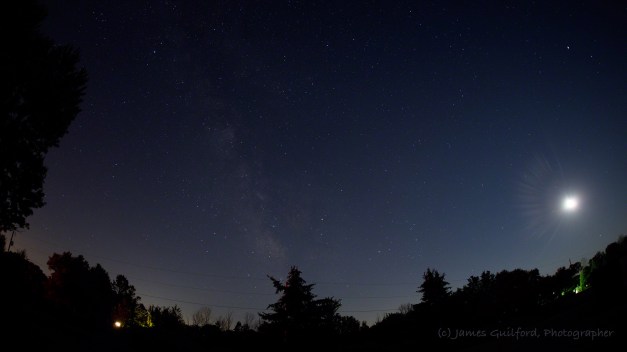
Sky dark enough, I started recording images of the sky. I used a simple photographic tripod, a 15mm diagonal fisheye lens, and my full-frame Canon EOS 6D, wide open at f/2.8, for various lengths of time. The waxing Crescent Moon drown out most of the Milky Way visually – it looked like an area of cloud spread thinly from the south to overhead – but showed up better in photographs. Near the horizon in the photo above, may be spotted the “Tea Pot” asterism of Sagittarius, and constellation Scorpius on opposite sides of the tree (and Milky Way) at center. The bright star above the Moon is Arcturus.
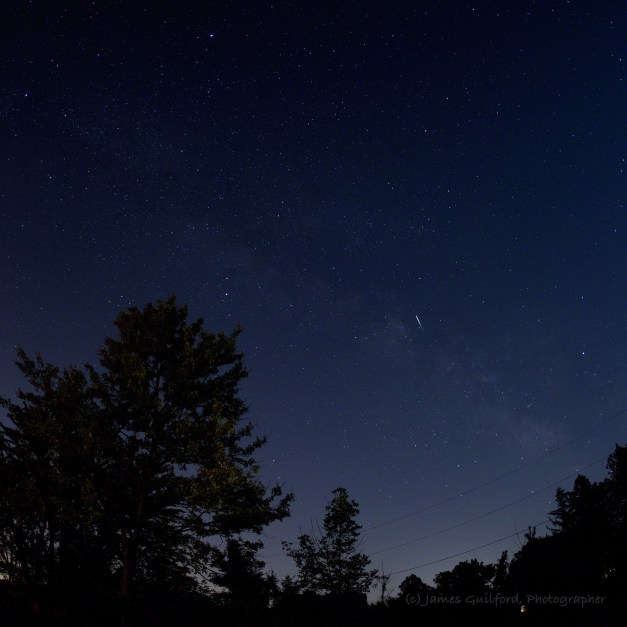
In another shot, concentrating on the Sagittarius area of the sky, I captured a little meteor that I did not see at the time of the exposure! I will definitely want to try shots like this again on moonless nights! Trouble is, however, on the horizon: human-made light pollution! Over the years since the astronomy club built their rural Medina County (Ohio) observatory, light pollution from the city of Medina has grown noticeably worse. My final photo in this post shows just how bad it’s getting. The center of Medina is about 12 miles from the park observatory and the city’s glow is intruding high into the sky. What once was a nighttime glow just above the treeline now extends high above it.
We are losing the glory of the night sky to the form of human environmental pollution that is probably easiest to control and that provide immediate benefits in doing so: turning off unneeded lighting, directing lights downward where they are needed (uses less light and power), and immediately save energy and money. I hope I don’t have to drive farther away from town with each passing year in search of darker skies. I can hope, can’t I?
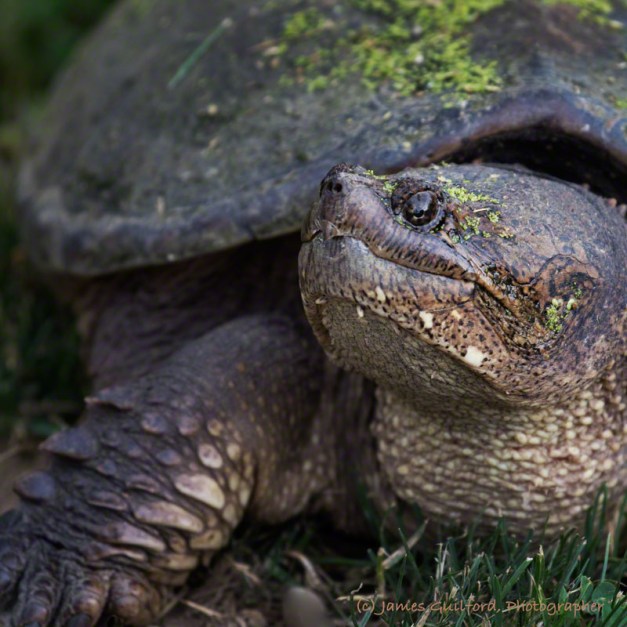
Snapping Turtle Close-Up
On a photo walk in the Medina County Parks’ Buckeye Woods Reservation, we happened upon a medium-sized snapping turtle. The turtle had hauled itself out of the water near a small pavilion at the edge of a wetland area; it was likely a female who was on an egg-laying mission. We shot some photos, including this one, and went on our way. After a relatively brief hike, we passed the shelter just in time to spy the turtle trundling back down the bank and clumsily enter the shallow water. This intimate portrait was shot with a long telephoto lens: you don’t mess with snapping turtles!
Since moving here late last year, I’ve wondered if the pond drew more than ducks and geese to feed, rest, and nest. This morning we spotted this beautiful Great Blue Heron perched on a tree trunk! I shot pictures as I slowly moved closer; the heron was aware of my presence. It wasn’t until the bird had enough of me that I learned, hidden below the edge of the bank was another Great Blue Heron! Hate to admit it: I was totally unprepared for the pair taking off together over the still waters of our pond. Still, I’m pretty happy with this portrait.
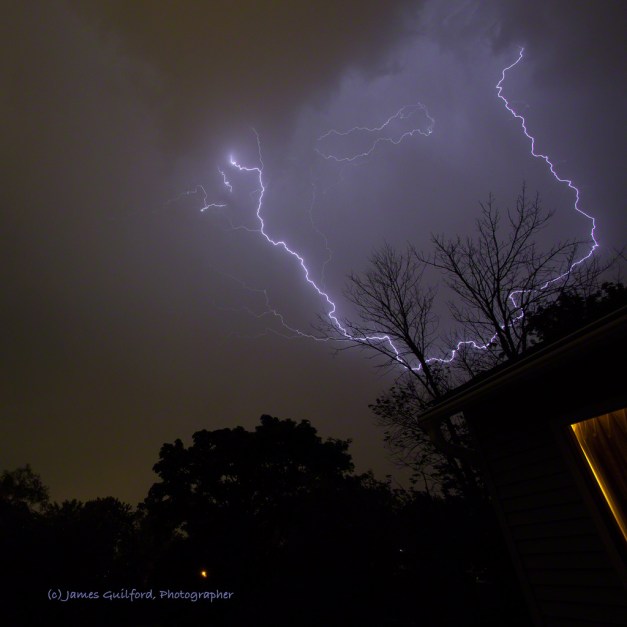
With storms, you never know. Usually, when I am shooting lightning photos my sessions are cut short by the storm’s winds and rain. Friday night, however, was a golden opportunity as a fairly compact thunderstorm producing plentiful lightning passed just to our north. As the storm approached, moved through, and departed I experienced only a light breeze and no rain at all. Wonderful! And so I was able to shoot a good number of lightning pictures, only missing a couple when I had to re-aim the camera. Here are my favorites from the shoot…

A Sky Full of Electricity. A nearby thunderstorm fills the sky with lightning. Photo by James Guilford.
I have loved weather-watching since I was a young boy and I believe that love has grown as I have grown older. I am now located in an area where, with a little head start, I can reach open country — away from town — to observe and photograph weather phenomena. My current favorites are lightning, and shelf clouds. (BTW: I don’t shoot lightning from open country!) Lately I’ve had two successes resulting from interpretation of weather radar that allowed interception of storms. I drove to places in the path of oncoming storms, waited, and photographed the developing scenes. In each case, once the storm shelf clouds appear, there are a very few minutes to set up the shot, record images, and then duck out of the rain as it arrives fast and furiously! The first picture (below) did not turn out as well as I’d have liked. I simply cannot seem to process the image in a way that pleases me and represents what I saw; and it’s way too blue! The second picture (above) is much better, in my opinion, depicting the leading edge of a thunderstorm as it barreled towards me. Both experiences were exciting, great fun, and rewarding in themselves. I’m working on photo techniques that will better depict the wondrous scenes.
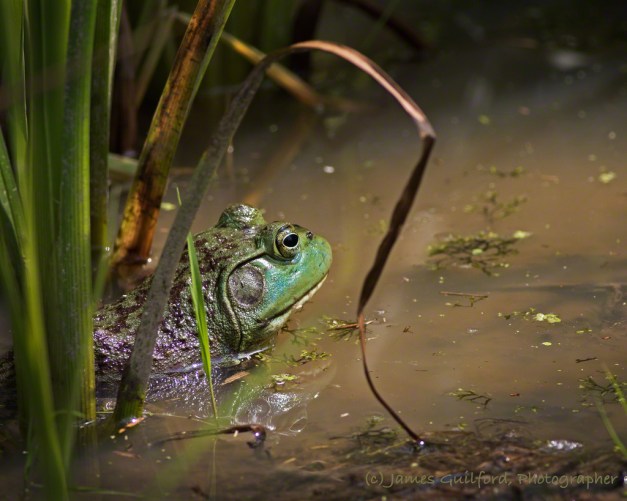
The weather hasn’t been very conducive to nature walks of late, that is if you don’t like getting stuck in mud! Over several recent days, however, there has been enough break in the rain to make trails more passable and skies a bit more cheerful. On a walk on the Buckeye Woods Park, Chippewa Inlet Trail we heard and encountered a number of birds I’d not seen before; most escaped my lens. My shot of the day, however, didn’t bear wings: it was a common American Bullfrog (Lithobates catesbeianus). I was delighted by the position of the frog amongst wetland reeds and how the scene led from light to shadow — a beautiful arrangement. The frog, perhaps to avoid being noticed, held perfectly still while I photographed. I’m quite pleased with the results.

A female Red-winged Blackbird (Agelaius phoeniceus) at Sheldon Marsh State Nature Preserve, Huron, Ohio
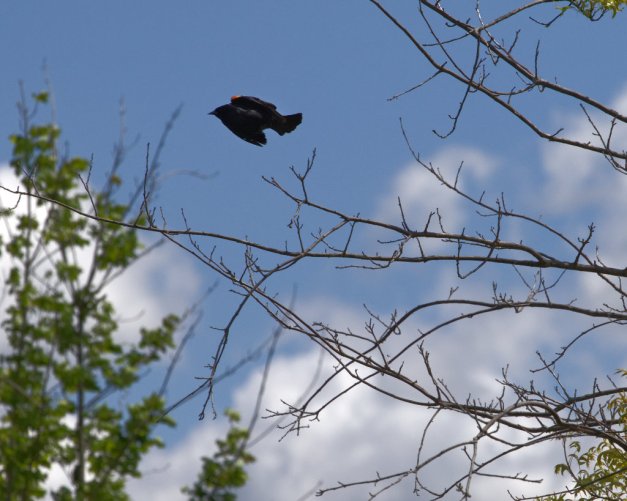
On Memorial Day we visited the Sheldon Marsh State Nature Preserve — a spit of land in Huron, Ohio that extends into Lake Erie. Wetlands line the paved trail and the area, though small, provides habitat for many varieties of bird, and a rest and refueling stop for migrants. Bird songs filled the woods, and wildlife was easy to see, including two snapping turtles laying their eggs in holes they excavated along the paved footpath! My shot of the day at Sheldon Marsh was a beautiful female Red-winged Blackbird (Agelaius phoeniceus). The bird alighted on a low bush and furiously shook and preened itself while I watched and shot photos. Then, all sorted off, the blackbird shot into the woods to go about her business. It was wonderful, in the truest sense of the word, to get out and explore everyday natural beauties.
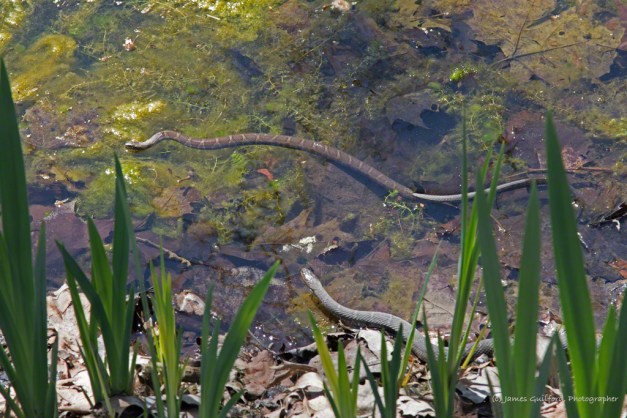
At Lorain County MetroParks’ Schoepfle Garden last Sunday, I spied two snakes sunning themselves on the bank of a pond. The snakes became aware of me but unpanicked, moved into the water and away at a leisurely pace. As they submerged and wriggle-swam, the pair changed from dark and dusty — nearly black — to their true shades of brown, revealing beautifully-patterned skins. As the larger of the two reptiles turned to meet its (apparent) mate which had gone in the opposite direction, it passed by a large bullfrog. Wary of the possible danger the frog, though too large to be swallowed, held perfectly still as the water snake passed.