
Full Moon – Pre-Eclipse Test
I really ought to know better but the early signs were positive! I rented a Sigma 150-500mm telephoto zoom lens to try out before making a possible purchase. That model lens has been marked down in price, presumably because Sigma is introducing a 150-600mm lens in the near future. At just under $1,000 the rental lens features APO lens elements and optical image stabilization — quite a bargain, if it works well! So, my pre-purchase trial was to include a nature shoot and, contingent upon a pre-event test, photos of the October 8 total lunar eclipse!
I did some test shots of the Full Moon the night of October 7 and they looked quite good. There was, on close inspection, a light gray “halo” around a portion of the lunar disk but that mostly disappeared in processing. Despite the very bright Moon, there was no color fringing and that’s a good sign of optical quality. The image was acceptably sharp and contrasty. It looked like I’d be set for the next morning’s eclipse!
I rose from bed at 4:45 AM the morning of the eclipse, about a half-hour before the Moon was to enter the central portion of Earth’s shadow, the umbra. The penumbral phase of the eclipse sees the Full Moon dim, imperceptibly to most casual observers, and uninteresting to me. Walking in the moonlight to my car, I noticed the subdued light and by the time I reached my observation point I could see a chunk of the Moon falling into deep shadow — it had begun!
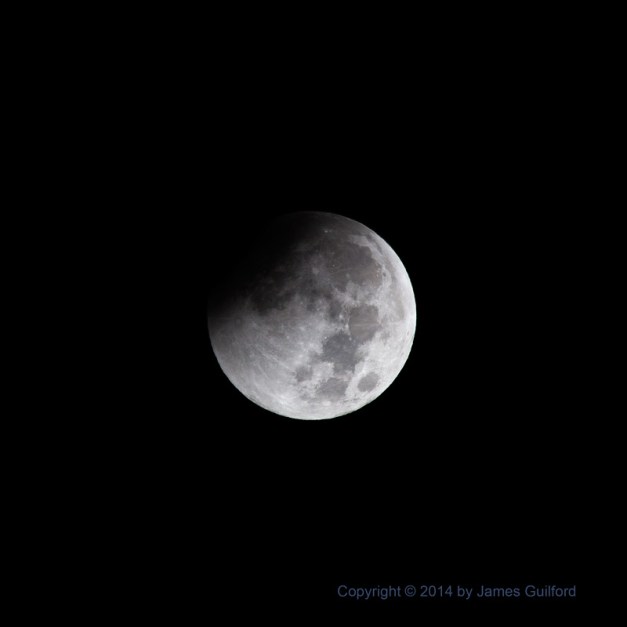
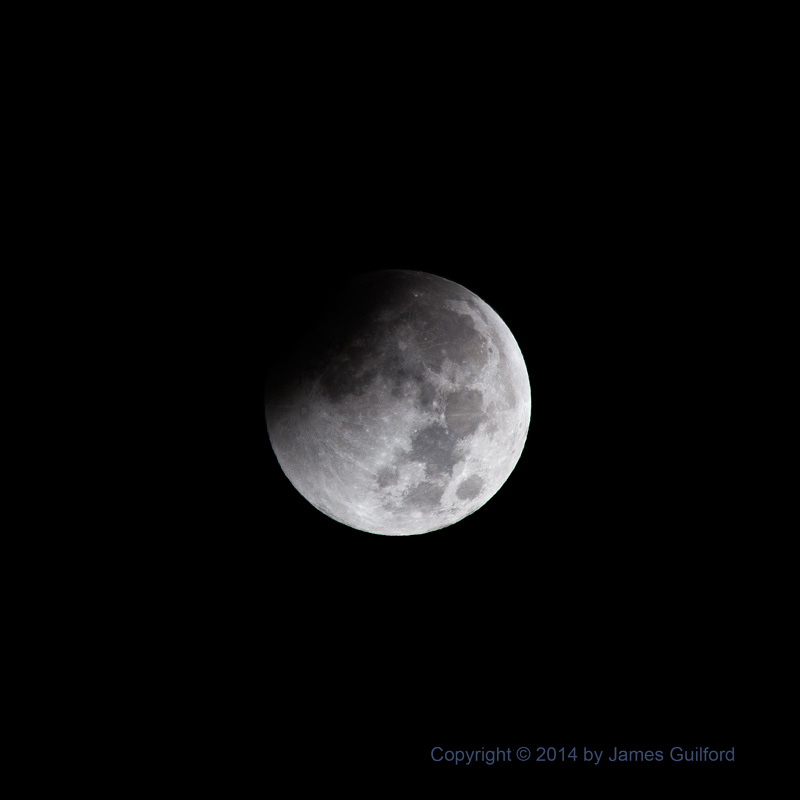
Eclipse Begins – Earth’s Shadow on the Moon – Good Quality
I quickly set up the camera and rented lens on my tripod, focused on the still-bright Moon, and began a long series of photographs, adjusting exposure as the eclipse progressed. Earth’s shadow, with its soft leading edge, crawled across the lunar surface. I shot image after image, checking exposures in the camera’s LCD panel. It looked like I had some excellent shots.
Totality in a lunar eclipse sees the Moon diminished to a dim ruddy coppery-red orb, requiring longish exposure and/or high ISO numbers to record. I could tell I had images but, critically, I could not tell just how good they were. I opted for shorter exposure times and higher ISOs which accounts for the “grainy” appearance of the images; I should have used a slightly lower ISO setting.

Total Lunar Eclipse – October 8, 2014 – Only Fair Quality
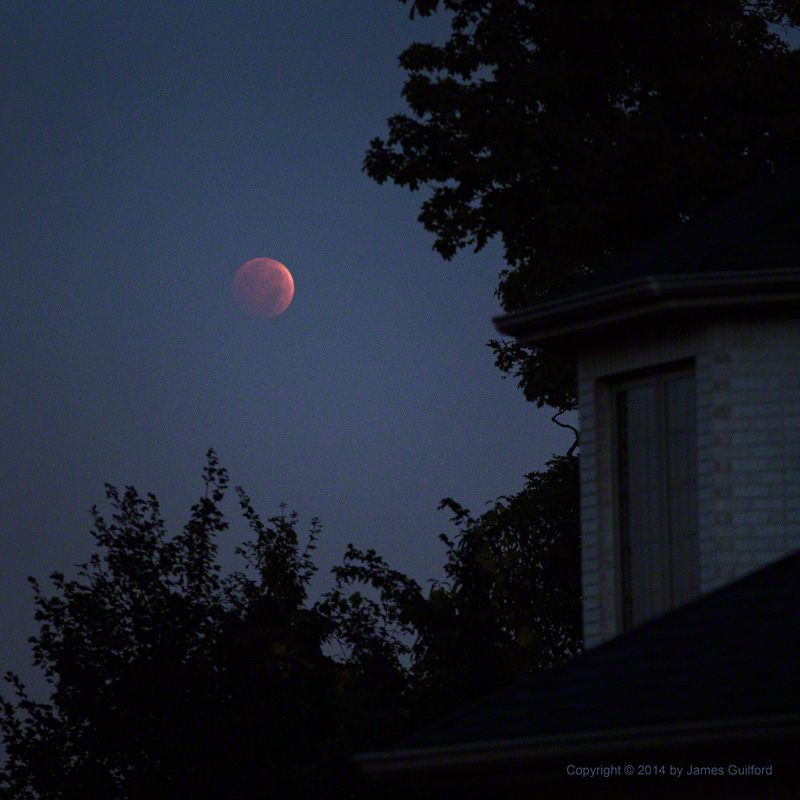
As totality continued and the sky began to show signs of pre-dawn twilight, I moved to a secondary location. I wanted to show the Moon as part of a landscape with city lights, trees, homes, something in the foreground or under the still-reddish eclipsed Luna. I switched lenses to my favorite, the Canon 70-200mm f/4 zoom telephoto — best glass I have ever owned. I shot the scenes until the Moon dipped into the morning mists of the western horizon and was washed out by approaching sunrise.

Total Lunar Eclipse – While Neighbors Sleep – Canon 70-200mm Zoom
The eclipse itself was a great experience and something I haven’t seen one since 2008. Despite the chill air, light breeze, and cold-aching fingers, I was enthralled. The Sigma photos were another matter. Later, as I examined the images on my computer, I was very disappointed. The shots of the partially-obscured Moon were barely acceptable and images of the eclipsed Moon were a mess … kind of pretty and interesting, but a mess. I’m not sure the exact cause of the soft focus but it was the lens that was at fault.

Got It! Great Egret Catches Small Fish
That afternoon the wildlife shoot went well and the Sigma produced very good (though not excellent) images. Possibly the best shot of the afternoon was a Great Egret catching a small fish at the Sandy Ridge Reservation of Lorain County Metro Parks. The zoom lens extends when reaching its 500mm extent and, unfortunately, the mechanism is too “loose,” sliding outward when the camera is pointed downward. When being carried, the zoom lock did not work. When zoomed from one focal length to another, the lens did not appear to hold focus. The zoom slipping may have been the cause of loss of focus and my lunar imaging woes. I wondered what corners may have been cut to keep the massive Sigma optic price so low … I think I discovered some of them!
I won’t be purchasing that lens.










 PhotonStopper